
Cookie preferences
This website uses cookies, which are necessary for the technical operation of the website and are always set. Other cookies, which increase the comfort when using this website, are used for direct advertising or to facilitate interaction with other websites and social networks, are only set with your consent.
Configuration
Technically required
These cookies are necessary for the basic functions of the shop.
"Allow all cookies" cookie
"Decline all cookies" cookie
CSRF token
Cookie preferences
Currency change
Customer-specific caching
FACT-Finder tracking
Individual prices
Selected shop
Session
Comfort functions
These cookies are used to make the shopping experience even more appealing, for example for the recognition of the visitor.
Note
Show the facebook fanpage in the right blod sidebar
Statistics & Tracking
Affiliate program
Conversion and usertracking via Google Tag Manager
Track device being used



| Item number | Size | Datasheet | Manual | SDS | Delivery time | Quantity | Price |
|---|---|---|---|---|---|---|---|
| NSJ-FY12168 | 100 µg | - | - |
3 - 10 business days* |
790.00€
|
If you have any questions, please use our Contact Form.
You can also order by e-mail: info@biomol.com
Larger quantity required? Request bulk
You can also order by e-mail: info@biomol.com
Larger quantity required? Request bulk
Adding 0.2 ml of distilled water will yield a concentration of 500 ug/ml. ESD antibody detects... more
Product information "Anti-ESD / Esterase D"
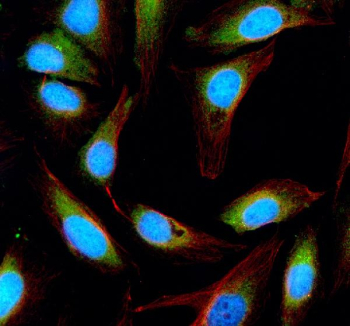
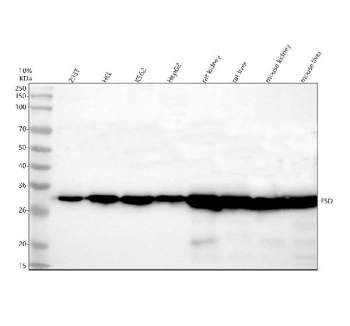
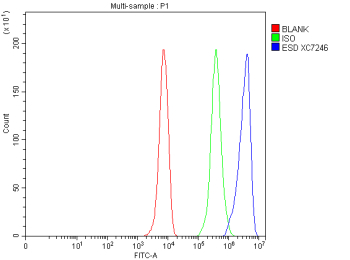
Adding 0.2 ml of distilled water will yield a concentration of 500 ug/ml. ESD antibody detects Esterase D, encoded by the ESD gene on chromosome 13q14.11. ESD antibody is used to study this cytosolic serine hydrolase involved in detoxification and xenobiotic metabolism. ESD was originally characterized as a polymorphic enzyme used in forensic medicine for paternity testing and blood typing. Beyond this historical role, Esterase D has biological functions in processing of ester-containing molecules, detoxification of aldehydes, and metabolism of drugs and environmental chemicals. It is expressed in liver, kidney, lung, and erythrocytes, reflecting its general detoxification role.Structurally, Esterase D is a 282 amino acid protein with an alpha/beta hydrolase fold. It contains the conserved catalytic triad of serine, histidine, and aspartate typical of serine esterases. Its active site is adapted for hydrolyzing a wide range of small esters. Genetic polymorphisms in ESD lead to enzyme variants with distinct electrophoretic mobility, which historically formed the basis of forensic applications. The conserved structure supports its role as a versatile detoxifying enzyme.Functionally, ESD hydrolyzes ester bonds in endogenous and exogenous compounds, contributing to clearance of aldehydes and drugs. It also participates in formaldehyde detoxification by metabolizing S-formylglutathione. Knockout or deficiency studies suggest that loss of Esterase D activity impairs detoxification pathways and increases susceptibility to oxidative stress. Researchers employ ESD antibody to study its enzymatic activity, tissue distribution, and regulation under toxicant exposure.Clinically, ESD deficiency has been associated with retinoblastoma and other developmental disorders due to its chromosomal location near the RB1 tumor suppressor gene. Altered ESD activity is also reported in liver disease, hemolytic anemia, and metabolic disorders. As a polymorphic enzyme, Esterase D has served as a genetic marker in population genetics and forensic investigations. Its ability to detoxify aldehydes and esters makes it relevant to environmental health and pharmacology. NSJ Bioreagents supplies ESD antibody for research into metabolism, toxicology, and disease associations.Experimentally, ESD antibody is used in western blotting to detect the ~33 kDa protein, in enzymatic assays to measure esterase activity, and in immunohistochemistry to study tissue expression. Immunoprecipitation with ESD antibody allows analysis of its enzyme complexes and potential regulatory partners. These applications provide tools for dissecting detoxification pathways and oxidative stress regulation.
| Keywords: | Anti-ESD, Anti-Esterase D, Anti-S-formylglutathione hydrolase, Anti-Methylumbelliferyl-acetate deacetylase, ESD Antibody / Esterase D |
| Supplier: | NSJ Bioreagents |
| Supplier-Nr: | FY12168 |
Properties
| Application: | WB, ICC/IF, FC, ELISA |
| Antibody Type: | Polyclonal |
| Conjugate: | No |
| Host: | Rabbit |
| Species reactivity: | human, mouse, rat |
| Immunogen: | E.coli-derived human ESD recombinant protein (Position: M1-A282) |
| Format: | Purified |
Database Information
| KEGG ID : | K01070 | Matching products |
| UniProt ID : | P10768 | Matching products |
| Gene ID : | GeneID 2098 | Matching products |
Handling & Safety
| Storage: | +4°C |
| Shipping: | +4°C (International: +4°C) |
Caution
Our products are for laboratory research use only: Not for administration to humans!
Our products are for laboratory research use only: Not for administration to humans!
Information about the product reference will follow.
more
You will get a certificate here
Viewed