
Cookie preferences
This website uses cookies, which are necessary for the technical operation of the website and are always set. Other cookies, which increase the comfort when using this website, are used for direct advertising or to facilitate interaction with other websites and social networks, are only set with your consent.
Configuration
Technically required
These cookies are necessary for the basic functions of the shop.
"Allow all cookies" cookie
"Decline all cookies" cookie
CSRF token
Cookie preferences
Currency change
Customer-specific caching
FACT-Finder tracking
Individual prices
Selected shop
Session
Comfort functions
These cookies are used to make the shopping experience even more appealing, for example for the recognition of the visitor.
Note
Show the facebook fanpage in the right blod sidebar
Statistics & Tracking
Affiliate program
Conversion and usertracking via Google Tag Manager
Track device being used



| Item number | Size | Datasheet | Manual | SDS | Delivery time | Quantity | Price |
|---|---|---|---|---|---|---|---|
| NSJ-FY13432 | 100 µg | - | - |
7 - 12 business days* |
790.00€
|
If you have any questions, please use our Contact Form.
You can also order by e-mail: info@biomol.com
Larger quantity required? Request bulk
You can also order by e-mail: info@biomol.com
Larger quantity required? Request bulk
Adding 0.2 ml of distilled water will yield a concentration of 500 ug/ml. EIF3D antibody targets... more
Product information "Anti-EIF3D / Eukaryotic translation initiation factor 3 subunit D"
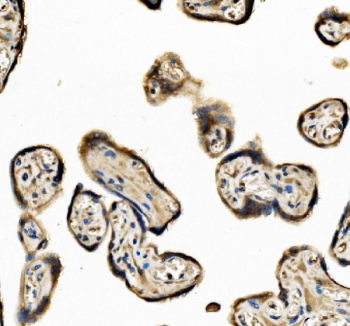
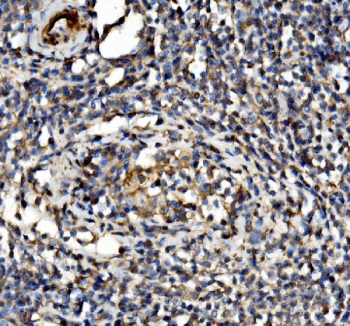
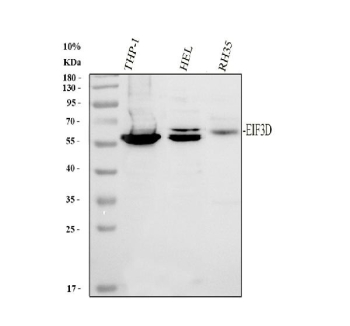
Adding 0.2 ml of distilled water will yield a concentration of 500 ug/ml. EIF3D antibody targets Eukaryotic translation initiation factor 3 subunit D, encoded by the EIF3D gene. EIF3D is a cytoplasmic protein that functions as a component of the eukaryotic translation initiation factor 3 (eIF3) complex, a central regulator of translation initiation. The eIF3 complex associates with the 40S ribosomal subunit and coordinates recruitment of mRNA and initiator tRNA during early steps of protein synthesis. EIF3D contributes to assembly and stability of this multiprotein complex and supports efficient translation initiation in eukaryotic cells.Functionally, Eukaryotic translation initiation factor 3 subunit D plays a role in regulating mRNA translation rather than acting as a general enzymatic factor. EIF3D has been implicated in selective translation of specific mRNA subsets, linking translational control to cellular growth, stress responses, and differentiation. Through its participation in the eIF3 complex, EIF3D influences translation efficiency and fidelity, allowing cells to adapt protein synthesis programs to changing physiological conditions. An EIF3D antibody supports studies focused on translational regulation and ribosome-associated signaling.EIF3D is broadly expressed across tissues and cell types, reflecting the universal requirement for regulated protein synthesis. Its activity is particularly relevant in proliferative cells, where tight control of translation initiation is essential for growth and cell cycle progression. EIF3D can interact with other eIF3 subunits and translation-associated factors, positioning it as part of a dynamic network that integrates signaling pathways with translational output.From a disease-relevance perspective, altered EIF3D expression or function has been investigated in cancer and other disorders characterized by dysregulated protein synthesis. Changes in translation initiation factor activity can contribute to abnormal cell growth, survival, and stress adaptation. EIF3D has therefore emerged as a protein of interest in studies examining how translational control mechanisms influence disease-associated cellular behavior.At the molecular level, Eukaryotic translation initiation factor 3 subunit D contains conserved regions required for interaction with ribosomal subunits and other components of the eIF3 complex. Post-translational modifications and complex assembly state - without altering the primary amino acid sequence - can influence its apparent behavior in biochemical assays. EIF3D antibody reagents support research applications focused on translation initiation, ribosome biology, and disease-associated alterations in protein synthesis, with NSJ Bioreagents providing reagents intended for research use.
| Keywords: | Anti-EIF3D, Anti-eIF3 p66, Anti-eIF-3-zeta, Anti-Eukaryotic translation initiation factor 3 subunit 7, Anti-Eukaryotic translation initiation factor 3 subunit D, EIF3D Antibody / Eukaryotic translation initiation factor 3 subunit D |
| Supplier: | NSJ Bioreagents |
| Supplier-Nr: | FY13432 |
Properties
| Application: | WB, IHC, ELISA |
| Antibody Type: | Polyclonal |
| Conjugate: | No |
| Host: | Rabbit |
| Species reactivity: | human, rat |
| Immunogen: | E.coli-derived human Eukaryotic translation initiation factor 3 subunit D recombinant protein (amino acids I319-D532) |
| Format: | Purified |
Database Information
| KEGG ID : | K03251 | Matching products |
| UniProt ID : | O15371 | Matching products |
| Gene ID : | GeneID 8664 | Matching products |
Handling & Safety
| Storage: | +4°C |
| Shipping: | +4°C (International: +4°C) |
Caution
Our products are for laboratory research use only: Not for administration to humans!
Our products are for laboratory research use only: Not for administration to humans!
Information about the product reference will follow.
more
You will get a certificate here
Viewed