
Cookie preferences
This website uses cookies, which are necessary for the technical operation of the website and are always set. Other cookies, which increase the comfort when using this website, are used for direct advertising or to facilitate interaction with other websites and social networks, are only set with your consent.
Configuration
Technically required
These cookies are necessary for the basic functions of the shop.
"Allow all cookies" cookie
"Decline all cookies" cookie
CSRF token
Cookie preferences
Currency change
Customer-specific caching
FACT-Finder tracking
Individual prices
Selected shop
Session
Comfort functions
These cookies are used to make the shopping experience even more appealing, for example for the recognition of the visitor.
Note
Show the facebook fanpage in the right blod sidebar
Statistics & Tracking
Affiliate program
Conversion and usertracking via Google Tag Manager
Track device being used


| Item number | Size | Datasheet | Manual | SDS | Delivery time | Quantity | Price |
|---|---|---|---|---|---|---|---|
| Cay42852-100 | 100 µl | - |
6 - 10 business days* |
554.00€
|
If you have any questions, please use our Contact Form.
You can also order by e-mail: info@biomol.com
Larger quantity required? Request bulk
You can also order by e-mail: info@biomol.com
Larger quantity required? Request bulk
DNA-dependent protein kinase catalytic subunit (DNA-PKcs) is a member of the PI3K-related kinase... more
Product information "Anti-DNA-PKcs (Phospho-Ser2056) Rabbit (Clone"
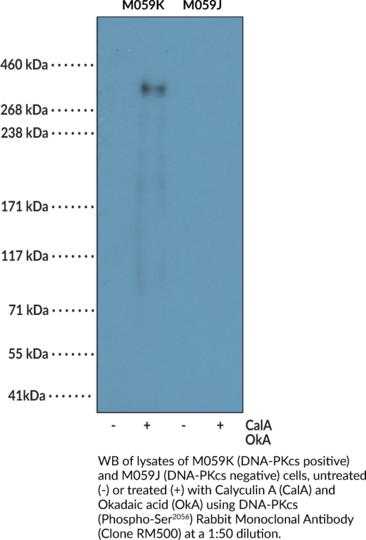
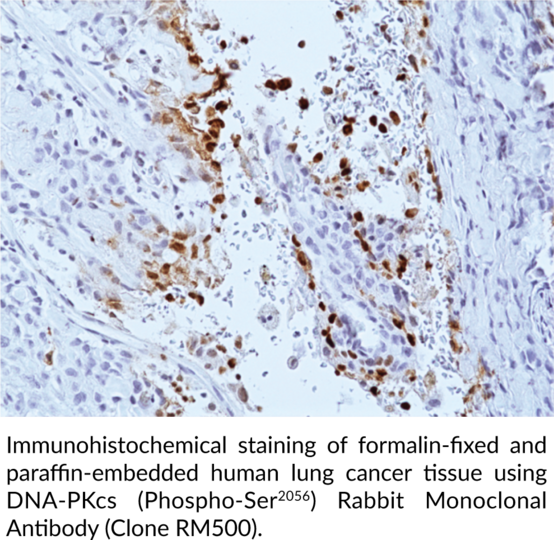
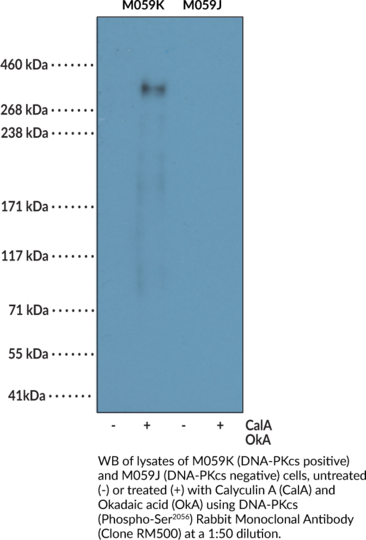
DNA-dependent protein kinase catalytic subunit (DNA-PKcs) is a member of the PI3K-related kinase (PIKK) family. It is composed of an N-terminal domain, which consists of two domains of HEAT repeats, a FAT homology domain, a FKBP12-rapamycin-binding (FRB) domain, a kinase domain, a PIKK regulatory domain, and a C-terminal FAT domain (FATC). DNA-PKcs localizes to the nucleus, cytoplasm, plasma membrane, cytoskeleton, and lipid rafts. It is involved in DNA double-strand break (DSB) repair through non-homologous end-joining (NHEJ) and homologous recombination (HR) pathways and contains numerous phosphorylation sites that modify its activity, such as Ser2056, which must be autophosphorylated for NHEJ to occur in response to DSBs. DNA-PKcs also plays a role in mitosis, telomere maintenance, transcriptional regulation, innate and adaptive immunity, and senescence, among many other processes. DNA-PKcs interacts with Ku70/Ku80 to form the DNA-PK holoenzyme, which acts on various substrates, including histone H2AX, heat shock protein 90 (Hsp90), and Artemis. High expression or increased activity of DNA-PKcs is associated with metastasis, poor prognosis, and radio- and chemoresistance in various cancers. Cayman's DNA-PKcs (Phospho-Ser2056) Rabbit Monoclonal Antibody (Clone RM500) can be used for immunohistochemistry (IHC) and Western blot (WB) applications.. Cross reactivity: (+) DNA-PKcs (phospho-Ser2056): (-) Unmodified DNA-PKcs. (+) Human: .. Protein function: Serine/threonine-protein kinase that acts as a molecular sensor for DNA damage. Involved in DNA non-homologous end joining (NHEJ) required for double-strand break (DSB) repair and V(D)J recombination (PubMed:11955432, PubMed:12649176, PubMed:14734805). Must be bound to DNA to express its catalytic properties. Promotes processing of hairpin DNA structures in V(D)J recombination by activation of the hairpin endonuclease artemis (DCLRE1C) (PubMed:11955432). The assembly of the DNA-PK complex at DNA ends is also required for the NHEJ ligation step (PubMed:15574326, PubMed:11955432, PubMed:12649176, PubMed:14734805). Required to protect and align broken ends of DNA (PubMed:15574326, PubMed:11955432, PubMed:12649176, PubMed:14734805). May also act as a scaffold protein to aid the localization of DNA repair proteins to the site of damage (PubMed:15574326, PubMed:11955432, PubMed:12649176, PubMed:14734805). Found at the ends of chromosomes, suggesting a further role in the maintenance of telomeric stability and the prevention of chromosomal end fusion. Also involved in modulation of transcription (PubMed:15574326, PubMed:11955432, PubMed:12649176, PubMed:14734805). As part of the DNA-PK complex, involved in the early steps of ribosome assembly by promoting the processing of precursor rRNA into mature 18S rRNA in the small-subunit processome (PubMed:32103174). Binding to U3 small nucleolar RNA, recruits PRKDC and XRCC5/Ku86 to the small-subunit processome (PubMed:32103174). Recognizes the substrate consensus sequence [ST]-Q (PubMed:15574326, PubMed:11955432, PubMed:12649176, PubMed:14734805). Phosphorylates 'Ser-139' of histone variant H2AX, thereby regulating DNA damage response mechanism (PubMed:14627815, PubMed:16046194). Phosphorylates DCLRE1C, c-Abl/ABL1, histone H1, HSPCA, c-jun/JUN, p53/TP53, PARP1, POU2F1, DHX9, FH, SRF, XRCC1, XRCC1, XRCC4, XRCC5, XRCC6, WRN, MYC and RFA2 (PubMed:2507541, PubMed:2247066, PubMed:1597196, PubMed:8407951, PubMed:8464713, PubMed:9362500, PubMed:9139719, PubMed:10026262, PubMed:10467406, PubMed:12509254, PubMed:11889123, PubMed:14612514, PubMed:14704337, PubMed:16397295, PubMed:26237645, PubMed:28712728). Can phosphorylate C1D not only in the presence of linear DNA but also in the presence of supercoiled DNA (PubMed:9679063). Ability to phosphorylate p53/TP53 in the presence of supercoiled DNA is dependent on C1D (PubMed:9363941). Contributes to the determination of the circadian period length by antagonizing phosphorylation of CRY1 'Ser-588' and increasing CRY1 protein stability, most likely through an indirect mechanism. Plays a role in the regulation of DNA virus-mediated innate immune response by assembling into the HDP-RNP complex, a complex that serves as a platform for IRF3 phosphorylation and subsequent innate immune response activation through the cGAS-STING pathway (PubMed:28712728). [The UniProt Consortium]
| Keywords: | DNA-dependent Protein Kinase Catalytic Subunit, DNA-PK Catalytic Subunit, p460 |
| Supplier: | Cayman Chemical |
| Supplier-Nr: | 42852 |
Properties
| Application: | IHC, WB |
| Antibody Type: | Monoclonal |
| Clone: | RM500 |
| Conjugate: | No |
| Host: | Rabbit |
| Species reactivity: | human |
| Immunogen: | A phosphopeptide corresponding to human DNA-PKcs (phospho-Ser2056) |
| Format: | Purified |
Database Information
| KEGG ID : | K06642 | Matching products |
| UniProt ID : | P78527 | Matching products |
| Gene ID : | GeneID 5591 | Matching products |
Handling & Safety
| Storage: | -20°C |
| Shipping: | +20°C (International: -20°C) |
Caution
Our products are for laboratory research use only: Not for administration to humans!
Our products are for laboratory research use only: Not for administration to humans!
Information about the product reference will follow.
more
You will get a certificate here
Viewed