
Cookie preferences
This website uses cookies, which are necessary for the technical operation of the website and are always set. Other cookies, which increase the comfort when using this website, are used for direct advertising or to facilitate interaction with other websites and social networks, are only set with your consent.
Configuration
Technically required
These cookies are necessary for the basic functions of the shop.
"Allow all cookies" cookie
"Decline all cookies" cookie
CSRF token
Cookie preferences
Currency change
Customer-specific caching
FACT-Finder tracking
Individual prices
Selected shop
Session
Comfort functions
These cookies are used to make the shopping experience even more appealing, for example for the recognition of the visitor.
Note
Show the facebook fanpage in the right blod sidebar
Statistics & Tracking
Affiliate program
Conversion and usertracking via Google Tag Manager
Track device being used




| Item number | Size | Datasheet | Manual | SDS | Delivery time | Quantity | Price |
|---|---|---|---|---|---|---|---|
| NSJ-V5931SAF-100UG | 100 µg | - | - |
3 - 10 business days* |
810.00€
|
If you have any questions, please use our Contact Form.
You can also order by e-mail: info@biomol.com
Larger quantity required? Request bulk
You can also order by e-mail: info@biomol.com
Larger quantity required? Request bulk
1 mg/ml in 1X PBS, BSA free, sodium azide free. KRT14 Antibody recognizes Keratin 14, also known... more
Product information "Anti-Cytokeratin 14 / CK14 / KRT14, clone KRT14/6961"
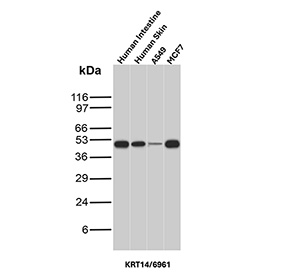
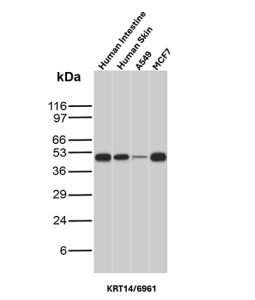
1 mg/ml in 1X PBS, BSA free, sodium azide free. KRT14 Antibody recognizes Keratin 14, also known as Cytokeratin 14 (KRT14), a type I intermediate filament protein that serves as a defining structural marker of basal cells in stratified squamous epithelia. Keratin 14 is a cytoplasmic protein that forms obligate heterodimers with type II keratins, most prominently Keratin 5, to assemble intermediate filaments that provide mechanical strength, cellular integrity, and resistance to physical stress in epithelial tissues. KRT14 Antibody is widely used in research contexts to identify basal squamous epithelial cells and is commonly referred to as Cytokeratin 14 antibody or CK14 antibody in the literature.Cytokeratin 14 expression is characteristically confined to the basal layer of stratified squamous epithelia, including epidermis, oral mucosa, esophagus, cervix, and other squamous-lined tissues. In these tissues, KRT14-positive basal cells represent the proliferative compartment responsible for epithelial renewal and regeneration. As basal cells differentiate and migrate toward suprabasal layers, Cytokeratin 14 expression decreases and is replaced by differentiation-associated keratins such as Cytokeratin 13 or Cytokeratin 10. This sharply defined basal localization makes KRT14 Antibody particularly useful for distinguishing basal progenitor cells from differentiated squamous epithelial populations.Altered Cytokeratin 14 expression has been documented in a range of pathological conditions. Expansion of KRT14 expression beyond the basal layer is frequently observed in epithelial hyperplasia, dysplasia, and squamous cell carcinoma, reflecting disrupted differentiation programs and abnormal epithelial architecture. For this reason, Cytokeratin 14 antibody staining patterns are commonly evaluated in research studies focused on basal cell biology, squamous lineage commitment, and epithelial tumor progression.At the cellular level, Cytokeratin 14 contributes to cytoskeletal organization and plays a role in anchoring basal epithelial cells to the basement membrane through interactions with desmosomes and hemidesmosomes. Its basal cell-restricted expression makes KRT14 Antibody a useful tool for studying epithelial stratification, basal cell dynamics, and squamous tissue organization. The KRT14 Antibody (clone KRT14/6961) is designed to detect Cytokeratin 14 expression in research applications where identification of basal squamous epithelial cells is required.
| Keywords: | Anti-KRT14, Anti-Keratin-14, Anti-Cytokeratin-14, Anti-Keratin, type I cytoskeletal 14, Cytokeratin 14 Antibody / CK14 / KRT14 |
| Supplier: | NSJ Bioreagents |
| Supplier-Nr: | V5931SAF |
Properties
| Application: | IHC, WB |
| Antibody Type: | Monoclonal |
| Clone: | KRT14/6961 |
| Conjugate: | No |
| Host: | Mouse |
| Species reactivity: | human |
| Immunogen: | Recombinant human KRT14 fragment (around amino acids 351-472) (exact sequence is proprietary) |
| Format: | Purified |
Database Information
| KEGG ID : | K07604 | Matching products |
| UniProt ID : | P02533 | Matching products |
| Gene ID : | GeneID 3861 | Matching products |
Handling & Safety
| Storage: | -20°C |
| Shipping: | -20°C (International: -20°C) |
Caution
Our products are for laboratory research use only: Not for administration to humans!
Our products are for laboratory research use only: Not for administration to humans!
Information about the product reference will follow.
more
You will get a certificate here
Viewed