
Cookie preferences
This website uses cookies, which are necessary for the technical operation of the website and are always set. Other cookies, which increase the comfort when using this website, are used for direct advertising or to facilitate interaction with other websites and social networks, are only set with your consent.
Configuration
Technically required
These cookies are necessary for the basic functions of the shop.
"Allow all cookies" cookie
"Decline all cookies" cookie
CSRF token
Cookie preferences
Currency change
Customer-specific caching
FACT-Finder tracking
Individual prices
Selected shop
Session
Comfort functions
These cookies are used to make the shopping experience even more appealing, for example for the recognition of the visitor.
Note
Show the facebook fanpage in the right blod sidebar
Statistics & Tracking
Affiliate program
Conversion and usertracking via Google Tag Manager
Track device being used

NEW
| Item number | Size | Datasheet | Manual | SDS | Delivery time | Quantity | Price |
|---|---|---|---|---|---|---|---|
| ABS-KC-43791.50 | 50 µl | - | - |
10 - 14 business days* |
206.00€
|
||
| ABS-KC-43791.100 | 100 µl | - | - |
10 - 14 business days* |
295.00€
|
If you have any questions, please use our Contact Form.
You can also order by e-mail: info@biomol.com
Larger quantity required? Request bulk
You can also order by e-mail: info@biomol.com
Larger quantity required? Request bulk
Formulation: Phosphate-buffered saline (PBS) with 50% glycerol, 0.5% BSA and 0.09% sodium azide.... more
Product information "Anti-Cystathionase/CTH"
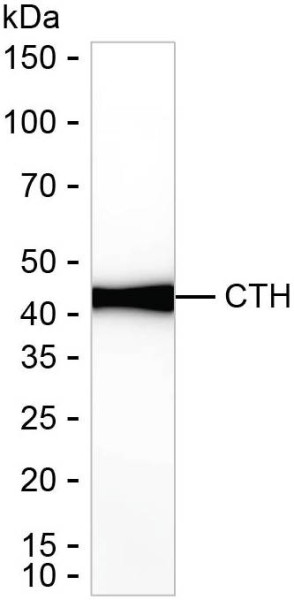
Formulation: Phosphate-buffered saline (PBS) with 50% glycerol, 0.5% BSA and 0.09% sodium azide. Identity-Mouse (%): 86%. Homologies: Highest antigen sequence identity to the following orthologs: Mouse - 86%, Rat - 84%, Pig - 91%, Cynomolgus monkey - 98%. IHC Verification: -. WB Verification: succeed. IP Verification: -. IF Verification: -. FC Verification: -. IP-MS Verification: -. Cross reactivity: Not tested. Sandwich ELISA Verification: -. Antigen ID: ABS-PP-12492. Recombinant Antibody: Protein Function: Catalyzes the last step in the trans-sulfuration pathway from L-methionine to L-cysteine in a pyridoxal-5'-phosphate (PLP)-dependent manner, which consists on cleaving the L,L-cystathionine molecule into L-cysteine, ammonia and 2-oxobutanoate (PubMed:10212249, PubMed:18476726, PubMed:19261609, PubMed:19961860). Part of the L-cysteine derived from the trans-sulfuration pathway is utilized for biosynthesis of the ubiquitous antioxidant glutathione (PubMed:18476726). Besides its role in the conversion of L-cystathionine into L-cysteine, it utilizes L-cysteine and L-homocysteine as substrates (at much lower rates than L,L-cystathionine) to produce the endogenous gaseous signaling molecule hydrogen sulfide (H2S) (PubMed:10212249, PubMed:19019829, PubMed:19261609, PubMed:19961860). In vitro, it converts two L-cysteine molecules into lanthionine and H2S, also two L-homocysteine molecules to homolanthionine and H2S, which can be particularly relevant under conditions of severe hyperhomocysteinemia (which is a risk factor for cardiovascular disease, diabetes, and Alzheimer's disease) (PubMed:19261609). Lanthionine and homolanthionine are structural homologs of L,L-cystathionine that differ by the absence or presence of an extra methylene group, respectively (PubMed:19261609). Acts as a cysteine-protein sulfhydrase by mediating sulfhydration of target proteins: sulfhydration consists of converting -SH groups into -SSH on specific cysteine residues of target proteins such as GAPDH, PTPN1 and NF-kappa-B subunit RELA, thereby regulating their function (PubMed:22169477). By generating the gasotransmitter H2S, it participates in a number of physiological processes such as vasodilation, bone protection, and inflammation (Probable) (PubMed:29254196). Plays an essential role in myogenesis by contributing to the biogenesis of H2S in skeletal muscle tissue (By similarity). Can also accept homoserine as substrate (By similarity). Catalyzes the elimination of selenocystathionine (which can be derived from the diet) to yield selenocysteine, ammonia and 2-oxobutanoate (By similarity) [The Uniprot Consortium]
| Keywords: | Anti-CTH, Anti-Gamma-cystathionase, Anti-Cysteine desulfhydrase, Anti-Cystathionine gamma-lyase, Anti-Homocysteine desulfhydrase, Anti-Cysteine-protein sulfhydrase, Cystathionase/CTH Antibody |
| Supplier: | Absea |
| Supplier-Nr: | KC-43791 |
Properties
| Application: | WB |
| Antibody Type: | Monoclonal |
| Clone: | K9N064_8E11 |
| Conjugate: | No |
| Host: | Mouse |
| Species reactivity: | human |
| Immunogen: | Recombinant human CTH |
| Purity: | >85% |
| Format: | Solution |
Database Information
| KEGG ID : | K01758 | Matching products |
| UniProt ID : | P32929 | Matching products |
| Gene ID : | GeneID 1491 | Matching products |
Handling & Safety
| Storage: | +4°C (-20 °C for long term storage) |
| Shipping: | +4°C (International: +4°C) |
Caution
Our products are for laboratory research use only: Not for administration to humans!
Our products are for laboratory research use only: Not for administration to humans!
You will get a certificate here
Viewed