
Cookie preferences
This website uses cookies, which are necessary for the technical operation of the website and are always set. Other cookies, which increase the comfort when using this website, are used for direct advertising or to facilitate interaction with other websites and social networks, are only set with your consent.
Configuration
Technically required
These cookies are necessary for the basic functions of the shop.
"Allow all cookies" cookie
"Decline all cookies" cookie
CSRF token
Cookie preferences
Currency change
Customer-specific caching
FACT-Finder tracking
Individual prices
Selected shop
Session
Comfort functions
These cookies are used to make the shopping experience even more appealing, for example for the recognition of the visitor.
Note
Show the facebook fanpage in the right blod sidebar
Statistics & Tracking
Affiliate program
Conversion and usertracking via Google Tag Manager
Track device being used



| Item number | Size | Datasheet | Manual | SDS | Delivery time | Quantity | Price |
|---|---|---|---|---|---|---|---|
| NSJ-FY12125 | 100 µg | - | - |
7 - 12 business days* |
790.00€
|
If you have any questions, please use our Contact Form.
You can also order by e-mail: info@biomol.com
Larger quantity required? Request bulk
You can also order by e-mail: info@biomol.com
Larger quantity required? Request bulk
Adding 0.2 ml of distilled water will yield a concentration of 500 ug/ml. CLCN3 antibody detects... more
Product information "Anti-CLCN3 / Chloride channel protein 3"
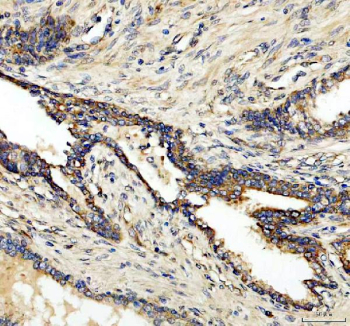
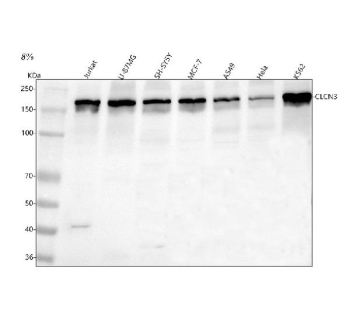
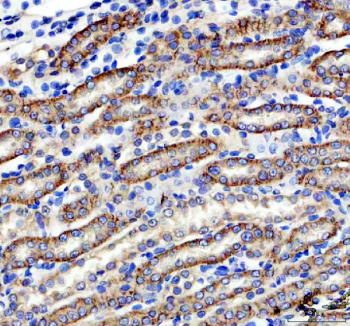
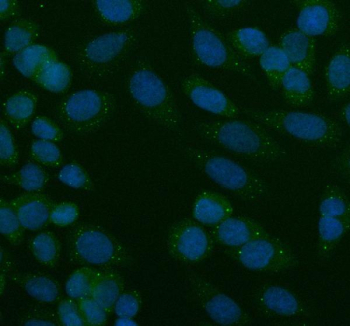
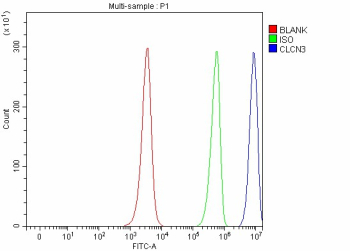
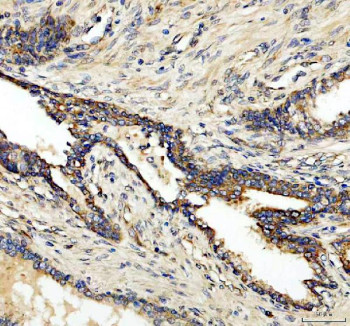
Adding 0.2 ml of distilled water will yield a concentration of 500 ug/ml. CLCN3 antibody detects Chloride channel protein 3, encoded by the CLCN3 gene on chromosome 4q33. CLCN3 belongs to the CLC family of voltage-gated chloride channels and chloride/proton exchangers, which regulate membrane potential, cell volume, and ion homeostasis. CLCN3 is widely expressed across tissues but is most abundant in the nervous system, kidney, and muscle, where it supports vesicular acidification, endosomal trafficking, and chloride transport across membranes. It plays a vital role in maintaining neuronal excitability, synaptic transmission, and endolysosomal homeostasis.Structurally, CLCN3 is a dimeric integral membrane protein with each subunit containing its own independent pore. It functions primarily as a Cl?/H+ antiporter rather than a pure chloride channel, coupling chloride efflux to proton influx. This electrogenic exchange contributes to acidification of endosomes and synaptic vesicles, processes essential for neurotransmitter storage and recycling. Mutations or dysregulation of CLCN3 impair endosomal acidification and lead to defective receptor trafficking, altered synaptic vesicle dynamics, and changes in neuronal function.In the nervous system, CLCN3 contributes to synaptic vesicle function by facilitating neurotransmitter loading and release. Knockout mice lacking CLCN3 display severe neurodegeneration, retinal degeneration, and defects in hippocampal synaptic plasticity. These phenotypes underscore its importance in brain development and function. Additionally, CLCN3 supports cell volume regulation under osmotic stress, protecting neurons and glial cells from swelling-induced injury.Pathologically, alterations in CLCN3 have been linked to epilepsy, intellectual disability, and neurodegenerative conditions. Some cancer studies have shown that CLCN3 expression is upregulated in gliomas and contributes to tumor growth and invasiveness by regulating intracellular chloride levels and endosomal signaling. As such, CLCN3 has been proposed as a potential therapeutic target in oncology and neurology. Researchers rely on CLCN3 antibody to study its role in these diverse processes, enabling insights into ion channel biology, synaptic function, and disease progression.Experimentally, CLCN3 antibody has been applied in western blotting to detect the expected ~97 kDa band, in immunofluorescence microscopy to visualize endosomal and vesicular localization, and in immunohistochemistry to track expression in brain and kidney tissue. Co-immunoprecipitation studies using CLCN3 antibody have identified interacting partners including clathrin, synaptophysin, and vesicular proton ATPases, highlighting its integration in vesicular trafficking networks. Functional assays combining CLCN3 antibody with electrophysiological studies allow researchers to correlate protein abundance with transport activity. NSJ Bioreagents provides CLCN3 antibody to support neuroscience, physiology, and cancer research by ensuring reliable detection of this critical ion transporter.
| Keywords: | Anti-CLCN3, Anti-Chloride transporter ClC-3, Anti-Chloride channel protein 3, Anti-H(+)/Cl(-) exchange transporter 3, CLCN3 Antibody / Chloride channel protein 3 |
| Supplier: | NSJ Bioreagents |
| Supplier-Nr: | FY12125 |
Properties
| Application: | WB, IHC, ICC, IF, FC, ELISA |
| Antibody Type: | Polyclonal |
| Conjugate: | No |
| Host: | Rabbit |
| Species reactivity: | human, rat |
| Immunogen: | E.coli-derived human CLCN3 recombinant protein (Position: G293-R752) |
| Format: | Purified |
Database Information
| KEGG ID : | K05012 | Matching products |
| UniProt ID : | P51790 | Matching products |
| Gene ID : | GeneID 1182 | Matching products |
Handling & Safety
| Storage: | +4°C |
| Shipping: | +4°C (International: +4°C) |
Caution
Our products are for laboratory research use only: Not for administration to humans!
Our products are for laboratory research use only: Not for administration to humans!
Information about the product reference will follow.
more
You will get a certificate here
Viewed