
Cookie preferences
This website uses cookies, which are necessary for the technical operation of the website and are always set. Other cookies, which increase the comfort when using this website, are used for direct advertising or to facilitate interaction with other websites and social networks, are only set with your consent.
Configuration
Technically required
These cookies are necessary for the basic functions of the shop.
"Allow all cookies" cookie
"Decline all cookies" cookie
CSRF token
Cookie preferences
Currency change
Customer-specific caching
FACT-Finder tracking
Individual prices
Selected shop
Session
Comfort functions
These cookies are used to make the shopping experience even more appealing, for example for the recognition of the visitor.
Note
Show the facebook fanpage in the right blod sidebar
Statistics & Tracking
Affiliate program
Conversion and usertracking via Google Tag Manager
Track device being used


| Item number | Size | Datasheet | Manual | SDS | Delivery time | Quantity | Price |
|---|---|---|---|---|---|---|---|
| NSJ-V6063-20UG | 20 µg | - | - |
3 - 10 business days* |
684.00€
|
||
| NSJ-V6063-100UG | 100 µg | - | - |
3 - 10 business days* |
1,265.00€
|
If you have any questions, please use our Contact Form.
You can also order by e-mail: info@biomol.com
Larger quantity required? Request bulk
You can also order by e-mail: info@biomol.com
Larger quantity required? Request bulk
Antibody in 1X PBS with 0.05% BSA, 0.05% sodium azide. CHGA antibody recognizes Chromogranin A, a... more
Product information "Anti-Chromogranin A / CHGA, clone MSVA-380R"
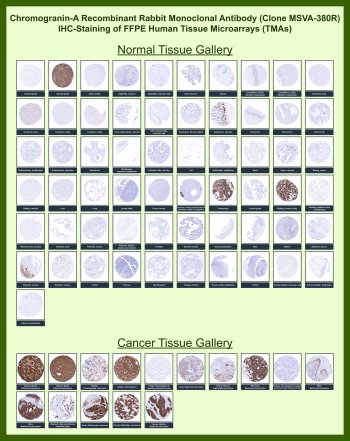
Antibody in 1X PBS with 0.05% BSA, 0.05% sodium azide. CHGA antibody recognizes Chromogranin A, a secretory glycoprotein encoded by the CHGA gene and widely expressed in neuroendocrine cells. CHGA Antibody for IHC (clone MSVA-380R) is a recombinant rabbit monoclonal antibody developed for immunohistochemical detection of this hallmark neuroendocrine marker in formalin-fixed, paraffin-embedded tissues. Chromogranin A localizes predominantly to the cytoplasm within dense-core secretory granules of endocrine and neuroendocrine cells, where it participates in hormone storage, granule biogenesis, and regulated secretion. This CHGA antibody is part of a broader Chromogranin A antibody panel offered by NSJ Bioreagents.CHGA antibody, also referred to as Chromogranin A antibody and CgA antibody in the literature, targets a member of the granin family of acidic secretory proteins. Chromogranin A is synthesized as a precursor protein that undergoes proteolytic processing to generate several bioactive peptides, including vasostatin, pancreastatin, and catestatin. These peptides contribute to regulation of hormone release, cardiovascular function, and metabolic signaling pathways. Within secretory granules, Chromogranin A plays an essential structural role by promoting aggregation of peptide hormones and stabilizing granule formation in the trans-Golgi network.CHGA expression is characteristic of neuroendocrine tissues such as adrenal medulla, pancreatic islets, gastrointestinal enteroendocrine cells, parathyroid gland, and various dispersed neuroendocrine cell populations throughout the respiratory and genitourinary tracts. Cytoplasmic granular staining is the expected immunohistochemical pattern in these cell types. Because of this restricted lineage distribution, Chromogranin A is widely used in research studies as a robust marker of neuroendocrine differentiation.In tumor biology, CHGA expression is frequently evaluated in neuroendocrine neoplasms including carcinoid tumors, pancreatic neuroendocrine tumors, small cell carcinoma, medullary thyroid carcinoma, and pheochromocytoma. Strong cytoplasmic granular staining supports neuroendocrine lineage, while most non-neuroendocrine carcinomas lack expression. CHGA antibody for IHC is therefore commonly incorporated into research panels investigating neuroendocrine differentiation and tumor classification.The recombinant rabbit monoclonal clone MSVA-380R provides consistent detection of Chromogranin A expression patterns in normal and neoplastic neuroendocrine tissues for research use at NSJ Bioreagents.This antibody is also part of a broader collection of IHC antibodies validated by tissue microarray analysis, supporting consistent staining across normal and cancer tissues.
| Keywords: | Anti-CHGA, Anti-Chromogranin-A, Anti-Pituitary secretory protein I, Chromogranin A Antibody / CHGA |
| Supplier: | NSJ Bioreagents |
| Supplier-Nr: | V6063 |
Properties
| Application: | IHC |
| Antibody Type: | Monoclonal |
| Clone: | MSVA-380R |
| Conjugate: | No |
| Host: | Rabbit |
| Species reactivity: | human |
| Immunogen: | Recombinant full-length human chromogranin A protein |
| Format: | Purified |
Database Information
| KEGG ID : | K19990 | Matching products |
| UniProt ID : | P10645 | Matching products |
| Gene ID : | GeneID 1113 | Matching products |
Handling & Safety
| Storage: | -20°C |
| Shipping: | -20°C (International: -20°C) |
Caution
Our products are for laboratory research use only: Not for administration to humans!
Our products are for laboratory research use only: Not for administration to humans!
Information about the product reference will follow.
more
You will get a certificate here
Viewed