
Cookie preferences
This website uses cookies, which are necessary for the technical operation of the website and are always set. Other cookies, which increase the comfort when using this website, are used for direct advertising or to facilitate interaction with other websites and social networks, are only set with your consent.
Configuration
Technically required
These cookies are necessary for the basic functions of the shop.
"Allow all cookies" cookie
"Decline all cookies" cookie
CSRF token
Cookie preferences
Currency change
Customer-specific caching
FACT-Finder tracking
Individual prices
Selected shop
Session
Comfort functions
These cookies are used to make the shopping experience even more appealing, for example for the recognition of the visitor.
Note
Show the facebook fanpage in the right blod sidebar
Statistics & Tracking
Affiliate program
Conversion and usertracking via Google Tag Manager
Track device being used



| Item number | Size | Datasheet | Manual | SDS | Delivery time | Quantity | Price |
|---|---|---|---|---|---|---|---|
| NSJ-FY13335 | 100 µg | - | - |
3 - 10 business days* |
790.00€
|
If you have any questions, please use our Contact Form.
You can also order by e-mail: info@biomol.com
Larger quantity required? Request bulk
You can also order by e-mail: info@biomol.com
Larger quantity required? Request bulk
Adding 0.2 ml of distilled water will yield a concentration of 500 ug/ml. CHP1 antibody detects... more
Product information "Anti-CHP1 / Calcineurin B homologous protein 1"
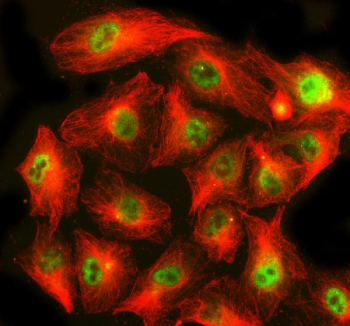
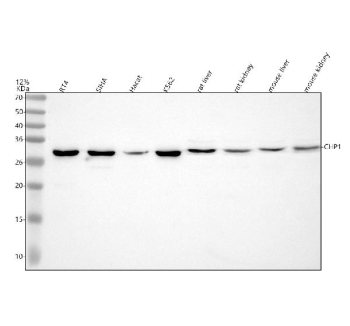
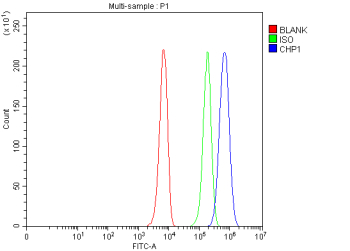
Adding 0.2 ml of distilled water will yield a concentration of 500 ug/ml. CHP1 antibody detects Calcineurin B homologous protein 1, a calcium-binding regulatory protein encoded by the CHP1 gene located on chromosome 15q15.1. CHP1 is a cytoplasmic and membrane-associated protein expressed in a wide range of tissues, including brain, heart, kidney, and skeletal muscle. It belongs to the EF-hand superfamily of calcium-binding proteins and functions as an essential regulator of sodium-hydrogen exchanger (NHE) activity, vesicle trafficking, and signal transduction. CHP1 acts as a molecular sensor of intracellular calcium levels, modulating transporter activity and contributing to pH homeostasis and cellular excitability.CHP1 directly binds to the cytoplasmic tails of NHE1, NHE2, and NHE3 isoforms, stabilizing their conformation and enhancing plasma membrane localization. This regulatory role links calcium signaling to intracellular pH regulation and ion balance. CHP1 also associates with calcineurin and other phosphatases, influencing downstream signaling in calcium-dependent pathways. High expression in neurons and cardiac cells underscores its importance in excitable tissues where calcium fluctuations tightly control function and metabolism.Structurally, CHP1 contains four EF-hand motifs, three of which bind calcium ions, and a myristoylation site that facilitates membrane association. Calcium binding induces conformational changes that alter its interaction with target proteins, providing a molecular mechanism for activity regulation. CHP1 belongs to the calcineurin B homologous protein family, which includes CHP2 and CHP3, all serving as modulators of NHEs and other transporters. CHP1 also co-localizes with NHE1 at the plasma membrane and Golgi apparatus, supporting its dual role in membrane trafficking and ion transport.Functionally, CHP1 contributes to multiple cellular processes including cytoskeletal organization, vesicle transport, and cell migration. It stabilizes the actin cytoskeleton through NHE1-ERM protein interactions and participates in cellular stress adaptation. CHP1 is implicated in the MAPK and calcium signaling pathways that mediate growth, differentiation, and apoptosis. In neurons, CHP1 interacts with voltage-gated ion channels and regulates excitatory signaling, while in cardiomyocytes it influences contractility by fine-tuning calcium dynamics.Dysregulation of CHP1 has been linked to neuropathies, cardiac dysfunction, and cancer. Mutations in CHP1 cause autosomal recessive ataxia, characterized by impaired motor coordination and Purkinje cell loss. Abnormal CHP1 expression can also contribute to altered NHE1 activity in glioblastoma and other tumors, affecting intracellular pH and invasive potential. Pathway analysis places CHP1 in ion transport regulation, calcium signaling, and cellular stress adaptation mechanisms.Immunohistochemical staining using CHP1 antibody shows cytoplasmic and membrane localization, with prominent expression in neurons and cardiac muscle. CHP1 antibody from NSJ Bioreagents provides a powerful reagent for studying calcium signaling, ion transport regulation, and neurological or cardiac disease mechanisms.
| Keywords: | Anti-CHP1, Anti-Calcineurin B-like protein, Anti-Calcium-binding protein CHP, Anti-Calcium-binding protein p22, Anti-Calcineurin B homologous protein 1, Anti-EF-hand calcium-binding domain-containing protein p22, CHP1 Antibody / Calcineurin B homologous p |
| Supplier: | NSJ Bioreagents |
| Supplier-Nr: | FY13335 |
Properties
| Application: | WB, ICC/IF, FC |
| Antibody Type: | Polyclonal |
| Conjugate: | No |
| Host: | Rabbit |
| Species reactivity: | human, mouse, rat |
| Immunogen: | A synthetic peptide corresponding to a sequence at the N-terminus of human CHP1 |
| Format: | Purified |
Database Information
| KEGG ID : | K17610 | Matching products |
| UniProt ID : | Q99653 | Matching products |
| Gene ID : | GeneID 11261 | Matching products |
Handling & Safety
| Storage: | +4°C |
| Shipping: | +4°C (International: +4°C) |
Caution
Our products are for laboratory research use only: Not for administration to humans!
Our products are for laboratory research use only: Not for administration to humans!
Information about the product reference will follow.
more
You will get a certificate here
Viewed