
Cookie preferences
This website uses cookies, which are necessary for the technical operation of the website and are always set. Other cookies, which increase the comfort when using this website, are used for direct advertising or to facilitate interaction with other websites and social networks, are only set with your consent.
Configuration
Technically required
These cookies are necessary for the basic functions of the shop.
"Allow all cookies" cookie
"Decline all cookies" cookie
CSRF token
Cookie preferences
Currency change
Customer-specific caching
FACT-Finder tracking
Individual prices
Selected shop
Session
Comfort functions
These cookies are used to make the shopping experience even more appealing, for example for the recognition of the visitor.
Note
Show the facebook fanpage in the right blod sidebar
Statistics & Tracking
Affiliate program
Conversion and usertracking via Google Tag Manager
Track device being used



| Item number | Size | Datasheet | Manual | SDS | Delivery time | Quantity | Price |
|---|---|---|---|---|---|---|---|
| NSJ-FY13329 | 100 µg | - | - |
3 - 10 business days* |
790.00€
|
If you have any questions, please use our Contact Form.
You can also order by e-mail: info@biomol.com
Larger quantity required? Request bulk
You can also order by e-mail: info@biomol.com
Larger quantity required? Request bulk
Adding 0.2 ml of distilled water will yield a concentration of 500 ug/ml. CHD4 antibody detects... more
Product information "Anti-CHD4 / Chromodomain-helicase-DNA-binding protein 4 / Mi2-beta"
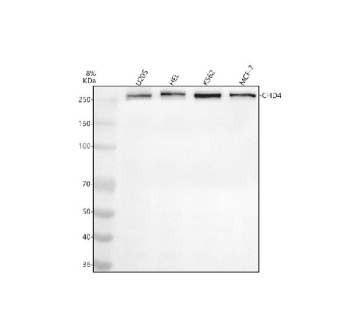
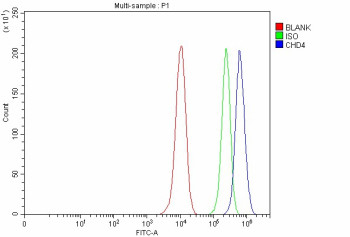
Adding 0.2 ml of distilled water will yield a concentration of 500 ug/ml. CHD4 antibody detects Chromodomain-helicase-DNA-binding protein 4, also called Mi2-beta, a nuclear ATP-dependent chromatin remodeler encoded by the CHD4 gene on chromosome 12p13.31. CHD4 is a member of the CHD family (chromodomain helicase DNA-binding proteins) and serves as the catalytic core of the nucleosome remodeling and deacetylase (NuRD) complex. This complex couples ATP-dependent chromatin remodeling with histone deacetylation to regulate gene transcription, DNA repair, and replication. CHD4 is highly expressed in proliferating cells, hematopoietic lineages, and neurons, where it orchestrates transcriptional repression and chromatin organization.As a key nuclear regulator, CHD4 modulates chromatin accessibility and transcriptional silencing by repositioning nucleosomes and recruiting histone-modifying enzymes. It interacts with co-repressors, including MTA1-3 and HDAC1/2, within the NuRD complex to establish repressive chromatin states. CHD4's helicase and chromodomain motifs enable recognition of methylated histones and remodeling of nucleosomal DNA, linking epigenetic signals to transcriptional control. It functions in diverse pathways such as cell cycle progression, stem cell maintenance, and DNA damage repair.CHD4 antibody identifies a protein that interacts with PARP1 and BRCA1 at sites of DNA double-strand breaks, coordinating chromatin remodeling and homologous recombination. Through this association, CHD4 contributes to the DNA damage response (DDR), facilitating repair factor recruitment and checkpoint activation. Mutations or misregulation of CHD4 impair genomic stability and can lead to carcinogenesis or developmental disorders. CHD4 also associates with replication protein A (RPA) and proliferating cell nuclear antigen (PCNA), supporting chromatin reassembly during DNA synthesis.Structurally, CHD4 contains two N-terminal plant homeodomain (PHD) zinc fingers, tandem chromodomains for methylated histone recognition, an ATPase/helicase domain for chromatin remodeling, and a C-terminal region mediating protein-protein interactions. This modular structure allows CHD4 to integrate epigenetic marks with mechanical chromatin rearrangement. It is part of the CHD family of SNF2-like ATPases that also includes CHD3 and CHD5, all involved in transcriptional regulation and chromatin remodeling.Dysfunction of CHD4 is linked to various diseases. Somatic mutations have been identified in endometrial carcinoma, chronic lymphocytic leukemia, and glioblastoma. Germline CHD4 mutations cause Sifrim-Hitz-Weiss syndrome, characterized by developmental delay, craniofacial abnormalities, and cardiac defects. Pathway analysis places CHD4 in the chromatin remodeling, DNA repair, and cell cycle regulation pathways. It also co-localizes with HDAC1/2 and MTA proteins in nuclear repressor complexes, reinforcing its central role in chromatin dynamics.Immunohistochemical staining using CHD4 antibody shows strong nuclear localization in proliferating and stem-like cells. The CHD4 antibody from NSJ Bioreagents is a high-quality reagent for studying chromatin remodeling, epigenetic silencing, and DNA repair mechanisms.
| Keywords: | Anti-CHD4, Anti-Mi2-beta, Anti-ATP-dependent helicase CHD4, Anti-Mi-2 autoantigen 218 kDa protein, Anti-Chromodomain-helicase-DNA-binding protein 4, CHD4 Antibody / Chromodomain-helicase-DNA-binding protein 4 / Mi2-beta |
| Supplier: | NSJ Bioreagents |
| Supplier-Nr: | FY13329 |
Properties
| Application: | WB, FC |
| Antibody Type: | Polyclonal |
| Conjugate: | No |
| Host: | Rabbit |
| Species reactivity: | human |
| Immunogen: | A synthetic peptide corresponding to a sequence at the N-terminus of human CHD4 |
| Format: | Purified |
Database Information
| KEGG ID : | K11643 | Matching products |
| UniProt ID : | Q14839 | Matching products |
| Gene ID : | GeneID 1108 | Matching products |
Handling & Safety
| Storage: | +4°C |
| Shipping: | +4°C (International: +4°C) |
Caution
Our products are for laboratory research use only: Not for administration to humans!
Our products are for laboratory research use only: Not for administration to humans!
Information about the product reference will follow.
more
You will get a certificate here
Viewed