
Cookie preferences
This website uses cookies, which are necessary for the technical operation of the website and are always set. Other cookies, which increase the comfort when using this website, are used for direct advertising or to facilitate interaction with other websites and social networks, are only set with your consent.
Configuration
Technically required
These cookies are necessary for the basic functions of the shop.
"Allow all cookies" cookie
"Decline all cookies" cookie
CSRF token
Cookie preferences
Currency change
Customer-specific caching
FACT-Finder tracking
Individual prices
Selected shop
Session
Comfort functions
These cookies are used to make the shopping experience even more appealing, for example for the recognition of the visitor.
Note
Show the facebook fanpage in the right blod sidebar
Statistics & Tracking
Affiliate program
Conversion and usertracking via Google Tag Manager
Track device being used

| Item number | Size | Datasheet | Manual | SDS | Delivery time | Quantity | Price |
|---|---|---|---|---|---|---|---|
| NSJ-FY13342 | 100 µg | - | - |
3 - 10 business days* |
790.00€
|
If you have any questions, please use our Contact Form.
You can also order by e-mail: info@biomol.com
Larger quantity required? Request bulk
You can also order by e-mail: info@biomol.com
Larger quantity required? Request bulk
Adding 0.2 ml of distilled water will yield a concentration of 500 ug/ml. CEP63 antibody detects... more
Product information "Anti-CEP63 / Centrosomal protein of 63 kDa"
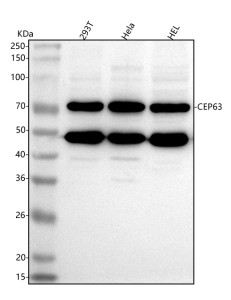
Adding 0.2 ml of distilled water will yield a concentration of 500 ug/ml. CEP63 antibody detects Centrosomal protein of 63 kDa, a centrosome-associated structural protein encoded by the CEP63 gene on chromosome 3q22.2. CEP63 is a critical regulator of centrosome duplication and spindle organization during cell division. The protein localizes to the pericentriolar material of centrosomes, where it functions as a scaffold to recruit additional centrosomal components required for centriole biogenesis. CEP63 is highly expressed in proliferating tissues such as bone marrow, testis, and developing neural cells, reflecting its key role in maintaining mitotic fidelity and genomic stability.CEP63 forms a complex with CEP152 to initiate centriole duplication by recruiting the kinase PLK4 to the mother centriole. This complex establishes a platform for procentriole assembly, ensuring that centrosomes duplicate only once per cell cycle. CEP63 also interacts with proteins such as CDK5RAP2, CEP192, and CENPJ, contributing to microtubule anchoring and spindle pole organization. Co-localization studies show CEP63 associating with centriolar satellites and the mitotic spindle, underlining its importance in centrosomal integrity and mitosis.Structurally, CEP63 contains coiled-coil domains that mediate dimerization and interactions with other centrosomal proteins. It belongs to the CEP protein family, which includes more than 30 structural and regulatory components of the centrosome. CEP63 acts as a scaffolding factor, stabilizing protein complexes essential for centriole duplication and spindle assembly. It also participates in DNA damage signaling by localizing to damaged chromatin and facilitating checkpoint activation in collaboration with ATM and MDC1.Functionally, CEP63 links centrosome duplication to cell cycle progression and DNA repair. It ensures accurate chromosome segregation and prevents aneuploidy. In developing neurons, CEP63 supports centriole cohesion and ciliogenesis, highlighting its role in neurodevelopment. During embryogenesis, CEP63 expression coincides with periods of rapid cell proliferation. Tissue-specific studies show that CEP63 supports germ cell division and early brain morphogenesis by maintaining centrosome integrity.Dysregulation or loss of CEP63 function has been associated with microcephaly and primary immunodeficiency disorders. Mutations in CEP63 disrupt centriole duplication, leading to mitotic defects, centrosome amplification, and genomic instability. In cancer, CEP63 overexpression has been observed in glioblastoma and breast carcinoma, where it contributes to uncontrolled proliferation. Pathway involvement includes cell cycle regulation, centrosome duplication, and DNA damage checkpoint signaling.Immunohistochemical staining using CEP63 antibody reveals pericentriolar and spindle pole localization during mitosis. The CEP63 antibody from NSJ Bioreagents is an excellent reagent for studying centrosome biology, mitotic regulation, and neurodevelopmental disease mechanisms.
| Keywords: | Anti-CEP63, Anti-Centrosomal protein of 63 kDa, CEP63 Antibody / Centrosomal protein of 63 kDa |
| Supplier: | NSJ Bioreagents |
| Supplier-Nr: | FY13342 |
Properties
| Application: | WB, ELISA |
| Antibody Type: | Polyclonal |
| Conjugate: | No |
| Host: | Rabbit |
| Species reactivity: | human |
| Immunogen: | E.coli-derived human CEP63 recombinant protein (Position: Q294-D628) |
| Format: | Purified |
Database Information
| KEGG ID : | K16763 | Matching products |
| UniProt ID : | Q96MT8 | Matching products |
| Gene ID : | GeneID 80254 | Matching products |
Handling & Safety
| Storage: | +4°C |
| Shipping: | +4°C (International: +4°C) |
Caution
Our products are for laboratory research use only: Not for administration to humans!
Our products are for laboratory research use only: Not for administration to humans!
Information about the product reference will follow.
more
You will get a certificate here
Viewed