
Cookie preferences
This website uses cookies, which are necessary for the technical operation of the website and are always set. Other cookies, which increase the comfort when using this website, are used for direct advertising or to facilitate interaction with other websites and social networks, are only set with your consent.
Configuration
Technically required
These cookies are necessary for the basic functions of the shop.
"Allow all cookies" cookie
"Decline all cookies" cookie
CSRF token
Cookie preferences
Currency change
Customer-specific caching
FACT-Finder tracking
Individual prices
Selected shop
Session
Comfort functions
These cookies are used to make the shopping experience even more appealing, for example for the recognition of the visitor.
Note
Show the facebook fanpage in the right blod sidebar
Statistics & Tracking
Affiliate program
Conversion and usertracking via Google Tag Manager
Track device being used


| Item number | Size | Datasheet | Manual | SDS | Delivery time | Quantity | Price |
|---|---|---|---|---|---|---|---|
| NSJ-FY13262 | 100 µg | - | - |
3 - 10 business days* |
790.00€
|
If you have any questions, please use our Contact Form.
You can also order by e-mail: info@biomol.com
Larger quantity required? Request bulk
You can also order by e-mail: info@biomol.com
Larger quantity required? Request bulk
Adding 0.2 ml of distilled water will yield a concentration of 500 ug/ml. CD36 antibody detects... more
Product information "Anti-CD36 / Platelet glycoprotein 4"
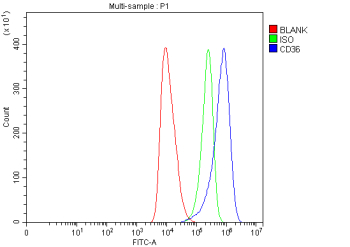
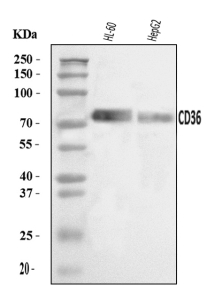
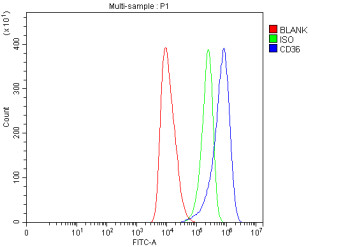
Adding 0.2 ml of distilled water will yield a concentration of 500 ug/ml. CD36 antibody detects Platelet glycoprotein 4, a multifunctional membrane receptor involved in lipid metabolism, angiogenesis, inflammation, and immune regulation. The UniProt recommended name is Platelet glycoprotein 4 (CD36). This scavenger receptor binds a wide range of ligands, including oxidized low-density lipoproteins (oxLDL), long-chain fatty acids, thrombospondin, and collagen, linking metabolic and inflammatory signaling pathways.Functionally, CD36 antibody identifies a 472-amino-acid glycoprotein expressed on the plasma membrane of platelets, macrophages, adipocytes, and endothelial cells. CD36 mediates fatty acid uptake and translocation across membranes, contributing to energy homeostasis and lipid storage. It also functions as a pattern recognition receptor in innate immunity, detecting oxidized lipids and apoptotic cells. Engagement of CD36 triggers signaling cascades involving Src-family kinases, MAPKs, and NF-kB, influencing inflammation, oxidative stress, and phagocytosis.The CD36 gene is located on chromosome 7q21.11 and is expressed in a broad range of tissues, including heart, skeletal muscle, liver, and immune cells. Expression is regulated by transcription factors such as PPARgamma and LXR, which respond to lipid availability and metabolic stress. CD36 plays a central role in coordinating cellular responses to lipid signals and oxidative modification.Pathologically, CD36 dysregulation contributes to atherosclerosis, insulin resistance, and metabolic syndrome. Overexpression in macrophages promotes foam cell formation and plaque development, while impaired expression leads to altered lipid uptake and cardiac dysfunction. In cancer, CD36 enhances metastatic potential by supporting lipid utilization in tumor cells. Research using CD36 antibody supports studies in lipid biology, cardiovascular disease, and metabolic signaling.CD36 antibody is validated for western blotting, flow cytometry, and immunohistochemistry to detect cell surface receptors. NSJ Bioreagents provides CD36 antibody reagents optimized for research in lipid transport, oxidative stress, and immune modulation.Structurally, Platelet glycoprotein 4 consists of two transmembrane domains, a large extracellular glycosylated loop, and short cytoplasmic tails that mediate signal transduction. The receptor interacts with caveolin and other membrane components to form lipid raft-associated complexes. This antibody enables investigation of CD36's function in lipid metabolism, inflammation, and vascular biology.
| Keywords: | Anti-CD36, Anti-PAS-4, Anti-PAS IV, Anti-Glycoprotein IIIb, Anti-Fatty acid translocase, Anti-Platelet glycoprotein 4, Anti-Thrombospondin receptor, Anti-Platelet glycoprotein IV, Anti-Platelet collagen receptor, Anti-Leukocyte differentiation antigen CD3 |
| Supplier: | NSJ Bioreagents |
| Supplier-Nr: | FY13262 |
Properties
| Application: | FC, WB |
| Antibody Type: | Polyclonal |
| Conjugate: | No |
| Host: | Rabbit |
| Species reactivity: | human, mouse, rat |
| Immunogen: | E.coli-derived human CD36 recombinant protein (Position: K233-N439) |
| Format: | Purified |
Database Information
| KEGG ID : | K06259 | Matching products |
| UniProt ID : | P16671 | Matching products |
| Gene ID : | GeneID 948 | Matching products |
Handling & Safety
| Storage: | +4°C |
| Shipping: | +4°C (International: +4°C) |
Caution
Our products are for laboratory research use only: Not for administration to humans!
Our products are for laboratory research use only: Not for administration to humans!
Information about the product reference will follow.
more
You will get a certificate here
Viewed