
Cookie preferences
This website uses cookies, which are necessary for the technical operation of the website and are always set. Other cookies, which increase the comfort when using this website, are used for direct advertising or to facilitate interaction with other websites and social networks, are only set with your consent.
Configuration
Technically required
These cookies are necessary for the basic functions of the shop.
"Allow all cookies" cookie
"Decline all cookies" cookie
CSRF token
Cookie preferences
Currency change
Customer-specific caching
FACT-Finder tracking
Individual prices
Selected shop
Session
Comfort functions
These cookies are used to make the shopping experience even more appealing, for example for the recognition of the visitor.
Note
Show the facebook fanpage in the right blod sidebar
Statistics & Tracking
Affiliate program
Conversion and usertracking via Google Tag Manager
Track device being used


| Item number | Size | Datasheet | Manual | SDS | Delivery time | Quantity | Price |
|---|---|---|---|---|---|---|---|
| NSJ-V6074-20UG | 20 µg | - | - |
7 - 12 business days* |
684.00€
|
||
| NSJ-V6074-100UG | 100 µg | - | - |
7 - 12 business days* |
1,265.00€
|
If you have any questions, please use our Contact Form.
You can also order by e-mail: info@biomol.com
Larger quantity required? Request bulk
You can also order by e-mail: info@biomol.com
Larger quantity required? Request bulk
Antibody in 1X PBS with 0.05% BSA, 0.05% sodium azide. Fc epsilon receptor II (FCER2), more... more
Product information "Anti-CD23 / Fc epsilon receptor 2, clone MSVA-023M"
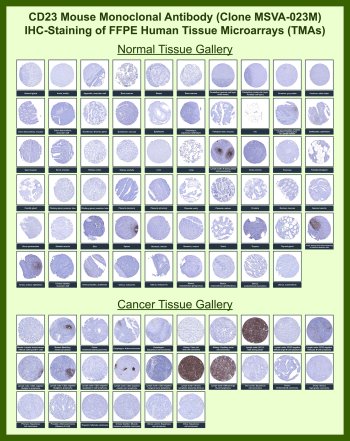
Antibody in 1X PBS with 0.05% BSA, 0.05% sodium azide. Fc epsilon receptor II (FCER2), more commonly known as CD23, is a low-affinity IgE receptor primarily expressed on mature B lymphocytes and follicular dendritic cells. CD23 Antibody for IHC / FCER2 Immunohistochemistry Antibody is widely used to evaluate B cell populations and lymphoid tissue organization in formalin-fixed, paraffin-embedded specimens. Its restricted and well-characterized expression pattern makes CD23 a valuable marker for studying immune cell distribution and lymphoid architecture in both normal and disease contexts.CD23 antibody, also referred to as FCER2 antibody or Fc epsilon receptor II antibody, produces characteristic membranous staining in B cell populations, often accompanied by cytoplasmic signal consistent with receptor internalization and turnover. In immunohistochemistry, strong staining is observed in germinal center B cells and follicular dendritic cell networks within lymphoid tissues such as tonsil, lymph node, and spleen. Tissue microarray (TMA) analysis further demonstrates consistent labeling of B cell-rich regions across a broad range of normal and cancer tissues, while most non-lymphoid tissues exhibit minimal to absent staining. This distinct staining profile supports its use as a lineage-associated marker with high specificity in tissue sections.Tissue microarray-based evaluation provides an effective framework for comparing CD23 expression across multiple tissue types under uniform staining conditions. Across TMA panels, CD23 staining highlights follicular structures and lymphocyte populations with clear contrast relative to surrounding stromal and epithelial compartments. In cancer tissue arrays, CD23-positive tumor-infiltrating lymphocytes may be observed, reflecting immune involvement within the tumor microenvironment. These patterns align with known biology and support the use of CD23 antibody for comparative tissue profiling and immune context analysis.In diagnostic and research settings, CD23 expression is frequently used in the classification of B cell lymphomas. It is characteristically expressed in chronic lymphocytic leukemia and small lymphocytic lymphoma, while showing variable or absent expression in other B cell neoplasms such as mantle cell lymphoma. The presence and distribution of CD23 staining, particularly within tissue architecture, provides important context for differentiating lymphoid malignancies when used alongside complementary markers.Structurally, CD23 is a type II transmembrane protein and a member of the C-type lectin family, localized primarily to the cell membrane of activated B cells. It participates in immune regulation through binding IgE and modulating antigen presentation and B cell signaling pathways. Expression can be influenced by immune activation states, further contributing to its functional relevance in lymphoid tissues.Overall, CD23 Antibody for IHC enables reliable detection of FCER2 expression with clear membranous staining patterns and strong performance across tissue microarray panels. Its consistent expression in B cell populations and defined distribution in lymphoid structures support its use in immunohistochemistry for tissue characterization, immune profiling, and lymphoma classification studies.This antibody is part of a broader collection of IHC antibodies validated by tissue microarray analysis, supporting consistent staining across normal and cancer tissues.Explore our central CD23 antibody resource page for additional western blot, immunohistochemistry, and microarray specificity validation data supporting studies of B-cell activation, germinal center biology, and IgE receptor signaling pathways.
| Keywords: | Anti-FCER2, Anti-BLAST-2, Anti-Fc-epsilon-RII, Anti-Lymphocyte IgE receptor, Anti-Immunoglobulin E-binding factor, Anti-C-type lectin domain family 4 member J, Anti-Low affinity immunoglobulin epsilon Fc receptor, CD23 Antibody / Fc epsilon receptor 2 |
| Supplier: | NSJ Bioreagents |
| Supplier-Nr: | V6074 |
Properties
| Application: | IHC |
| Antibody Type: | Monoclonal |
| Clone: | MSVA-023M |
| Conjugate: | No |
| Host: | Mouse |
| Species reactivity: | human |
| Immunogen: | Recombinant fragment (around amino acids 48-321) of human FCER2/CD23 protein (exact sequence is proprietary) |
| Format: | Purified |
Database Information
| KEGG ID : | K06468 | Matching products |
| UniProt ID : | P06734 | Matching products |
| Gene ID : | GeneID 2208 | Matching products |
Handling & Safety
| Storage: | -20°C |
| Shipping: | -20°C (International: -20°C) |
Caution
Our products are for laboratory research use only: Not for administration to humans!
Our products are for laboratory research use only: Not for administration to humans!
Information about the product reference will follow.
more
You will get a certificate here
Viewed