
Cookie preferences
This website uses cookies, which are necessary for the technical operation of the website and are always set. Other cookies, which increase the comfort when using this website, are used for direct advertising or to facilitate interaction with other websites and social networks, are only set with your consent.
Configuration
Technically required
These cookies are necessary for the basic functions of the shop.
"Allow all cookies" cookie
"Decline all cookies" cookie
CSRF token
Cookie preferences
Currency change
Customer-specific caching
FACT-Finder tracking
Individual prices
Selected shop
Session
Comfort functions
These cookies are used to make the shopping experience even more appealing, for example for the recognition of the visitor.
Note
Show the facebook fanpage in the right blod sidebar
Statistics & Tracking
Affiliate program
Conversion and usertracking via Google Tag Manager
Track device being used



| Item number | Size | Datasheet | Manual | SDS | Delivery time | Quantity | Price |
|---|---|---|---|---|---|---|---|
| NSJ-FY13360 | 100 µg | - | - |
7 - 12 business days* |
790.00€
|
If you have any questions, please use our Contact Form.
You can also order by e-mail: info@biomol.com
Larger quantity required? Request bulk
You can also order by e-mail: info@biomol.com
Larger quantity required? Request bulk
Adding 0.2 ml of distilled water will yield a concentration of 500 ug/ml. CARD10 antibody detects... more
Product information "Anti-CARD10 / Caspase recruitment domain-containing protein 10"
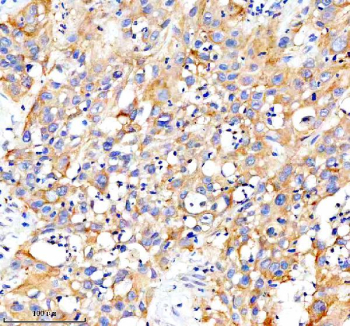
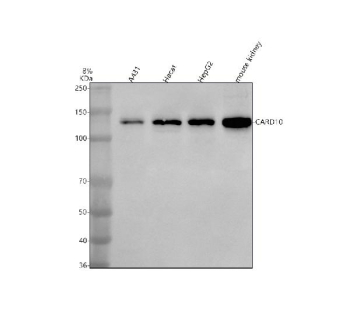
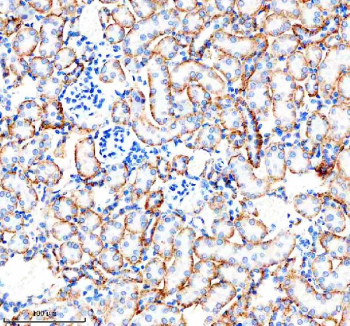
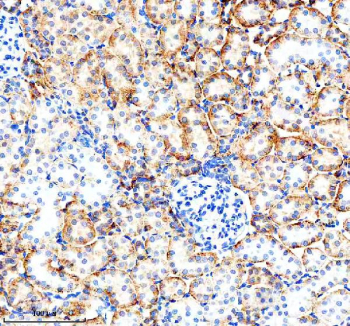
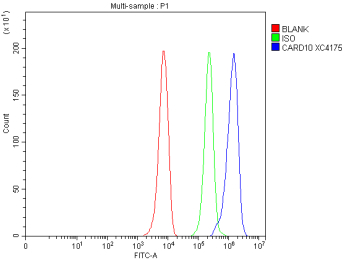
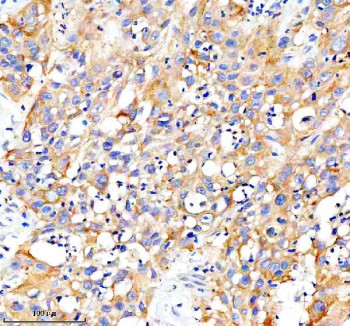
Adding 0.2 ml of distilled water will yield a concentration of 500 ug/ml. CARD10 antibody detects Caspase recruitment domain-containing protein 10, a cytoplasmic scaffold protein encoded by the CARD10 gene on chromosome 22q13.1. CARD10 is part of the membrane-associated guanylate kinase (MAGUK) family and functions as an adaptor linking G protein-coupled receptor (GPCR) and receptor tyrosine kinase signaling to NF-kappaB activation. It is expressed in epithelial cells, endothelial cells, and some immune tissues, where it mediates signal transduction leading to cell survival, cytokine production, and inflammation.CARD10 operates as a component of the CARD10-BCL10-MALT1 (CBM) signaling complex. Upon activation of upstream receptors such as GPCRs or EGFR, CARD10 recruits BCL10 and MALT1, initiating downstream IKK complex activation and NF-kappaB signaling. This pathway leads to transcription of genes involved in immune response, cell adhesion, and proliferation. Co-localization studies show CARD10 forming punctate cytoplasmic complexes at the plasma membrane following receptor stimulation.Structurally, CARD10 contains an N-terminal CARD domain that mediates homotypic interactions with other CARD-containing proteins, a coiled-coil domain for oligomerization, and a C-terminal MAGUK-like domain that anchors it to membranes. It belongs to the CARMA protein subfamily, which also includes CARD11 (CARMA1) and CARD14 (CARMA2), each mediating tissue-specific NF-kappaB activation. Known interaction partners include BCL10, MALT1, and IKKgamma, forming the CBM signalosome responsible for transcriptional activation of inflammatory genes.Functionally, CARD10 plays a central role in signal transduction from GPCRs to NF-kappaB and JNK pathways. It regulates cytokine production, apoptosis resistance, and epithelial barrier integrity. In epithelial cells, CARD10-mediated signaling contributes to immune surveillance and tissue remodeling, while in vascular endothelial cells, it supports cytokine-induced adhesion molecule expression. CARD10 also regulates responses to hormones, growth factors, and stress stimuli through activation of MAPK and PI3K pathways.Dysregulation of CARD10 signaling contributes to cancer, chronic inflammation, and cardiovascular diseases. Overexpression enhances NF-kappaB-dependent transcription, promoting tumor growth and resistance to apoptosis. Mutations or altered expression of CARD10 have been reported in colorectal, breast, and renal cancers. Pathway associations include NF-kappaB signaling, GPCR signaling, and innate immune regulation. Developmentally, CARD10 expression is detected in epithelial progenitors and contributes to tissue differentiation.The CARD10 antibody from NSJ Bioreagents is a powerful reagent for research on signal transduction, NF-kappaB activation, and inflammation-related diseases.
| Keywords: | Anti-CARD10, Anti-CARD-containing MAGUK protein 3, Anti-Caspase recruitment domain-containing protein 10, CARD10 Antibody / Caspase recruitment domain-containing protein 10 |
| Supplier: | NSJ Bioreagents |
| Supplier-Nr: | FY13360 |
Properties
| Application: | WB, IHC, FC, ELISA |
| Antibody Type: | Polyclonal |
| Conjugate: | No |
| Host: | Rabbit |
| Species reactivity: | human, mouse, rat |
| Immunogen: | E.coli-derived human CARD10 recombinant protein (Position: E63-R1014) |
| Format: | Purified |
Database Information
| KEGG ID : | K20912 | Matching products |
| UniProt ID : | Q9BWT7 | Matching products |
| Gene ID : | GeneID 29775 | Matching products |
Handling & Safety
| Storage: | +4°C |
| Shipping: | +4°C (International: +4°C) |
Caution
Our products are for laboratory research use only: Not for administration to humans!
Our products are for laboratory research use only: Not for administration to humans!
Information about the product reference will follow.
more
You will get a certificate here
Viewed