
Anti-C1QBP/HABP1 Monoclonal Antibody

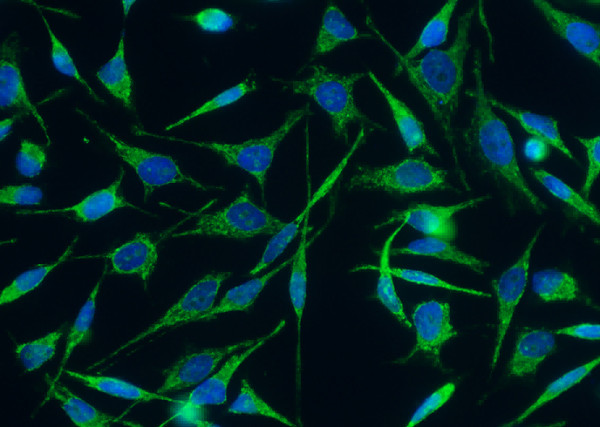
| Item number | Size | Datasheet | Manual | SDS | Delivery time | Quantity | Price |
|---|---|---|---|---|---|---|---|
| E-AN200044P.100 | 100 µl | - |
7 - 16 business days* |
389.00€
|
If you have any questions, please use our Contact Form.
You can also order by e-mail: info@biomol.com
Larger quantity required? Request bulk
You can also order by e-mail: info@biomol.com
Larger quantity required? Request bulk
The human complement subcomponent C1q associates with C1r and C1s in order to yield the first... more
Product information "Anti-C1QBP/HABP1 Monoclonal Antibody"
The human complement subcomponent C1q associates with C1r and C1s in order to yield the first component of the serum complement system. The protein encoded by this gene is known to bind to the globular heads of C1q molecules and inhibit C1 activation. This protein has also been identified as the p32 subunit of pre-mRNA splicing factor SF1, as well as a hyaluronic acid-binding protein. Protein function: Multifunctional and multicompartmental protein involved in inflammation and infection processes, ribosome biogenesis, protein synthesis in mitochondria, regulation of apoptosis, transcriptional regulation and pre-mRNA splicing (PubMed:10022843, PubMed:10479529, PubMed:10722602, PubMed:11086025, PubMed:11859136, PubMed:15243141, PubMed:16140380, PubMed:16177118, PubMed:17881511, PubMed:18676636, PubMed:19004836, PubMed:19164550, PubMed:20810993, PubMed:21536856, PubMed:21544310, PubMed:22700724, PubMed:28942965, PubMed:8662673, PubMed:8710908, PubMed:9461517). At the cell surface is thought to act as an endothelial receptor for plasma proteins of the complement and kallikrein-kinin cascades (PubMed:10479529, PubMed:11859136, PubMed:8662673, PubMed:8710908). Putative receptor for C1q, specifically binds to the globular 'heads' of C1q thus inhibiting C1, may perform the receptor function through a complex with C1qR/CD93 (PubMed:20810993, PubMed:8195709). In complex with cytokeratin-1/KRT1 is a high affinity receptor for kininogen-1/HMWK (PubMed:21544310). Can also bind other plasma proteins, such as coagulation factor XII leading to its autoactivation. May function to bind initially fluid kininogen-1 to the cell membrane. The secreted form may enhance both extrinsic and intrinsic coagulation pathways. It is postulated that the cell surface form requires docking with transmembrane proteins for downstream signaling which might be specific for a cell-type or response. By acting as C1q receptor is involved in chemotaxis of immature dendritic cells and neutrophils and is proposed to signal through CD209/DC-SIGN on immature dendritic cells, through integrin alpha-4/beta-1 during trophoblast invasion of the decidua, and through integrin beta-1 during endothelial cell adhesion and spreading (PubMed:16140380, PubMed:22700724, PubMed:9461517). Signaling involved in inhibition of innate immune response is implicating the PI3K-AKT/PKB pathway (PubMed:16177118). Required for protein synthesis in mitochondria (PubMed:28942965). In mitochondrial translation may be involved in formation of functional 55S mitoribosomes, the function seems to involve its RNA-binding activity. Acts as a RNA modification reader, which specifically recognizes and binds mitochondrial RNAs modified by C5-methylcytosine (m5C) in response to stress, and promotes recruitment of the mitochondrial degradosome complex, leading to their degradation (PubMed:39019044). May be involved in the nucleolar ribosome maturation process, the function may involve the exchange of FBL for RRP1 in the association with pre- ribosome particles. Involved in regulation of RNA splicing by inhibiting the RNA-binding capacity of SRSF1 and its phosphorylation (PubMed:10022843, PubMed:21536856). Is required for the nuclear translocation of splicing factor U2AF1L4. Involved in regulation of CDKN2A- and HRK-mediated apoptosis. Stabilizes mitochondrial CDKN2A isoform smARF (PubMed:17486078). May be involved in regulation of FOXC1 transcriptional activity and NFY/CCAAT- binding factor complex-mediated transcription (PubMed:15243141, PubMed:18676636). May play a role in antibacterial defense as it can bind to cell surface hyaluronan and inhibit Streptococcus pneumoniae hyaluronate lyase (PubMed:19004836). May be involved in modulation of the immune response, ligation by HCV core protein is resulting in suppression of interleukin-12 production in monocyte-derived dendritic cells (PubMed:11086025, PubMed:17881511). Involved in regulation of antiviral response by inhibiting RIGI- and IFIH1-mediated signaling pathways probably involving its association with MAVS after viral infection (PubMed:19164550). Acts as a regulator of DNA repair via homologous recombination by inhibiting the activity of MRE11: interacts with unphosphorylated MRE11 and RAD50 in absence of DNA damage, preventing formation and activity of the MRN complex. Following DNA damage, dissociates from phosphorylated MRE11, allowing formation of the MRN complex (PubMed:31353207). [The UniProt Consortium]
| Keywords: | p33, C1qBP, C1QBP, GC1QBP, SF2AP32, gC1q-R protein, Glycoprotein gC1qBP, Hyaluronan-binding protein 1, ASF/SF2-associated protein p32, Mitochondrial matrix protein p32, Complement component 1 Q subcomponent-binding protein, mitochondrial, C1QBP/HABP1 Mono |
| Supplier: | Elabscience |
| Supplier-Nr: | E-AN200044P |
Properties
| Application: | FCM, ICC/IF |
| Antibody Type: | Monoclonal |
| Clone: | 6H1 |
| Conjugate: | No |
| Host: | Mouse |
| Species reactivity: | human |
| Immunogen: | Recombinant Human C1QBP / HABP1 protein |
| Format: | Purified |
Database Information
| KEGG ID : | K15414 | Matching products |
| UniProt ID : | Q07021 | Matching products |
| Gene ID : | GeneID 708 | Matching products |
Handling & Safety
| Storage: | +4°C (avoid repeat freezing and thawing cycles) |
| Shipping: | +4°C (International: +4°C) |
| Signal Word: | Warning |
| GHS Hazard Pictograms: |

|
| H Phrases: | H317 |
| P Phrases: | P261, P272, P280, P302+352, P333+313 |
Caution
Our products are for laboratory research use only: Not for administration to humans!
Our products are for laboratory research use only: Not for administration to humans!
Information about the product reference will follow.
more
You will get a certificate here
Viewed