
Cookie preferences
This website uses cookies, which are necessary for the technical operation of the website and are always set. Other cookies, which increase the comfort when using this website, are used for direct advertising or to facilitate interaction with other websites and social networks, are only set with your consent.
Configuration
Technically required
These cookies are necessary for the basic functions of the shop.
"Allow all cookies" cookie
"Decline all cookies" cookie
CSRF token
Cookie preferences
Currency change
Customer-specific caching
FACT-Finder tracking
Individual prices
Selected shop
Session
Comfort functions
These cookies are used to make the shopping experience even more appealing, for example for the recognition of the visitor.
Note
Show the facebook fanpage in the right blod sidebar
Statistics & Tracking
Affiliate program
Conversion and usertracking via Google Tag Manager
Track device being used



| Item number | Size | Datasheet | Manual | SDS | Delivery time | Quantity | Price |
|---|---|---|---|---|---|---|---|
| NSJ-FY12906 | 100 µg | - | - |
3 - 10 business days* |
790.00€
|
If you have any questions, please use our Contact Form.
You can also order by e-mail: info@biomol.com
Larger quantity required? Request bulk
You can also order by e-mail: info@biomol.com
Larger quantity required? Request bulk
Adding 0.2 ml of distilled water will yield a concentration of 500 ug/ml. C1 Inhibitor (C1-INH)... more
Product information "Anti-C1 Inhibitor (C1-INH) / SERPING1"
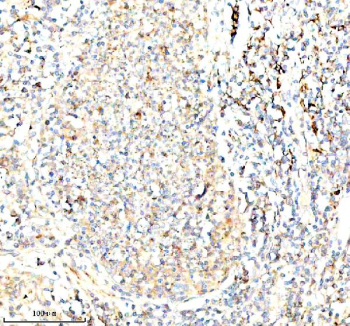
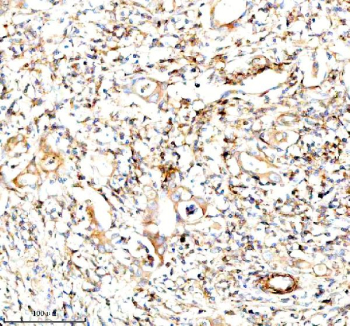
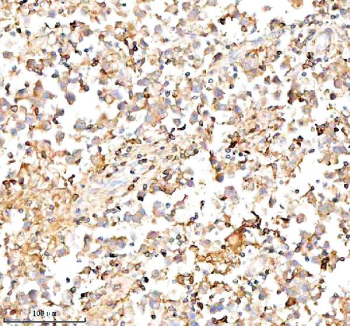
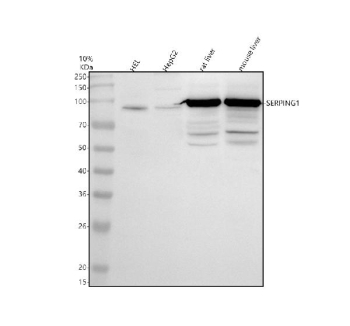
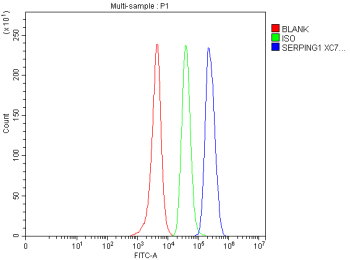
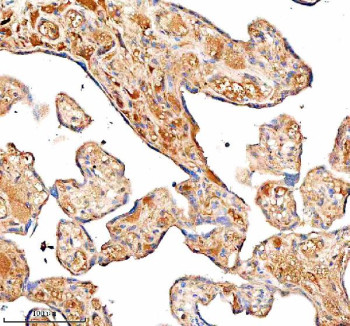
Adding 0.2 ml of distilled water will yield a concentration of 500 ug/ml. C1 Inhibitor (C1-INH) Antibody recognizes a secreted serine protease inhibitor encoded by the SERPING1 gene, which is essential for controlling complement activation and vascular permeability. Although the predicted molecular weight is ~55 kDa, the mature glycoprotein migrates near 100-105 kDa due to extensive N-linked glycosylation. C1 Inhibitor, also known as C1 esterase inhibitor or plasma protease C1 inhibitor, is synthesized mainly by hepatocytes and secreted into the plasma where it inactivates the complement proteases C1r and C1s. This regulation prevents uncontrolled complement activation and protects tissues from inflammatory damage. The protein is part of the serpin superfamily and contributes to immune, vascular, and coagulation homeostasis through its inhibition of multiple serine proteases.The C1 Inhibitor (C1-INH) Antibody detects a multifunctional protein that serves as a critical regulator of both the complement and contact systems. By inhibiting kallikrein and factor XIIa, C1 inhibitor controls bradykinin release, preventing excessive vasodilation and edema formation. Genetic or acquired deficiency of SERPING1 leads to hereditary angioedema (HAE), an autosomal dominant disorder characterized by recurrent subcutaneous and submucosal swelling episodes. In these patients, reduced or dysfunctional C1 inhibitor fails to block complement activation and bradykinin formation, causing fluid extravasation and tissue swelling. The proteinâ?(TM)s physiological importance extends beyond the complement system, influencing inflammation, coagulation, and endothelial permeability.C1 inhibitor belongs to the serpin family of irreversible protease inhibitors, sharing structural similarities with alpha-1 antitrypsin and antithrombin III. It contains a conserved serpin domain with a reactive center loop that inserts into its own beta-sheet following protease binding, trapping and inactivating the enzyme. This mechanism results in the formation of stable covalent complexes visible as higher molecular weight species on western blot. The proteinâ?(TM)s extensive glycosylation accounts for its diffuse migration and apparent mass variation between 90 and 105 kDa. Treatment with PNGase F collapses the heterogeneity, confirming glycan modification as the major cause of the migration shift. The protein is synthesized in the endoplasmic reticulum and Golgi before secretion and functions primarily in extracellular plasma compartments.C1 inhibitor expression is highest in the liver but also found in endothelial cells, monocytes, macrophages, and astrocytes. Local expression in the vascular endothelium contributes to regulation of complement and bradykinin signaling at inflammation sites. During acute-phase responses, hepatic production of the protein increases in response to cytokines such as interleukin-6 and tumor necrosis factor alpha. Elevated plasma levels are observed in infection and trauma, whereas deficiency enhances susceptibility to vascular leakage and complement-driven pathology. Studies using C1 Inhibitor (C1-INH) Antibody have revealed the protein's participation in protecting the blood-brain barrier and moderating neuroinflammatory processes in the central nervous system.The SERPING1 gene is located on chromosome 11q12.1 and encodes a single-chain glycoprotein of 478 amino acids containing multiple N-glycosylation sites. Over 200 disease-associated variants have been identified, many disrupting protein folding or secretion and leading to reduced plasma concentrations or inactive molecules. C1 inhibitor deficiency types I and II are classified by whether the mutation decreases quantity or function. The proteinâ?(TM)s interaction network includes C1r, C1s, kallikrein, and factor XIIa, and it can also form complexes with high-molecular-weight kininogen. These interactions place it at the intersection of complement activation, coagulation, and fibrinolysis pathways.In western blot analysis, the C1 Inhibitor (C1-INH) Antibody detects a dominant band around 100 kDa corresponding to the mature glycosylated form, along with weaker lower bands between 70 and 90 kDa representing partially glycosylated or cleaved intermediates. Higher molecular weight complexes may also appear due to SDS-stable binding with target proteases. The antibody provides robust recognition of both plasma and intracellular forms of the protein, making it suitable for studies on complement regulation, endothelial barrier integrity, and hereditary angioedema mechanisms. It is validated for use in relevant research applications focused on complement biology, vascular inflammation, and serpin protein function.C1 inhibitor plays a critical role in multiple biological pathways including the classical complement cascade, the kallikrein-kinin system, and the regulation of vascular permeability. By inactivating several proteolytic enzymes, it maintains immune balance and prevents spontaneous inflammatory activation. Dysregulation of this protein has been linked to autoimmune diseases, vascular leakage syndromes, and neuroinflammatory disorders. The C1 Inhibitor (C1-INH) Antibody enables reliable detection of endogenous or recombinant SERPING1 protein across tissues and species and is an effective tool for assessing serpin-mediated immune regulation. This reagent is manufactured and quality-tested by NSJ Bioreagents for use in relevant research applications.
| Keywords: | Anti-SERPING1, Anti-Serpin G1, Anti-C1-inhibiting factor, Anti-C1 esterase inhibitor, Anti-Plasma protease C1 inhibitor, C1 Inhibitor (C1-INH) Antibody / SERPING1 |
| Supplier: | NSJ Bioreagents |
| Supplier-Nr: | FY12906 |
Properties
| Application: | WB, FC, ELISA |
| Antibody Type: | Polyclonal |
| Conjugate: | No |
| Host: | Rabbit |
| Species reactivity: | human, mouse, rat |
| Immunogen: | E.coli-derived human SERPING1 recombinant protein (Position: S131-A500) |
| Format: | Purified |
Database Information
| KEGG ID : | K04001 | Matching products |
| UniProt ID : | P05155 | Matching products |
| Gene ID : | GeneID 710 | Matching products |
Handling & Safety
| Storage: | +4°C |
| Shipping: | +4°C (International: +4°C) |
Caution
Our products are for laboratory research use only: Not for administration to humans!
Our products are for laboratory research use only: Not for administration to humans!
Information about the product reference will follow.
more
You will get a certificate here
Viewed