
Cookie preferences
This website uses cookies, which are necessary for the technical operation of the website and are always set. Other cookies, which increase the comfort when using this website, are used for direct advertising or to facilitate interaction with other websites and social networks, are only set with your consent.
Configuration
Technically required
These cookies are necessary for the basic functions of the shop.
"Allow all cookies" cookie
"Decline all cookies" cookie
CSRF token
Cookie preferences
Currency change
Customer-specific caching
FACT-Finder tracking
Individual prices
Selected shop
Session
Comfort functions
These cookies are used to make the shopping experience even more appealing, for example for the recognition of the visitor.
Note
Show the facebook fanpage in the right blod sidebar
Statistics & Tracking
Affiliate program
Conversion and usertracking via Google Tag Manager
Track device being used



| Item number | Size | Datasheet | Manual | SDS | Delivery time | Quantity | Price |
|---|---|---|---|---|---|---|---|
| NSJ-FY13461 | 100 µg | - | - |
3 - 10 business days* |
790.00€
|
If you have any questions, please use our Contact Form.
You can also order by e-mail: info@biomol.com
Larger quantity required? Request bulk
You can also order by e-mail: info@biomol.com
Larger quantity required? Request bulk
Mouse ascites fluid, 1.2% sodium acetate, 2mg BSA, with 0.01mg NaN3 as preservative.. c-Myc... more
Product information "Anti-c-Myc, clone 90000000000"
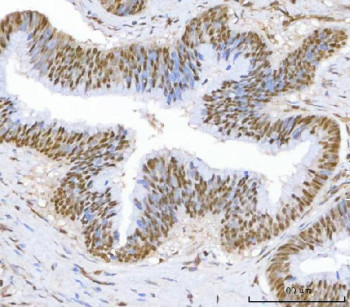
Mouse ascites fluid, 1.2% sodium acetate, 2mg BSA, with 0.01mg NaN3 as preservative.. c-Myc Antibody targets c-Myc, also known as MYC, a nuclear transcription factor encoded by the MYC gene that functions as a central regulator of cellular growth, metabolism, and proliferation. c-Myc is a member of the Myc family of basic helix-loop-helix leucine zipper proteins and is widely recognized for its ability to coordinate large-scale gene expression programs. Through this regulatory capacity, c-Myc integrates extracellular growth signals with intracellular metabolic and biosynthetic demands.Functionally, c-Myc exerts its effects on gene expression by forming heterodimers with the MAX protein. The c-Myc-MAX complex binds to specific DNA motifs within promoters and enhancers of target genes, influencing transcriptional output across diverse biological pathways. These targets include genes involved in ribosome biogenesis, nucleotide synthesis, mitochondrial activity, and cell cycle progression. A c-Myc Antibody enables investigation of MYC-driven transcriptional regulation and growth-associated gene networks in research studies.Expression of c-Myc is tightly regulated and highly responsive to mitogenic stimuli. In quiescent cells, MYC expression is generally low, while growth factor signaling induces rapid transcriptional activation and protein accumulation. At the subcellular level, c-Myc localizes predominantly to the nucleus, where it associates with chromatin and transcriptional machinery. Its short protein half-life allows cells to fine-tune MYC activity in response to changing environmental and metabolic conditions.At the molecular level, c-Myc contains a conserved C-terminal DNA-binding and dimerization domain responsible for interaction with MAX, along with N-terminal regulatory regions that modulate transcriptional activation and protein stability. These regulatory regions interact with cofactors and chromatin-associated proteins, enabling c-Myc to influence both gene activation and repression depending on cellular context. Post-translational modifications further regulate MYC stability and activity, contributing to precise control of its biological effects.From a biological and disease relevance perspective, dysregulation of MYC is a hallmark of many cancers. Sustained MYC activation can drive uncontrolled cell proliferation, metabolic reprogramming, and altered differentiation states. Amplification, overexpression, or deregulated signaling upstream of MYC has been observed across a wide range of tumor types, making c-Myc a focal point of cancer biology research. As a result, MYC expression is frequently examined as an indicator of proliferative signaling and oncogenic transcriptional activity.c-Myc Antibody reagents are valuable tools for studying transcription factor biology, growth control mechanisms, and MYC-associated signaling pathways. These antibodies support research into gene expression regulation, cellular metabolism, and disease-associated alterations in transcriptional programs. NSJ Bioreagents provides c-Myc Antibody products intended for research use.
| Keywords: | Anti-MYC, Anti-Proto-oncogene c-Myc, Anti-Transcription factor p64, Anti-Myc proto-oncogene protein, Anti-Class E basic helix-loop-helix protein 39, c-Myc Antibody |
| Supplier: | NSJ Bioreagents |
| Supplier-Nr: | FY13461 |
Properties
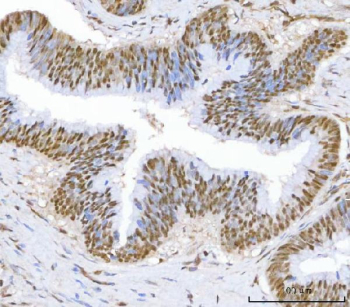
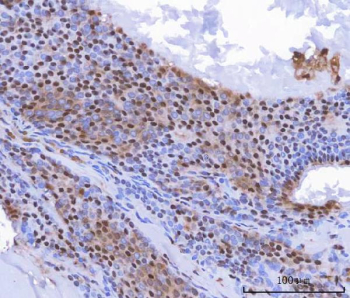
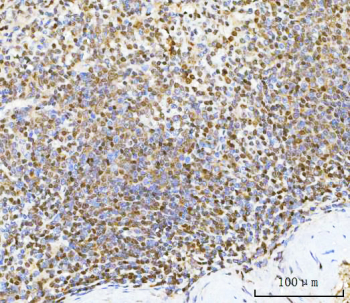
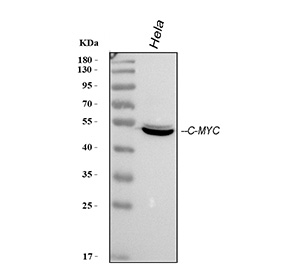
| Application: | IHC (paraffin), WB |
| Antibody Type: | Monoclonal |
| Clone: | 90000000000 |
| Conjugate: | No |
| Host: | Mouse |
| Species reactivity: | human |
| Immunogen: | Synthetic peptide corresponding to residues 408-439 of the human p62c-Myc protein |
| Format: | Purified |
Database Information
| KEGG ID : | K04377 | Matching products |
| UniProt ID : | P01106 | Matching products |
| Gene ID : | GeneID 4609 | Matching products |
Handling & Safety
| Storage: | +4°C |
| Shipping: | +4°C (International: +4°C) |
Caution
Our products are for laboratory research use only: Not for administration to humans!
Our products are for laboratory research use only: Not for administration to humans!
Information about the product reference will follow.
more
You will get a certificate here
Viewed