
Cookie preferences
This website uses cookies, which are necessary for the technical operation of the website and are always set. Other cookies, which increase the comfort when using this website, are used for direct advertising or to facilitate interaction with other websites and social networks, are only set with your consent.
Configuration
Technically required
These cookies are necessary for the basic functions of the shop.
"Allow all cookies" cookie
"Decline all cookies" cookie
CSRF token
Cookie preferences
Currency change
Customer-specific caching
FACT-Finder tracking
Individual prices
Selected shop
Session
Comfort functions
These cookies are used to make the shopping experience even more appealing, for example for the recognition of the visitor.
Note
Show the facebook fanpage in the right blod sidebar
Statistics & Tracking
Affiliate program
Conversion and usertracking via Google Tag Manager
Track device being used

| Item number | Size | Datasheet | Manual | SDS | Delivery time | Quantity | Price |
|---|---|---|---|---|---|---|---|
| NSJ-FY13026 | 100 µg | - | - |
3 - 10 business days* |
790.00€
|
If you have any questions, please use our Contact Form.
You can also order by e-mail: info@biomol.com
Larger quantity required? Request bulk
You can also order by e-mail: info@biomol.com
Larger quantity required? Request bulk
Adding 0.2 ml of distilled water will yield a concentration of 500 ug/ml. BCHE antibody detects... more
Product information "Anti-BCHE / Butyrylcholinesterase"
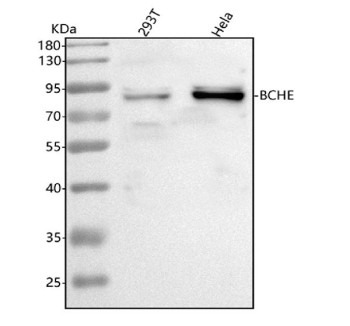
Adding 0.2 ml of distilled water will yield a concentration of 500 ug/ml. BCHE antibody detects Butyrylcholinesterase, a serine hydrolase that catalyzes the hydrolysis of esters of choline, contributing to neurotransmitter metabolism and detoxification of xenobiotics. The UniProt recommended name is Butyrylcholinesterase (BCHE). This enzyme is found predominantly in plasma, liver, and nervous tissue and acts as a metabolic complement to acetylcholinesterase in cholinergic regulation.Functionally, BCHE antibody identifies a 602-amino-acid glycoprotein secreted as a tetrameric enzyme that hydrolyzes choline esters such as butyrylcholine and succinylcholine. BCHE regulates cholinergic neurotransmission indirectly by hydrolyzing circulating esters and serves as a bioscavenger for organophosphorus compounds and nerve agents. It also participates in drug metabolism by inactivating esterified anesthetics and muscle relaxants.The BCHE gene is located on chromosome 3q26.1-q26.2 and encodes a protein synthesized mainly in the liver before secretion into plasma. BCHE shares structural homology with acetylcholinesterase but differs in substrate specificity and inhibitor sensitivity. Its activity is regulated by genetic polymorphisms that influence catalytic efficiency and drug sensitivity. Reduced BCHE activity causes prolonged neuromuscular blockade following exposure to succinylcholine or mivacurium, a clinically relevant pharmacogenetic condition.Beyond neurotransmission, BCHE plays roles in lipid metabolism, inflammation, and neurodegenerative diseases. Elevated BCHE activity is associated with obesity and metabolic syndrome, while decreased activity has been observed in liver dysfunction, Alzheimer's disease, and chronic inflammation. Its ability to hydrolyze ghrelin and other acylated hormones links it to appetite regulation and energy balance. In neurobiology, BCHE is thought to modulate cholinergic tone during aging and cognitive decline.BCHE antibody is widely used in neurobiology, pharmacology, and metabolic disease research. It is suitable for western blotting, ELISA, and enzyme histochemistry to detect BCHE in plasma, liver, or neural tissue. This antibody supports studies of cholinesterase activity, drug metabolism, and neurodegenerative mechanisms. In toxicology, BCHE detection helps evaluate exposure to organophosphate inhibitors and nerve agents.Structurally, BCHE is a glycoprotein composed of four identical subunits stabilized by disulfide bonds and carbohydrate moieties. Its catalytic triad (Ser-His-Glu) mediates ester hydrolysis through a charge-relay mechanism. NSJ Bioreagents provides BCHE antibody reagents validated for use in neurotransmission, toxicology, and enzyme metabolism research.
| Keywords: | Anti-BCHE, Anti-Cholinesterase, Anti-Choline esterase II, Anti-Pseudocholinesterase, Anti-Butyrylcholine esterase, Anti-Acylcholine acylhydrolase, BCHE Antibody / Butyrylcholinesterase |
| Supplier: | NSJ Bioreagents |
| Supplier-Nr: | FY13026 |
Properties
| Application: | WB, ELISA |
| Antibody Type: | Polyclonal |
| Conjugate: | No |
| Host: | Rabbit |
| Species reactivity: | human |
| Immunogen: | E.coli-derived human BCHE recombinant protein (Position: E29-L602) |
| Format: | Purified |
Database Information
| KEGG ID : | K01050 | Matching products |
| UniProt ID : | P06276 | Matching products |
| Gene ID : | GeneID 590 | Matching products |
Handling & Safety
| Storage: | +4°C |
| Shipping: | +4°C (International: +4°C) |
Caution
Our products are for laboratory research use only: Not for administration to humans!
Our products are for laboratory research use only: Not for administration to humans!
Information about the product reference will follow.
more
You will get a certificate here
Viewed