
Cookie preferences
This website uses cookies, which are necessary for the technical operation of the website and are always set. Other cookies, which increase the comfort when using this website, are used for direct advertising or to facilitate interaction with other websites and social networks, are only set with your consent.
Configuration
Technically required
These cookies are necessary for the basic functions of the shop.
"Allow all cookies" cookie
"Decline all cookies" cookie
CSRF token
Cookie preferences
Currency change
Customer-specific caching
FACT-Finder tracking
Individual prices
Selected shop
Session
Comfort functions
These cookies are used to make the shopping experience even more appealing, for example for the recognition of the visitor.
Note
Show the facebook fanpage in the right blod sidebar
Statistics & Tracking
Affiliate program
Conversion and usertracking via Google Tag Manager
Track device being used


| Item number | Size | Datasheet | Manual | SDS | Delivery time | Quantity | Price |
|---|---|---|---|---|---|---|---|
| NSJ-FY13327 | 100 µg | - | - |
7 - 12 business days* |
790.00€
|
If you have any questions, please use our Contact Form.
You can also order by e-mail: info@biomol.com
Larger quantity required? Request bulk
You can also order by e-mail: info@biomol.com
Larger quantity required? Request bulk
Adding 0.2 ml of distilled water will yield a concentration of 500 ug/ml. BAD antibody detects... more
Product information "Anti-BAD / Bcl2-associated agonist of cell death"
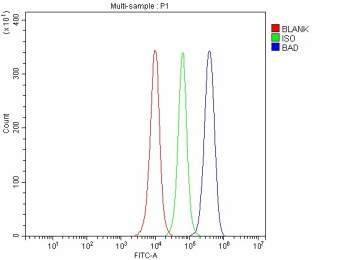
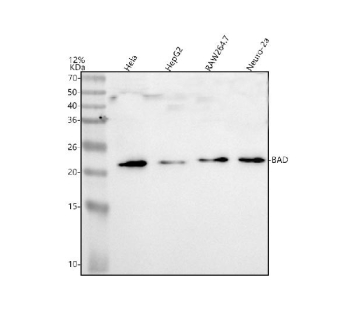
Adding 0.2 ml of distilled water will yield a concentration of 500 ug/ml. BAD antibody detects Bcl2-associated agonist of cell death, a pro-apoptotic member of the BCL2 protein family encoded by the BAD gene on chromosome 11q13.1. BAD is a cytoplasmic and mitochondrial-associated protein that regulates apoptosis by controlling mitochondrial outer membrane permeability. It is highly expressed in lymphoid tissues, liver, heart, and neurons, where it serves as a pivotal switch between cell survival and programmed cell death. BAD promotes apoptosis by binding to anti-apoptotic proteins BCL2 and BCL-XL, thereby freeing pro-apoptotic effectors such as BAX and BAK to induce cytochrome c release and caspase activation.Under normal growth conditions, BAD remains phosphorylated and inactive, sequestered in the cytosol through association with 14-3-3 scaffold proteins. Upon cellular stress or growth factor deprivation, BAD becomes dephosphorylated by phosphatases such as PP2A, leading to its translocation to mitochondria and initiation of apoptosis. Functionally, BAD integrates signals from multiple pathways, including PI3K-AKT, MAPK, and cAMP-PKA, which regulate its phosphorylation state and apoptotic potential. Thus, BAD acts as a key convergence point for survival and death signals in diverse cell types.Structurally, BAD contains BH3 (Bcl2 homology 3) domains essential for heterodimerization with other BCL2 family proteins. This domain mediates selective binding that determines the balance between apoptosis inhibition and activation. Post-translational modifications such as phosphorylation at serine residues (Ser112, Ser136, and Ser155) and dephosphorylation events fine-tune BAD activity in response to extracellular cues. The protein localizes to mitochondria during apoptosis induction, where it promotes permeabilization of the mitochondrial outer membrane and triggers the intrinsic apoptotic cascade.Dysregulation of BAD expression or phosphorylation contributes to cancer, neurodegenerative diseases, and ischemic injury. Overactivation of BAD leads to neuronal loss in neurodegenerative conditions, while reduced activity supports tumor cell survival and resistance to therapy. In cancer research, BAD phosphorylation status serves as a marker for apoptosis sensitivity and therapeutic response. BAD also plays a metabolic role in glucose homeostasis, influencing insulin secretion and mitochondrial respiration in pancreatic beta cells.BAD is a member of the BCL2 protein family, which governs mitochondrial apoptotic pathways by regulating membrane permeability and caspase activation. Pathway associations include the intrinsic apoptosis pathway and PI3K-AKT signaling, which modulate BAD phosphorylation and cellular survival. The protein's regulatory versatility makes it an important target in oncology, neurology, and metabolic research.Immunohistochemical staining using BAD antibody reveals cytoplasmic and mitochondrial localization in apoptotic cells. The BAD antibody from NSJ Bioreagents is a reliable tool for studying apoptosis regulation, mitochondrial signaling, and stress-induced cell death mechanisms.
| Keywords: | Anti-BAD, Anti-Bcl-2-like protein 8, Anti-Bcl-2-binding component 6, Anti-Bcl2 antagonist of cell death, Anti-Bcl2-associated agonist of cell death, Anti-Bcl-xL/Bcl-2-associated death promoter, BAD Antibody / Bcl2-associated agonist of cell death |
| Supplier: | NSJ Bioreagents |
| Supplier-Nr: | FY13327 |
Properties
| Application: | WB |
| Antibody Type: | Polyclonal |
| Conjugate: | No |
| Host: | Rabbit |
| Species reactivity: | human, mouse |
| Immunogen: | A synthetic peptide corresponding to a sequence in the middle region of human BAD |
| Format: | Purified |
Database Information
| KEGG ID : | K02158 | Matching products |
| UniProt ID : | Q92934 | Matching products |
| Gene ID : | GeneID 572 | Matching products |
Handling & Safety
| Storage: | +4°C |
| Shipping: | +4°C (International: +4°C) |
Caution
Our products are for laboratory research use only: Not for administration to humans!
Our products are for laboratory research use only: Not for administration to humans!
Information about the product reference will follow.
more
You will get a certificate here
Viewed