
Cookie preferences
This website uses cookies, which are necessary for the technical operation of the website and are always set. Other cookies, which increase the comfort when using this website, are used for direct advertising or to facilitate interaction with other websites and social networks, are only set with your consent.
Configuration
Technically required
These cookies are necessary for the basic functions of the shop.
"Allow all cookies" cookie
"Decline all cookies" cookie
CSRF token
Cookie preferences
Currency change
Customer-specific caching
FACT-Finder tracking
Individual prices
Selected shop
Session
Comfort functions
These cookies are used to make the shopping experience even more appealing, for example for the recognition of the visitor.
Note
Show the facebook fanpage in the right blod sidebar
Statistics & Tracking
Affiliate program
Conversion and usertracking via Google Tag Manager
Track device being used


| Item number | Size | Datasheet | Manual | SDS | Delivery time | Quantity | Price |
|---|---|---|---|---|---|---|---|
| NSJ-FY12679 | 100 µg | - | - |
7 - 12 business days* |
790.00€
|
If you have any questions, please use our Contact Form.
You can also order by e-mail: info@biomol.com
Larger quantity required? Request bulk
You can also order by e-mail: info@biomol.com
Larger quantity required? Request bulk
Adding 0.2 ml of distilled water will yield a concentration of 500 ug/ml. ATP6V1B2 antibody... more
Product information "Anti-ATP6V1B2 / ATPase H+ transporting V1 subunit B2"
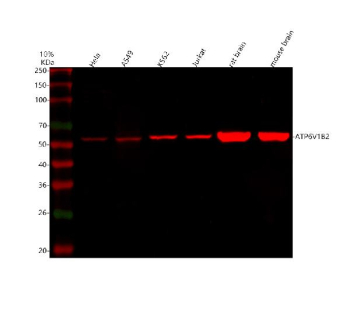
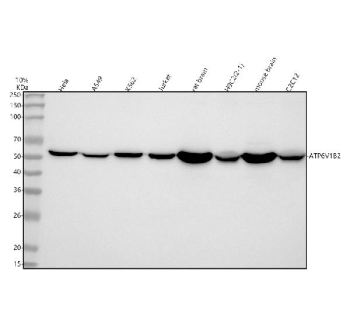
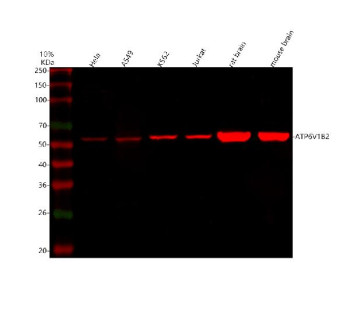
Adding 0.2 ml of distilled water will yield a concentration of 500 ug/ml. ATP6V1B2 antibody recognizes ATPase H+ transporting V1 subunit B2, a catalytic subunit of the vacuolar ATPase (V-ATPase) complex that mediates proton translocation across intracellular membranes. V-ATPases are multi-subunit enzymes responsible for acidifying organelles such as endosomes, lysosomes, the Golgi apparatus, and synaptic vesicles, thereby regulating protein sorting, receptor recycling, and neurotransmitter loading. The B2 subunit encoded by the ATP6V1B2 gene provides ATP-hydrolytic activity within the V1 sector of the complex, coupling energy derived from ATP hydrolysis to proton pumping through the V0 membrane domain. This process maintains intracellular pH homeostasis, a prerequisite for vesicular trafficking, autophagy, and enzymatic activity within acidic compartments.ATP6V1B2 is highly expressed in neural tissues, particularly in neurons where acidification of synaptic vesicles supports neurotransmitter storage and release. The protein localizes to the cytoplasmic side of vesicular membranes and interacts with other V1 subunits including A, D, and E to form the catalytic hexameric headpiece. Genetic studies have linked mutations in ATP6V1B2 to dominant deafness-onychodystrophy syndrome, characterized by hearing loss and nail dysplasia, and to developmental disorders with epilepsy, underscoring its physiological importance in neural and epithelial systems. By sustaining organelle acidification, ATP6V1B2 ensures correct maturation of lysosomal enzymes and degradation of endocytosed material, influencing neuronal viability and metabolic turnover.The ATP6V1B2 antibody is used in neuroscience, cell biology, and pathology research to examine the localization and function of V-ATPase complexes. Immunofluorescence and immunohistochemistry reveal strong punctate staining in synaptic regions, consistent with the protein's vesicular distribution. In biochemical assays, western blot detection with this antibody confirms the ~56 kilodalton B2 subunit and can distinguish it from the related B1 isoform (ATP6V1B1) found mainly in kidney and inner ear epithelia. Because of its neural enrichment, ATP6V1B2 serves as a marker for vesicle acidification and proton pump activity in brain tissue and cultured neurons.Research indicates that ATP6V1B2 also participates in cellular signaling and autophagy. V-ATPase activity influences mTORC1 localization and nutrient-sensing pathways by regulating lysosomal pH. Deficiency of ATP6V1B2 disrupts these mechanisms, impairing cell growth and autophagic flux. The antibody thus enables studies investigating the intersection of metabolism, membrane transport, and neurodegenerative disease. Alterations in V-ATPase function have been observed in Alzheimer's and Parkinson's disease models, making ATP6V1B2 a potential biomarker for vesicular dysfunction. NSJ Bioreagents provides this antibody validated for high specificity and compatibility with multiple applications, supporting research into acidification dynamics and organelle physiology.
| Keywords: | Anti-HO57, Anti-ATP6V1B2, Anti-Vacuolar proton pump subunit B 2, Anti-Endomembrane proton pump 58 kDa subunit, Anti-V-type proton ATPase subunit B, brain isoform, ATP6V1B2 Antibody / ATPase H+ transporting V1 subunit B2 |
| Supplier: | NSJ Bioreagents |
| Supplier-Nr: | FY12679 |
Properties
| Application: | WB |
| Antibody Type: | Polyclonal |
| Conjugate: | No |
| Host: | Rabbit |
| Species reactivity: | human, mouse, rat |
| Immunogen: | A synthetic peptide corresponding to a sequence at the C-terminus of human ATP6V1B2 |
| Format: | Purified |
Database Information
| KEGG ID : | K02147 | Matching products |
| UniProt ID : | P21281 | Matching products |
| Gene ID : | GeneID 526 | Matching products |
Handling & Safety
| Storage: | +4°C |
| Shipping: | +4°C (International: +4°C) |
Caution
Our products are for laboratory research use only: Not for administration to humans!
Our products are for laboratory research use only: Not for administration to humans!
Information about the product reference will follow.
more
You will get a certificate here
Viewed