
Cookie preferences
This website uses cookies, which are necessary for the technical operation of the website and are always set. Other cookies, which increase the comfort when using this website, are used for direct advertising or to facilitate interaction with other websites and social networks, are only set with your consent.
Configuration
Technically required
These cookies are necessary for the basic functions of the shop.
"Allow all cookies" cookie
"Decline all cookies" cookie
CSRF token
Cookie preferences
Currency change
Customer-specific caching
FACT-Finder tracking
Individual prices
Selected shop
Session
Comfort functions
These cookies are used to make the shopping experience even more appealing, for example for the recognition of the visitor.
Note
Show the facebook fanpage in the right blod sidebar
Statistics & Tracking
Affiliate program
Conversion and usertracking via Google Tag Manager
Track device being used

NEW
| Item number | Size | Datasheet | Manual | SDS | Delivery time | Quantity | Price |
|---|---|---|---|---|---|---|---|
| ABS-KC-19080.50 | 50 µl | - | - |
10 - 14 business days* |
206.00€
|
||
| ABS-KC-19080.100 | 100 µl | - | - |
10 - 14 business days* |
295.00€
|
If you have any questions, please use our Contact Form.
You can also order by e-mail: info@biomol.com
Larger quantity required? Request bulk
You can also order by e-mail: info@biomol.com
Larger quantity required? Request bulk
Formulation: Phosphate-buffered saline (PBS) with 50% glycerol, 0.5% BSA and 0.09% sodium azide.... more
Product information "Anti-ATG4A"
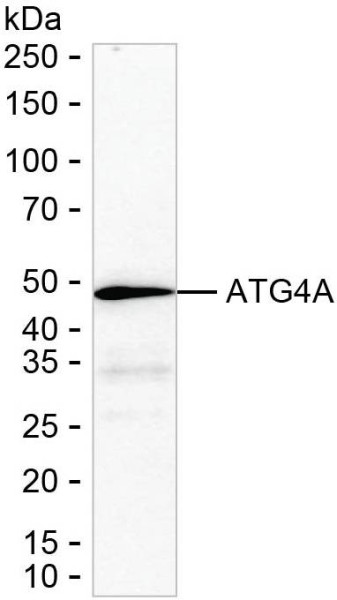
Formulation: Phosphate-buffered saline (PBS) with 50% glycerol, 0.5% BSA and 0.09% sodium azide. Identity-Mouse (%): 92%. Homologies: Highest antigen sequence identity to the following orthologs: Mouse - 92%, Rat - 59%, Pig - 93%, Cynomolgus monkey - 99%. IHC Verification: -. WB Verification: succeed. IP Verification: -. IF Verification: -. FC Verification: -. IP-MS Verification: -. Cross reactivity: Not tested. Sandwich ELISA Verification: -. Antigen ID: ABS-P02387PAD. Core Sequence: EYPDTDELVW ILGKQHLLKT EKSKLLSDIS ARLWFTYRRK FSPIGGTGPS SDAGWGCMLR CGQMMLAQAL ICRHLGRDWS WEKQKEQPKE YQRILQCFLD RKDCCYSIHQ MAQMGVGEGK SIGEWFGPNT VAQVLKKLAL FDEWNSLAVY VSMDNTVVIE DIKKMCRVLP LSADTAGDRP PDSLTASNQS KGTSAYCSAW KPLLLIVPLR LGINQINPVY VDAFKECFKM PQSLGALGGK PNNAYYFIGF LGDELIFLDP HTTQTFVDTE. Recombinant Antibody: Protein Function: Cysteine protease that plays a key role in autophagy by mediating both proteolytic activation and delipidation of ATG8 family proteins (PubMed:12473658, PubMed:15169837, PubMed:17347651, PubMed:21177865, PubMed:21245471, PubMed:22302004, PubMed:32732290). The protease activity is required for proteolytic activation of ATG8 family proteins: cleaves the C-terminal amino acid of ATG8 proteins to reveal a C-terminal glycine (PubMed:12473658, PubMed:15169837, PubMed:17347651, PubMed:21177865, PubMed:21245471, PubMed:22302004). Exposure of the glycine at the C-terminus is essential for ATG8 proteins conjugation to phosphatidylethanolamine (PE) and insertion to membranes, which is necessary for autophagy (PubMed:12473658, PubMed:15169837, PubMed:17347651, PubMed:21177865, PubMed:21245471, PubMed:22302004). Preferred substrate is GABARAPL2 followed by MAP1LC3A and GABARAP (PubMed:12473658, PubMed:15169837, PubMed:17347651, PubMed:21177865, PubMed:21245471, PubMed:22302004). Protease activity is also required to counteract formation of high-molecular weight conjugates of ATG8 proteins (ATG8ylation): acts as a deubiquitinating-like enzyme that removes ATG8 conjugated to other proteins, such as ATG3 (PubMed:31315929, PubMed:33773106). In addition to the protease activity, also mediates delipidation of ATG8 family proteins (PubMed:29458288, PubMed:33909989). Catalyzes delipidation of PE-conjugated forms of ATG8 proteins during macroautophagy (PubMed:29458288, PubMed:33909989). Compared to ATG4B, the major protein for proteolytic activation of ATG8 proteins, shows weaker ability to cleave the C-terminal amino acid of ATG8 proteins, while it displays stronger delipidation activity (PubMed:29458288). Involved in phagophore growth during mitophagy independently of its protease activity and of ATG8 proteins: acts by regulating ATG9A trafficking to mitochondria and promoting phagophore-endoplasmic reticulum contacts during the lipid transfer phase of mitophagy (PubMed:33773106) [The Uniprot Consortium]
| Keywords: | Anti-ATG4A, Anti-Cysteine protease ATG4A, Anti-AUT-like 2 cysteine endopeptidase, Anti-Autophagy-related protein 4 homolog A, Anti-Autophagy-related cysteine endopeptidase 2, ATG4A Antibody |
| Supplier: | Absea |
| Supplier-Nr: | KC-19080 |
Properties
| Application: | WB |
| Antibody Type: | Monoclonal |
| Clone: | K16301_4H11 |
| Conjugate: | No |
| Host: | Mouse |
| Species reactivity: | human |
| Immunogen: | Recombinant human ATG4A |
| Purity: | >85% |
| Format: | Solution |
Database Information
| KEGG ID : | K08342 | Matching products |
| UniProt ID : | Q8WYN0 | Matching products |
| Gene ID : | GeneID 115201 | Matching products |
Handling & Safety
| Storage: | +4°C (-20 °C for long term storage) |
| Shipping: | +4°C (International: +4°C) |
Caution
Our products are for laboratory research use only: Not for administration to humans!
Our products are for laboratory research use only: Not for administration to humans!
You will get a certificate here
Viewed