
Cookie preferences
This website uses cookies, which are necessary for the technical operation of the website and are always set. Other cookies, which increase the comfort when using this website, are used for direct advertising or to facilitate interaction with other websites and social networks, are only set with your consent.
Configuration
Technically required
These cookies are necessary for the basic functions of the shop.
"Allow all cookies" cookie
"Decline all cookies" cookie
CSRF token
Cookie preferences
Currency change
Customer-specific caching
FACT-Finder tracking
Individual prices
Selected shop
Session
Comfort functions
These cookies are used to make the shopping experience even more appealing, for example for the recognition of the visitor.
Note
Show the facebook fanpage in the right blod sidebar
Statistics & Tracking
Affiliate program
Conversion and usertracking via Google Tag Manager
Track device being used

| Item number | Size | Datasheet | Manual | SDS | Delivery time | Quantity | Price |
|---|---|---|---|---|---|---|---|
| NSJ-F44355-0.08ML | 80 µl | - | - |
7 - 12 business days* |
361.00€
|
||
| NSJ-F44355-0.4ML | 400 µl | - | - |
7 - 12 business days* |
772.00€
|
If you have any questions, please use our Contact Form.
You can also order by e-mail: info@biomol.com
Larger quantity required? Request bulk
You can also order by e-mail: info@biomol.com
Larger quantity required? Request bulk
In 1X PBS, pH 7.4, with 0.09% sodium azide. Transcriptional activator which binds the cAMP... more
Product information "Anti-ATF5"
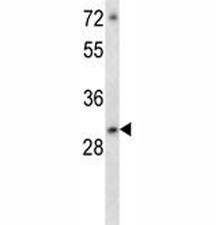
In 1X PBS, pH 7.4, with 0.09% sodium azide. Transcriptional activator which binds the cAMP response element (CRE) (consensus: 5'-GTGACGT[AC][AG]-3'), a sequence present in many viral and cellular promoters and blocks the differentiation of neuroprogenitor cells into neurons. Its transcriptional activity is enhanced by CCND3 and slightly inhibited by CDK4. Protein function: Transcription factor that either stimulates or represses gene transcription through binding of different DNA regulatory elements such as cAMP response element (CRE) (consensus: 5'- GTGACGT[AC][AG]-3'), ATF5-specific response element (ARE) (consensus: 5'-C[CT]TCT[CT]CCTT[AT]-3') but also the amino acid response element (AARE), present in many viral and cellular promoters. Critically involved, often in a cell type-dependent manner, in cell survival, proliferation, and differentiation (PubMed:10373550, PubMed:15358120, PubMed:21212266, PubMed:20654631). Its transcriptional activity is enhanced by CCND3 and slightly inhibited by CDK4 (PubMed:15358120). Important regulator of the cerebral cortex formation, functions in cerebral cortical neuroprogenitor cells to maintain proliferation and to block differentiation into neurons. Must be down-regulated in order for such cells to exit the cycle and differentiate. Participates in the pathways by which SHH promotes cerebellar granule neuron progenitor cells proliferation. Critical for survival of mature olfactory sensory neurons (OSN), directs expression of OSN-specific genes. May be involved in osteogenic differentiation (PubMed:22442021). Promotes cell proliferation and survival by inducing the expression of EGR1 sinergistically with ELK1. Once acetylated by EP300, binds to ARE sequences on target genes promoters, such as BCL2 and EGR1 (PubMed:21791614). Plays an anti- apoptotic role through the transcriptional regulation of BCL2, this function seems to be cell type-dependent. Cooperates with NR1I3/CAR in the transcritpional activation of CYP2B6 in liver (PubMed:18332083). In hepatic cells, represses CRE-dependent transcription and inhibits proliferation by blocking at G2/M phase (PubMed:22528486, PubMed:18701499). May act as a negative regulator of IL1B transduction pathway in liver (PubMed:24379400). Upon IL1B stimulus, cooperates with NLK to activate the transactivation activity of C/EBP subfamily members (PubMed:25512613). Besides its function of transcription factor, acts as a cofactor of CEBPB to activate CEBPA and promote adipocyte differentiation (PubMed:24216764). Regulates centrosome dynamics in a cell-cycle- and centriole-age-dependent manner. Forms 9-foci symmetrical ring scaffold around the mother centriole to control centrosome function and the interaction between centrioles and pericentriolar material (PubMed:26213385). [The UniProt Consortium]
| Keywords: | Anti-ATF5, Anti-ATFX, Anti-Transcription factor ATFx, Anti-Activating transcription factor 5, Anti-cAMP-dependent transcription factor ATF-5, Anti-Cyclic AMP-dependent transcription factor ATF-5, ATF5 Antibody |
| Supplier: | NSJ Bioreagents |
| Supplier-Nr: | F44355 |
Properties
| Application: | WB, ELISA |
| Antibody Type: | Polyclonal |
| Conjugate: | No |
| Host: | Rabbit |
| Species reactivity: | human |
| Immunogen: | A portion of amino acids 188-216 from the human protein was used as the immunogen for this ATF5 antibody. |
| Format: | Purified |
Database Information
| KEGG ID : | K09044 | Matching products |
| UniProt ID : | Q9Y2D1 | Matching products |
| Gene ID : | GeneID 22809 | Matching products |
Handling & Safety
| Storage: | -20°C |
| Shipping: | +4°C (International: +4°C) |
Caution
Our products are for laboratory research use only: Not for administration to humans!
Our products are for laboratory research use only: Not for administration to humans!
Information about the product reference will follow.
more
You will get a certificate here


Viewed