
Cookie preferences
This website uses cookies, which are necessary for the technical operation of the website and are always set. Other cookies, which increase the comfort when using this website, are used for direct advertising or to facilitate interaction with other websites and social networks, are only set with your consent.
Configuration
Technically required
These cookies are necessary for the basic functions of the shop.
"Allow all cookies" cookie
"Decline all cookies" cookie
CSRF token
Cookie preferences
Currency change
Customer-specific caching
FACT-Finder tracking
Individual prices
Selected shop
Session
Comfort functions
These cookies are used to make the shopping experience even more appealing, for example for the recognition of the visitor.
Note
Show the facebook fanpage in the right blod sidebar
Statistics & Tracking
Affiliate program
Conversion and usertracking via Google Tag Manager
Track device being used



| Item number | Size | Datasheet | Manual | SDS | Delivery time | Quantity | Price |
|---|---|---|---|---|---|---|---|
| REV-31-1355-00-R100 | 100 µl | - | - |
3 - 9 business days* |
541.00€
|
If you have any questions, please use our Contact Form.
You can also order by e-mail: info@biomol.com
Larger quantity required? Request bulk
You can also order by e-mail: info@biomol.com
Larger quantity required? Request bulk
Asprosin is a new fasting-induced protein hormone that targets the liver to increase plasma... more
Product information "Anti-Asprosin, Rabbit Monoclonal (RM463)"
Asprosin is a new fasting-induced protein hormone that targets the liver to increase plasma glucose levels. Asprosin is the C-terminal cleavage product of the protein pro-Fibrillin-1. Asprosin is secreted from white adipose tissue and increases hepatic glucose production by using cAMP as a second messenger, leading to activation of protein Kinase A. Reduction of Asprosin levels protects against metabolic syndrome-associated hyperinsulinism. Asprosin may act as a circulating hunger signal. Indeed, peripherally injected recombinant asprosin can cross the blood-brain barrier and intracerebroventricular (i.c.v.) injection of recombinant asprosin stimulated appetite in wild-type mice, indicating a central mechanism of action. Loss of Asprosin in mice and human leads to decreased fat mass and body weight, and hypophagia. Mice are also completely protected from the development of diet-induced obesity. Asprosin works by stimulating the orexigenic AgRP+ (Agouti related neuropeptide) neurons via a cAMP-dependent pathway and by inhibiting the anorexigenic neurons POMC+ (pro-opiomelanocortin) neurons in a GABA-dependent manner. Mutation in Asprosin in human leads to the pattern of metabolic dysregulation, including partial lipodystrophy, accompanied by reduced plasma insulin. Due to its key role in food regulation, Asprosin function could serve as a potentially unique therapeutic target against obesity, diabetes or metabolic diseases. Protein function: [Fibrillin-1]: Structural component of the 10-12 nm diameter microfibrils of the extracellular matrix, which conveys both structural and regulatory properties to load-bearing connective tissues (PubMed:1860873, PubMed:15062093). Fibrillin-1-containing microfibrils provide long-term force bearing structural support. In tissues such as the lung, blood vessels and skin, microfibrils form the periphery of the elastic fiber, acting as a scaffold for the deposition of elastin. In addition, microfibrils can occur as elastin-independent networks in tissues such as the ciliary zonule, tendon, cornea and glomerulus where they provide tensile strength and have anchoring roles. Fibrillin-1 also plays a key role in tissue homeostasis through specific interactions with growth factors, such as the bone morphogenetic proteins (BMPs), growth and differentiation factors (GDFs) and latent transforming growth factor-beta-binding proteins (LTBPs), cell-surface integrins and other extracellular matrix protein and proteoglycan components (PubMed:27026396). Regulates osteoblast maturation by controlling TGF-beta bioavailability and calibrating TGF-beta and BMP levels, respectively. Negatively regulates osteoclastogenesis by binding and sequestering an osteoclast differentiation and activation factor TNFSF11. This leads to disruption of TNFSF11-induced Ca(2+) signaling and impairment of TNFSF11-mediated nuclear translocation and activation of transcription factor NFATC1 which regulates genes important for osteoclast differentiation and function (PubMed:24039232). Mediates cell adhesion via its binding to cell surface receptors integrins ITGAV:ITGB3 and ITGA5:ITGB1 (PubMed:12807887, PubMed:17158881). Binds heparin and this interaction has an important role in the assembly of microfibrils (PubMed:11461921). [The UniProt Consortium]
| Keywords: | Anti-FBN |
| Supplier: | RevMAb Biosciences |
| Supplier-Nr: | 31-1355-00 |
Properties
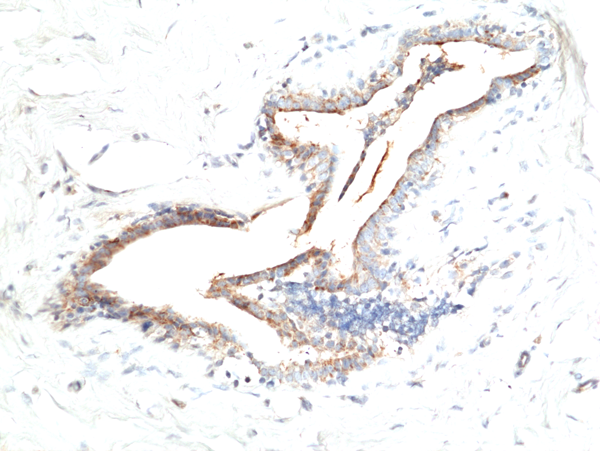
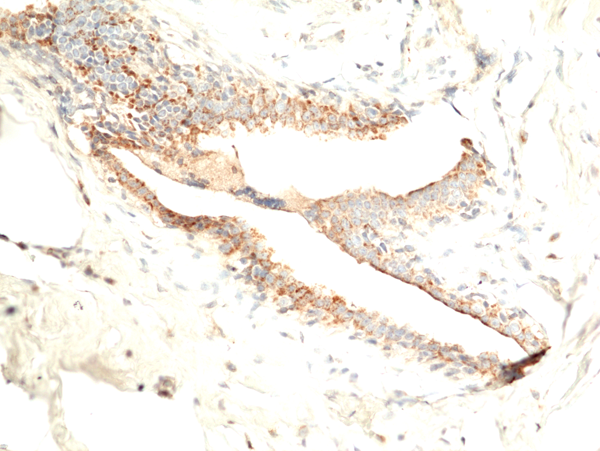
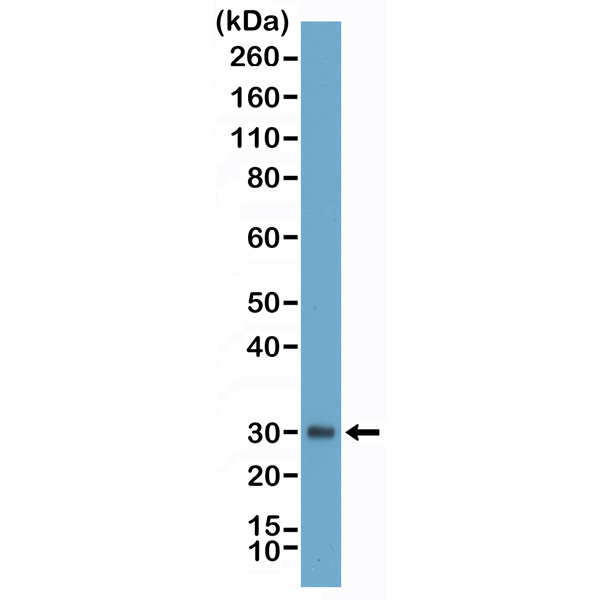
| Application: | IHC, WB |
| Antibody Type: | Monoclonal |
| Clone: | RM463 |
| Conjugate: | No |
| Host: | Rabbit |
| Species reactivity: | human |
| Immunogen: | Recombinant full-length human Asprosin protein. |
| Format: | Purified |
Database Information
| KEGG ID : | K06825 | Matching products |
| UniProt ID : | P35555 | Matching products |
| Gene ID : | GeneID 2200 | Matching products |
Handling & Safety
| Storage: | -20°C |
| Shipping: | +4°C (International: +4°C) |
Caution
Our products are for laboratory research use only: Not for administration to humans!
Our products are for laboratory research use only: Not for administration to humans!
Information about the product reference will follow.
more
You will get a certificate here
Viewed