
Cookie preferences
This website uses cookies, which are necessary for the technical operation of the website and are always set. Other cookies, which increase the comfort when using this website, are used for direct advertising or to facilitate interaction with other websites and social networks, are only set with your consent.
Configuration
Technically required
These cookies are necessary for the basic functions of the shop.
"Allow all cookies" cookie
"Decline all cookies" cookie
CSRF token
Cookie preferences
Currency change
Customer-specific caching
FACT-Finder tracking
Individual prices
Selected shop
Session
Comfort functions
These cookies are used to make the shopping experience even more appealing, for example for the recognition of the visitor.
Note
Show the facebook fanpage in the right blod sidebar
Statistics & Tracking
Affiliate program
Conversion and usertracking via Google Tag Manager
Track device being used


| Item number | Size | Datasheet | Manual | SDS | Delivery time | Quantity | Price |
|---|---|---|---|---|---|---|---|
| NSJ-FY12692 | 100 µg | - | - |
7 - 12 business days* |
790.00€
|
If you have any questions, please use our Contact Form.
You can also order by e-mail: info@biomol.com
Larger quantity required? Request bulk
You can also order by e-mail: info@biomol.com
Larger quantity required? Request bulk
Adding 0.2 ml of distilled water will yield a concentration of 500 ug/ml. ANGPTL4 antibody... more
Product information "Anti-ANGPTL4 / Angiopoietin-like 4"
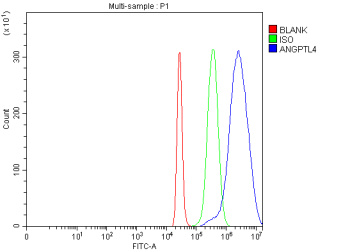
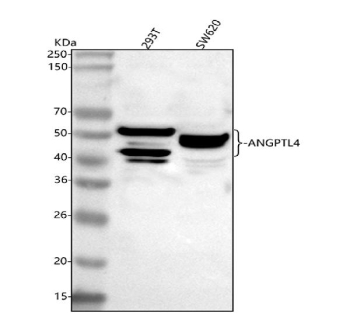
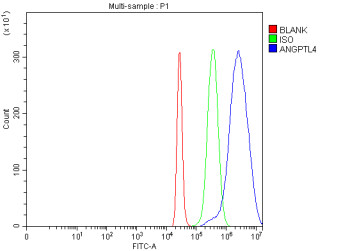
Adding 0.2 ml of distilled water will yield a concentration of 500 ug/ml. ANGPTL4 antibody detects Angiopoietin-like 4, a secreted glycoprotein that plays critical roles in lipid metabolism, angiogenesis, wound healing, and tumor progression. Encoded by the ANGPTL4 gene on chromosome 19p13.3, the protein belongs to the angiopoietin-like family of vascular regulators, which share structural similarity to angiopoietins but act independently of the Tie receptor system. Angiopoietin-like 4 contains an N-terminal coiled-coil domain and a C-terminal fibrinogen-like domain that mediate distinct biological functions. The N-terminal region primarily regulates lipid metabolism, while the C-terminal fragment influences angiogenesis and vascular permeability.Angiopoietin-like 4 is synthesized and secreted by adipose tissue, liver, skeletal muscle, and endothelial cells, where it modulates triglyceride homeostasis through inhibition of lipoprotein lipase (LPL). By preventing premature triglyceride hydrolysis, ANGPTL4 redistributes lipids among tissues during fasting and feeding cycles. This function has made ANGPTL4 a major focus of metabolic and cardiovascular research. Genetic studies demonstrate that loss-of-function variants in ANGPTL4 are associated with reduced plasma triglyceride levels and decreased risk of coronary artery disease, identifying it as a potential therapeutic target for dyslipidemia.Beyond metabolism, Angiopoietin-like 4 exerts profound effects on vascular biology. It enhances endothelial barrier integrity in certain contexts while promoting permeability in others, depending on proteolytic processing and redox status. The C-terminal domain can stimulate endothelial cell migration and tube formation, processes crucial to wound healing and tumor angiogenesis. Elevated ANGPTL4 expression has been observed in hypoxic tumors, where it promotes metastasis by enhancing vascular leakiness and resistance to detachment-induced apoptosis (anoikis). Conversely, in some tissues, ANGPTL4 limits inflammation by preventing leukocyte extravasation and oxidative stress. These context-dependent effects highlight its dual regulatory capacity in physiology and disease.The ANGPTL4 antibody is used in research focused on lipid metabolism, vascular biology, and cancer. In western blot assays, it detects both the full-length 50 kilodalton protein and its processed fragments. Immunohistochemistry demonstrates strong cytoplasmic and extracellular staining in adipocytes, endothelial cells, and hepatocytes. In cell culture studies, ANGPTL4 levels rise under hypoxic conditions or upon treatment with PPAR agonists, reflecting its transcriptional control by peroxisome proliferator-activated receptors. This antibody supports investigation into the pathways linking metabolism, angiogenesis, and inflammation.Angiopoietin-like 4 also participates in tissue remodeling, wound repair, and fibrosis by regulating matrix metalloproteinase expression and fibroblast activity. Dysregulation contributes to pathologies such as diabetic retinopathy, where increased ANGPTL4 disrupts retinal vascular integrity. The ANGPTL4 antibody enables detection of these changes and facilitates translational research aimed at developing ANGPTL4-targeted therapies. NSJ Bioreagents provides this antibody validated for its applications, ensuring reliable detection across multiple species.
| Keywords: | Anti-ANGPTL4, Anti-Angiopoietin-like protein 4, Anti-Angiopoietin-related protein 4, Anti-Hepatic fibrinogen/angiopoietin-related protein, ANGPTL4 Antibody / Angiopoietin-like 4 |
| Supplier: | NSJ Bioreagents |
| Supplier-Nr: | FY12692 |
Properties
| Application: | WB, FC, ELISA |
| Antibody Type: | Polyclonal |
| Conjugate: | No |
| Host: | Rabbit |
| Species reactivity: | human |
| Immunogen: | E.coli-derived human ANGPTL4 recombinant protein (Position: D39-S406) |
| Format: | Purified |
Database Information
| KEGG ID : | K08767 | Matching products |
| UniProt ID : | Q9BY76 | Matching products |
| Gene ID : | GeneID 51129 | Matching products |
Handling & Safety
| Storage: | +4°C |
| Shipping: | +4°C (International: +4°C) |
Caution
Our products are for laboratory research use only: Not for administration to humans!
Our products are for laboratory research use only: Not for administration to humans!
Information about the product reference will follow.
more
You will get a certificate here
Viewed