
Cookie preferences
This website uses cookies, which are necessary for the technical operation of the website and are always set. Other cookies, which increase the comfort when using this website, are used for direct advertising or to facilitate interaction with other websites and social networks, are only set with your consent.
Configuration
Technically required
These cookies are necessary for the basic functions of the shop.
"Allow all cookies" cookie
"Decline all cookies" cookie
CSRF token
Cookie preferences
Currency change
Customer-specific caching
FACT-Finder tracking
Individual prices
Selected shop
Session
Comfort functions
These cookies are used to make the shopping experience even more appealing, for example for the recognition of the visitor.
Note
Show the facebook fanpage in the right blod sidebar
Statistics & Tracking
Affiliate program
Conversion and usertracking via Google Tag Manager
Track device being used

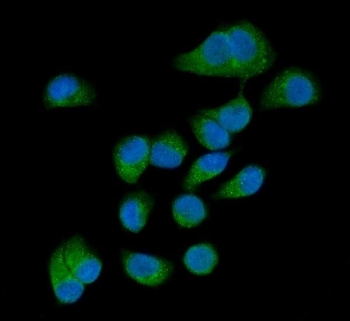
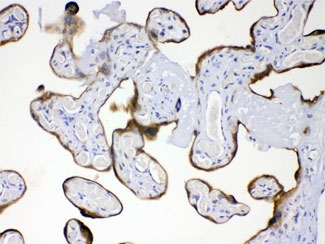
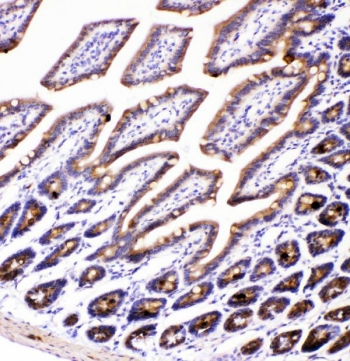
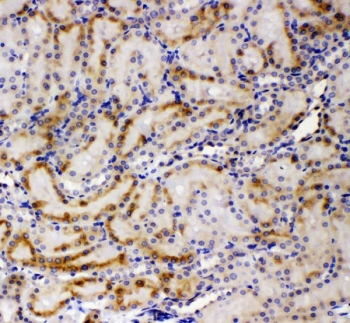


| Item number | Size | Datasheet | Manual | SDS | Delivery time | Quantity | Price |
|---|---|---|---|---|---|---|---|
| NSJ-R32507 | 100 µg | - | - |
3 - 10 business days* |
790.00€
|
If you have any questions, please use our Contact Form.
You can also order by e-mail: info@biomol.com
Larger quantity required? Request bulk
You can also order by e-mail: info@biomol.com
Larger quantity required? Request bulk
0.5mg/ml if reconstituted with 0.2ml sterile DI water. Autocrine motility factor receptor,... more
Product information "Anti-AMFR / GP78"
0.5mg/ml if reconstituted with 0.2ml sterile DI water. Autocrine motility factor receptor, isoform 2, also called GP78, is a protein that in humans is encoded by the AMFR gene. Autocrine motility factor is a tumor motility-stimulating protein secreted by tumor cells. The protein encoded by this gene is a glycosylated transmembrane protein and a receptor for autocrine motility factor. The receptor, which shows some sequence similarity to tumor protein p53, is localized to the leading and trailing edges of carcinoma cells. Its ligand, autocrine motility factor, is a tumor motility-stimulating protein secreted by tumor cells. The encoded receptor is also a member of the E3 ubiquitin ligase family of proteins. It catalyzes ubiquitination and endoplasmic reticulum-associated degradation of specific proteins. Protein function: E3 ubiquitin-protein ligase that mediates the polyubiquitination of lysine and cysteine residues on target proteins, such as CD3D, CYP3A4, CFTR, INSIG1, SOAT2/ACAT2 and APOB for proteasomal degradation (PubMed:10456327, PubMed:11724934, PubMed:12670940, PubMed:19103148, PubMed:24424410, PubMed:28604676). Component of a VCP/p97-AMFR/gp78 complex that participates in the final step of endoplasmic reticulum-associated degradation (ERAD) (PubMed:10456327, PubMed:11724934, PubMed:19103148, PubMed:24424410). The VCP/p97-AMFR/gp78 complex is involved in the sterol-accelerated ERAD degradation of HMGCR through binding to the HMGCR-INSIG1 complex at the ER membrane (PubMed:16168377, PubMed:22143767). In addition, interaction of AMFR with AUP1 facilitates interaction of AMFR with ubiquitin-conjugating enzyme UBE2G2 and ubiquitin ligase RNF139, leading to sterol-induced HMGCR ubiquitination (PubMed:23223569). The ubiquitinated HMGCR is then released from the ER into the cytosol for subsequent destruction (PubMed:16168377, PubMed:22143767, PubMed:23223569). In addition to ubiquitination on lysine residues, catalyzes ubiquitination on cysteine residues: together with INSIG1, mediates polyubiquitination of SOAT2/ACAT2 at 'Cys-277', leading to its degradation when the lipid levels are low (PubMed:28604676). Catalyzes ubiquitination and subsequent degradation of INSIG1 when cells are depleted of sterols (PubMed:17043353). Mediates polyubiquitination of INSIG2 at 'Cys-215' in some tissues, leading to its degradation (PubMed:31953408). Also regulates ERAD through the ubiquitination of UBL4A a component of the BAG6/BAT3 complex (PubMed:21636303). Also acts as a scaffold protein to assemble a complex that couples ubiquitination, retranslocation and deglycosylation (PubMed:21636303). Mediates tumor invasion and metastasis as a receptor for the GPI/autocrine motility factor (PubMed:10456327). In association with LMBR1L and UBAC2, negatively regulates the canonical Wnt signaling pathway in the lymphocytes by promoting the ubiquitin-mediated degradation of CTNNB1 and Wnt receptors FZD6 and LRP6 (PubMed:31073040). [The UniProt Consortium]
| Keywords: | Anti-gp78, Anti-AMF receptor, Anti-RING finger protein 45, Anti-E3 ubiquitin-protein ligase AMFR, Anti-Autocrine motility factor receptor, AMFR Antibody / GP78 |
| Supplier: | NSJ Bioreagents |
| Supplier-Nr: | R32507 |
Properties
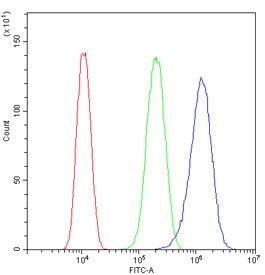
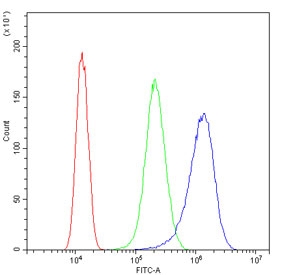
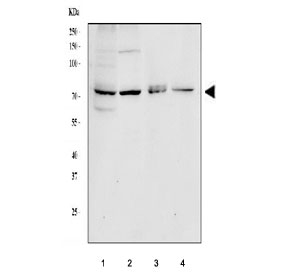
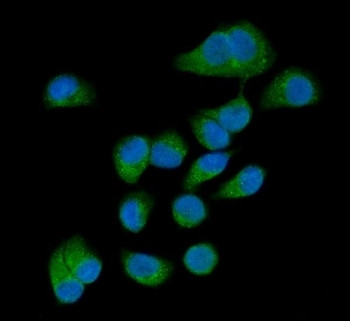
| Application: | WB, IHC (paraffin), FC, IF |
| Antibody Type: | Polyclonal |
| Conjugate: | No |
| Host: | Rabbit |
| Species reactivity: | human, mouse, rat |
| Immunogen: | Amino acids E553-S643 from the human protein |
| Format: | Purified |
Database Information
| KEGG ID : | K10636 | Matching products |
| UniProt ID : | Q9UKV5 | Matching products |
| Gene ID : | GeneID 267 | Matching products |
Handling & Safety
| Storage: | +4°C |
| Shipping: | +4°C (International: +4°C) |
Caution
Our products are for laboratory research use only: Not for administration to humans!
Our products are for laboratory research use only: Not for administration to humans!
Information about the product reference will follow.
more
You will get a certificate here



Viewed