
Cookie preferences
This website uses cookies, which are necessary for the technical operation of the website and are always set. Other cookies, which increase the comfort when using this website, are used for direct advertising or to facilitate interaction with other websites and social networks, are only set with your consent.
Configuration
Technically required
These cookies are necessary for the basic functions of the shop.
"Allow all cookies" cookie
"Decline all cookies" cookie
CSRF token
Cookie preferences
Currency change
Customer-specific caching
FACT-Finder tracking
Individual prices
Selected shop
Session
Comfort functions
These cookies are used to make the shopping experience even more appealing, for example for the recognition of the visitor.
Note
Show the facebook fanpage in the right blod sidebar
Statistics & Tracking
Affiliate program
Conversion and usertracking via Google Tag Manager
Track device being used

If you have any questions, please use our Contact Form.
You can also order by e-mail: info@biomol.com
Larger quantity required? Request bulk
You can also order by e-mail: info@biomol.com
Larger quantity required? Request bulk
This gene encodes a homolog to the E. coli alkB gene product. The E. coli alkB protein is part of... more
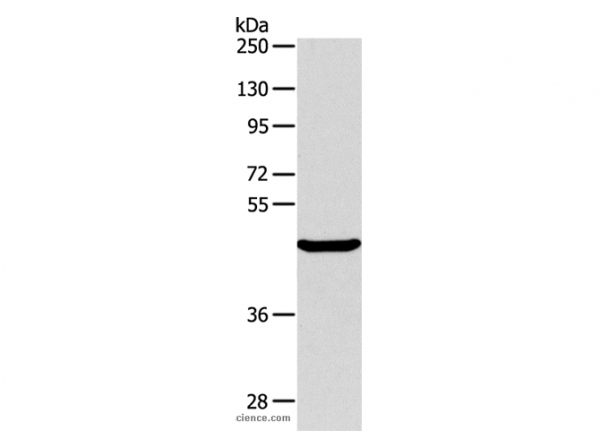
Product information "Anti-ALKBH1"
This gene encodes a homolog to the E. coli alkB gene product. The E. coli alkB protein is part of the adaptive response mechanism of DNA alkylation damage repair. It is involved in damage reversal by oxidative demethylation of 1-methyladenine and 3-methylcytosine. Dioxygenase that repairs alkylated single-stranded DNA and RNA containing 3-methylcytosine by oxidative demethylation. Requires molecular oxygen, alpha-ketoglutarate and iron. May have a role in placental trophoblast lineage differentiation. Has DNA lyase activity and introduces double-stranded breaks at abasic sites. Cleaves both single-stranded DNA and double-stranded DNA at abasic sites, with the greatest activity towards double-stranded DNA with two abasic sites. Protein function: Dioxygenase that acts as on nucleic acids, such as DNA and tRNA (PubMed:18603530, PubMed:27745969, PubMed:27497299). Requires molecular oxygen, alpha-ketoglutarate and iron (PubMed:18603530, PubMed:27497299). A number of activities have been described for this dioxygenase, but recent results suggest that it mainly acts as on tRNAs and mediates their demethylation or oxidation depending on the context and subcellular compartment (PubMed:27745969, PubMed:27497299). Mainly acts as a tRNA demethylase by removing N(1)-methyladenine from various tRNAs, with a preference for N(1)-methyladenine at position 58 (m1A58) present on a stem loop structure of tRNAs (PubMed:27745969). Acts as a regulator of translation initiation and elongation in response to glucose deprivation: regulates both translation initiation, by mediating demethylation of tRNA(Met), and translation elongation, N(1)-methyladenine-containing tRNAs being preferentially recruited to polysomes to promote translation elongation (PubMed:27745969). In mitochondrion, specifically interacts with mt-tRNA(Met) and mediates oxidation of mt-tRNA(Met) methylated at cytosine(34) to form 5-formylcytosine (f(5)c) at this position (PubMed:27497299). mt-tRNA(Met) containing the f(5)c modification at the wobble position enables recognition of the AUA codon in addition to the AUG codon, expanding codon recognition in mitochondrial translation (PubMed:27497299). Specifically demethylates DNA methylated on the 6th position of adenine (N(6)- methyladenosine) DNA. N(6)-methyladenosine (m6A) DNA is present at some L1 elements in embryonic stem cells and probably promotes their silencing. Also able to repair alkylated single-stranded DNA and RNA containing 3-methylcytosine by oxidative demethylation, but with low activity (PubMed:18603530). Also has DNA lyase activity and introduces double-stranded breaks at abasic sites: cleaves both single-stranded DNA and double- stranded DNA at abasic sites, with the greatest activity towards double-stranded DNA with two abasic sites (PubMed:19959401). DNA lyase activity does not require alpha-ketboglutarate and iron and leads to the formation of an irreversible covalent protein-DNA adduct with the 5' DNA product (PubMed:19959401, PubMed:23577621). DNA lyase activity is not required during base excision repair and class switch recombination of the immunoglobulin heavy chain during B lymphocyte activation. May play a role in placental trophoblast lineage differentiation. [The UniProt Consortium]
| Keywords: | Anti-DNA lyase ABH1, Anti-DNA 6mA demethylase, Anti-Nucleic acid dioxygenase ALKBH1, Anti-DNA oxidative demethylase ALKBH1, Anti-DNA N6-methyl adenine demethylase, Anti-tRNA N1-methyl adenine demethylase, Anti-Alkylated DNA repair protein alkB homolog 1, |
| Supplier: | Elabscience |
| Supplier-Nr: | E-AB-10699 |
Properties
| Application: | WB, ELISA |
| Antibody Type: | Polyclonal |
| Conjugate: | No |
| Host: | Rabbit |
| Species reactivity: | human, mouse |
| Immunogen: | Recombinant protein of human ALKBH1 |
| Format: | Purified |
Database Information
| KEGG ID : | K10765 | Matching products |
| UniProt ID : | Q13686 | Matching products |
| Gene ID : | GeneID 8846 | Matching products |
Handling & Safety
| Storage: | -20°C |
| Shipping: | 4°C (International: -20°C) |
Caution
Our products are for laboratory research use only: Not for administration to humans!
Our products are for laboratory research use only: Not for administration to humans!
Information about the product reference will follow.
more
You will get a certificate here
Viewed