
This website uses cookies, which are necessary for the technical operation of the website and are always set. Other cookies, which increase the comfort when using this website, are used for direct advertising or to facilitate interaction with other websites and social networks, are only set with your consent.
Configuration
Technically required
These cookies are necessary for the basic functions of the shop.
"Allow all cookies" cookie
"Decline all cookies" cookie
CSRF token
Cookie preferences
Currency change
Customer-specific caching
FACT-Finder tracking
Individual prices
Selected shop
Session
Comfort functions
These cookies are used to make the shopping experience even more appealing, for example for the recognition of the visitor.
Note
Show the facebook fanpage in the right blod sidebar
Statistics & Tracking
Affiliate program
Conversion and usertracking via Google Tag Manager
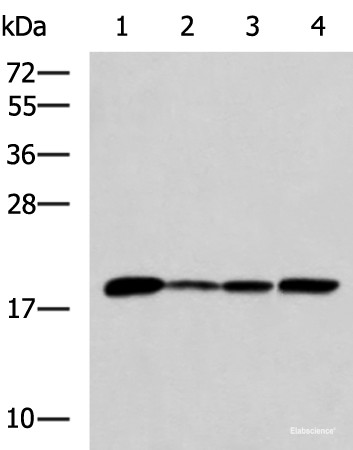
This gene encodes a protein that belongs to the adenylate kinase family of enzymes. The protein has a nuclear localization and contains Walker A (P-loop) and Walker B motifs and a metal-coordinating residue. The protein may be involved in regulation of Cajal body formation. In human, AK6 and TAF9 (GeneID: 6880) are two distinct genes that share 5' exons. Alternative splicing results in multiple transcript variants.AK6 (Adenylate Kinase 6) is a Protein Coding gene. Among its related pathways are Ribosome biogenesis in eukaryotes and Purine metabolism (REACTOME). GO annotations related to this gene include ATPase activity and adenylate kinase activity. Protein function: Broad-specificity nucleoside monophosphate (NMP) kinase that catalyzes the reversible transfer of the terminal phosphate group between nucleoside triphosphates and monophosphates. AMP and dAMP are the preferred substrates, but CMP and dCMP are also good substrates. IMP is phosphorylated to a much lesser extent. All nucleoside triphosphates ATP, GTP, UTP, CTP, dATP, dCTP, dGTP, and TTP are accepted as phosphate donors. CTP is the best phosphate donor, followed by UTP, ATP, GTP and dCTP. May have a role in nuclear energy homeostasis. Has also ATPase activity. May be involved in regulation of Cajal body (CB) formation. [The UniProt Consortium]
This website uses cookies, which are necessary for the technical operation of the website and are always set. Other cookies, which increase the usability of this website, serve for direct advertising or simplify interaction with other websites and social networks, will only be used with your consent.
More information