
Anti-AGO2/Argonaute 2/EIF2C2 Monoclonal Recombinant Antibody


| Item number | Size | Datasheet | Manual | SDS | Delivery time | Quantity | Price |
|---|---|---|---|---|---|---|---|
| E-AN300165P.20 | 20 µl | - |
7 - 16 business days* |
182.00€
|
|||
| E-AN300165P.100 | 100 µl | - |
7 - 16 business days* |
462.00€
|
If you have any questions, please use our Contact Form.
You can also order by e-mail: info@biomol.com
Larger quantity required? Request bulk
You can also order by e-mail: info@biomol.com
Larger quantity required? Request bulk
Argonaute 2 (AGO2), also known as Eukaryotic translation initiation factor 2C2 (EIF2C2), belongs... more
Product information "Anti-AGO2/Argonaute 2/EIF2C2 Monoclonal Recombinant Antibody"
Argonaute 2 (AGO2), also known as Eukaryotic translation initiation factor 2C2 (EIF2C2), belongs to the Argonaute family, AGO subfamily, which is a component of the RNA-induced silencing complex (RISC) and mediates small interfering RNA (siRNA)-directed mRNA cleavage and microRNA translational suppression. AGO2 protein is the catalytic engine of mammalian RNAi. It contains a PIWI domain that is structurally related to RNases H and possibly shares with them a two-metal-ion catalysis mechanism. Human AGO2 was unable to cleave preformed RNA duplexes and exhibited weaker binding affinity for RNA duplexes compared with the single strand RNA. The enzyme exhibited greater RNase H activity in the presence of Mn2+ compared with Mg2+. Human AGO2 exhibited weaker binding affinities and reduced cleavage activities for antisense RNAs with either a 5'-terminal hydroxyl or abasic nucleotide. In mouse hematopoiesis, AGO2 controls early development of lymphoid and erythroid cells. AGO2 is a highly specialized member of the Argonaute family with an essential nonredundant Slicer-independent function within the mammalian miRNA pathway. AGO2 regulates dFMR1 expression, and the relationship between dFMR1 and AGO2 was defined by their physical interaction and co-regulation of downstream targets. AGO2 and dFMR1 are also connected through a regulatory relationship. AGO2 is a regulator of dFMR1 expression and have clarified an important developmental role for AGO2 in the nervous system and germ line that requires dFMR1 function. In addition, AGO2 is regulated at both the transcriptional and posttranslational level, and also implicate AGO2 and enhanced micro-RNA activity in the tumorigenic progression of breast cancer cell lines. Protein function: Required for RNA-mediated gene silencing (RNAi) by the RNA- induced silencing complex (RISC). The 'minimal RISC' appears to include AGO2 bound to a short guide RNA such as a microRNA (miRNA) or short interfering RNA (siRNA). These guide RNAs direct RISC to complementary mRNAs that are targets for RISC-mediated gene silencing. The precise mechanism of gene silencing depends on the degree of complementarity between the miRNA or siRNA and its target. Binding of RISC to a perfectly complementary mRNA generally results in silencing due to endonucleolytic cleavage of the mRNA specifically by AGO2. Binding of RISC to a partially complementary mRNA results in silencing through inhibition of translation, and this is independent of endonuclease activity. May inhibit translation initiation by binding to the 7- methylguanosine cap, thereby preventing the recruitment of the translation initiation factor eIF4-E. May also inhibit translation initiation via interaction with EIF6, which itself binds to the 60S ribosomal subunit and prevents its association with the 40S ribosomal subunit. The inhibition of translational initiation leads to the accumulation of the affected mRNA in cytoplasmic processing bodies (P- bodies), where mRNA degradation may subsequently occur. In some cases RISC-mediated translational repression is also observed for miRNAs that perfectly match the 3' untranslated region (3'-UTR). Can also up- regulate the translation of specific mRNAs under certain growth conditions. Binds to the AU element of the 3'-UTR of the TNF (TNF- alpha) mRNA and up-regulates translation under conditions of serum starvation. Also required for transcriptional gene silencing (TGS), in which short RNAs known as antigene RNAs or agRNAs direct the transcriptional repression of complementary promoter regions. Regulates lymphoid and erythroid development and function, and this is independent of endonuclease activity. [The UniProt Consortium]
| Keywords: | Ago2, mAgo2, Eif2c2, eIF2C 2, eIF-2C 2, Argonaute2, Protein slicer, Protein argonaute-2, Argonaute RISC catalytic component 2, Piwi/argonaute family protein meIF2C2, Eukaryotic translation initiation factor 2C 2, Recombinant AGO2/Argonaute 2/EIF2C2 Monocl |
| Supplier: | Elabscience |
| Supplier-Nr: | E-AN300165P |
Properties
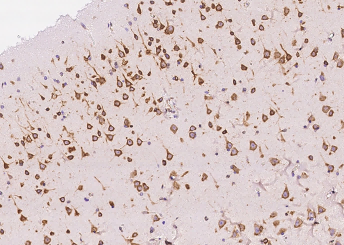
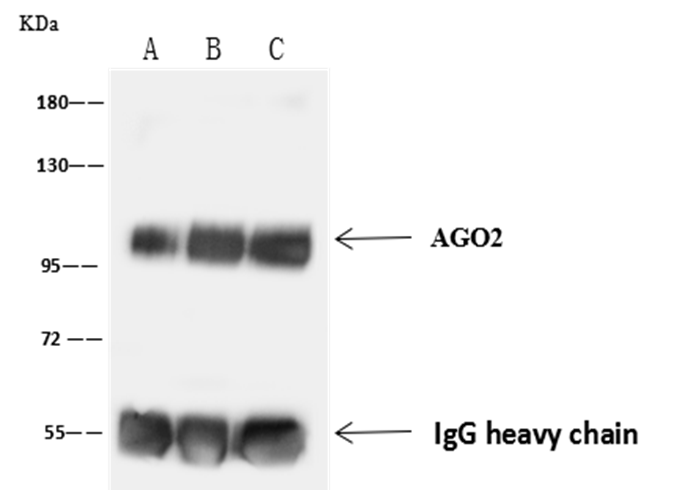
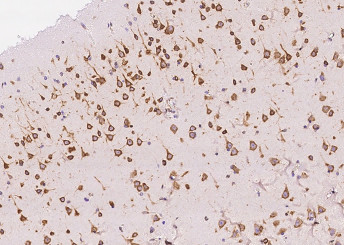
| Application: | IHC (paraffin), IP |
| Antibody Type: | Monoclonal |
| Clone: | 5H4 |
| Conjugate: | No |
| Host: | Rabbit |
| Species reactivity: | mouse |
| Immunogen: | Recombinant Mouse AGO2 protein |
| Format: | Purified |
Database Information
| KEGG ID : | K11593 | Matching products |
| UniProt ID : | Q8CJG0 | Matching products |
| Gene ID : | GeneID 239528 | Matching products |
Handling & Safety
| Storage: | +4°C (avoid repeat freezing and thawing cycles) |
| Shipping: | +4°C (International: +4°C) |
| Signal Word: | Warning |
| GHS Hazard Pictograms: |

|
| H Phrases: | H317 |
| P Phrases: | P261, P272, P280, P302+352, P333+313 |
Caution
Our products are for laboratory research use only: Not for administration to humans!
Our products are for laboratory research use only: Not for administration to humans!
Information about the product reference will follow.
more
You will get a certificate here
Viewed