
Cookie preferences
This website uses cookies, which are necessary for the technical operation of the website and are always set. Other cookies, which increase the comfort when using this website, are used for direct advertising or to facilitate interaction with other websites and social networks, are only set with your consent.
Configuration
Technically required
These cookies are necessary for the basic functions of the shop.
"Allow all cookies" cookie
"Decline all cookies" cookie
CSRF token
Cookie preferences
Currency change
Customer-specific caching
FACT-Finder tracking
Individual prices
Selected shop
Session
Comfort functions
These cookies are used to make the shopping experience even more appealing, for example for the recognition of the visitor.
Note
Show the facebook fanpage in the right blod sidebar
Statistics & Tracking
Affiliate program
Conversion and usertracking via Google Tag Manager
Track device being used



| Item number | Size | Datasheet | Manual | SDS | Delivery time | Quantity | Price |
|---|---|---|---|---|---|---|---|
| NSJ-FY12716 | 100 µg | - | - |
3 - 10 business days* |
790.00€
|
If you have any questions, please use our Contact Form.
You can also order by e-mail: info@biomol.com
Larger quantity required? Request bulk
You can also order by e-mail: info@biomol.com
Larger quantity required? Request bulk
Adding 0.2 ml of distilled water will yield a concentration of 500 ug/ml. ADGRE5 antibody detects... more
Product information "Anti-ADGRE5 / Adhesion G protein-coupled receptor E5 / CD97"
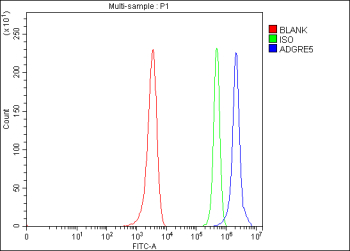
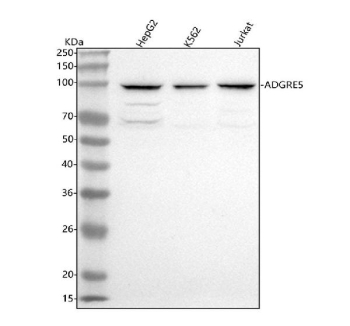
Adding 0.2 ml of distilled water will yield a concentration of 500 ug/ml. ADGRE5 antibody detects Adhesion G protein-coupled receptor E5 (also known as CD97), a member of the E class of adhesion GPCRs that mediate cell-cell and cell-matrix interactions. Encoded by the ADGRE5 gene on chromosome 19p13.12, this receptor is composed of an extended extracellular region with multiple EGF-like repeats, a GPCR autoproteolysis-inducing (GAIN) domain, and a seven-transmembrane region typical of GPCRs. CD97 is expressed on leukocytes, smooth muscle cells, and epithelial cells, where it regulates adhesion, migration, and immune cell activation. The receptor interacts with multiple ligands, including CD55 (decay-accelerating factor), integrins, and chondroitin sulfate, which modulate immune responses and tissue remodeling.ADGRE5 undergoes autoproteolytic cleavage within the GAIN domain, producing a large extracellular alpha subunit and a smaller membrane-bound beta subunit that remain noncovalently associated. This processing is essential for receptor maturation and ligand binding. The EGF-like domains mediate interaction with CD55, linking ADGRE5 function to complement regulation and immune evasion. In immune cells, ADGRE5 participates in leukocyte migration to inflammatory sites, co-stimulation of T cells, and macrophage activation. It also contributes to angiogenesis, smooth muscle contraction, and cell-cell adhesion in epithelial tissues. Dysregulated expression of CD97 has been associated with inflammatory disorders and several cancers, where it promotes invasion, epithelial-mesenchymal transition, and metastasis.The ADGRE5 antibody is widely used in immunology, cancer biology, and vascular research to detect receptor expression and distribution. Western blot analysis identifies multiple bands (75-120 kilodaltons) corresponding to the various glycosylated receptor forms, while flow cytometry and immunohistochemistry reveal strong membrane localization. In tumors, overexpression of ADGRE5 enhances motility through interactions with integrins and activation of RhoA and MAPK pathways. Elevated expression correlates with poor prognosis in colorectal, thyroid, and gastric cancers. Conversely, in leukocytes, ADGRE5 expression is dynamically regulated during activation and differentiation, serving as a marker for immune cell subsets.Beyond cancer and inflammation, ADGRE5 participates in vascular remodeling and smooth muscle physiology. It mediates heterotypic interactions between leukocytes and endothelial cells, facilitating transmigration across the vessel wall. Experimental deletion of ADGRE5 in mice reduces inflammatory cell recruitment and limits tissue damage, underscoring its role in immune regulation. The ADGRE5 antibody enables detailed characterization of receptor expression and function across tissues and disease contexts. NSJ Bioreagents provides this antibody validated for its applications, ensuring specificity for both membrane-bound and cleaved receptor forms in human and model systems.
| Keywords: | Anti-ADGRE5, Anti-Leukocyte antigen CD97, Anti-Adhesion G protein-coupled receptor E5, ADGRE5 Antibody / Adhesion G protein-coupled receptor E5 / CD97 |
| Supplier: | NSJ Bioreagents |
| Supplier-Nr: | FY12716 |
Properties
| Application: | WB, FC, ELISA |
| Antibody Type: | Polyclonal |
| Conjugate: | No |
| Host: | Rabbit |
| Species reactivity: | human |
| Immunogen: | E.coli-derived human ADGRE5 recombinant protein (Position: R287-Q690) |
| Format: | Purified |
Database Information
| KEGG ID : | K08446 | Matching products |
| UniProt ID : | P48960 | Matching products |
| Gene ID : | GeneID 976 | Matching products |
Handling & Safety
| Storage: | +4°C |
| Shipping: | +4°C (International: +4°C) |
Caution
Our products are for laboratory research use only: Not for administration to humans!
Our products are for laboratory research use only: Not for administration to humans!
Information about the product reference will follow.
more
You will get a certificate here
Viewed