
Cookie preferences
This website uses cookies, which are necessary for the technical operation of the website and are always set. Other cookies, which increase the comfort when using this website, are used for direct advertising or to facilitate interaction with other websites and social networks, are only set with your consent.
Configuration
Technically required
These cookies are necessary for the basic functions of the shop.
"Allow all cookies" cookie
"Decline all cookies" cookie
CSRF token
Cookie preferences
Currency change
Customer-specific caching
FACT-Finder tracking
Individual prices
Selected shop
Session
Comfort functions
These cookies are used to make the shopping experience even more appealing, for example for the recognition of the visitor.
Note
Show the facebook fanpage in the right blod sidebar
Statistics & Tracking
Affiliate program
Conversion and usertracking via Google Tag Manager
Track device being used




| Item number | Size | Datasheet | Manual | SDS | Delivery time | Quantity | Price |
|---|---|---|---|---|---|---|---|
| NSJ-FY13014 | 100 µg | - | - |
3 - 10 business days* |
790.00€
|
If you have any questions, please use our Contact Form.
You can also order by e-mail: info@biomol.com
Larger quantity required? Request bulk
You can also order by e-mail: info@biomol.com
Larger quantity required? Request bulk
Adding 0.2 ml of distilled water will yield a concentration of 500 ug/ml. ADAM12 antibody detects... more
Product information "Anti-ADAM12 / Disintegrin and metalloproteinase domain-containing protein 12"
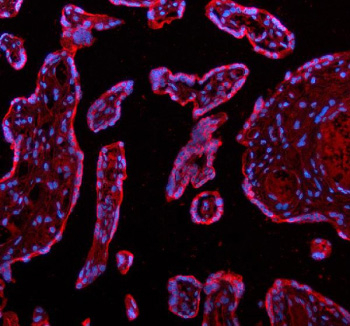
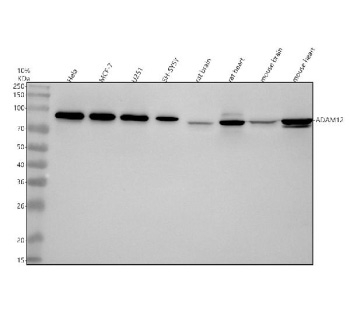
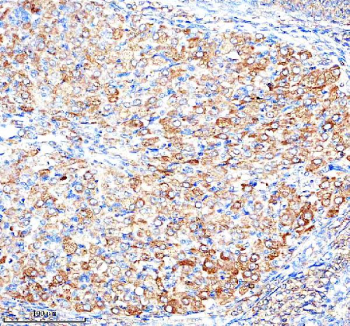
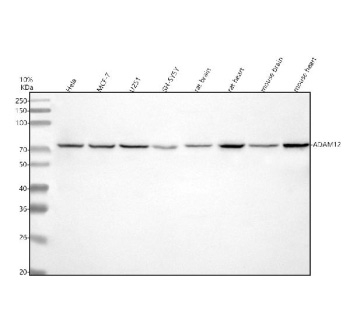
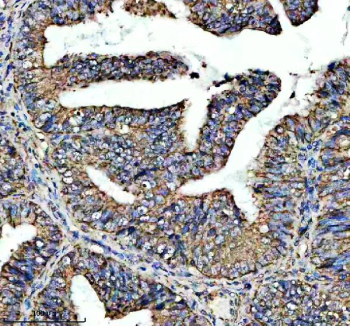
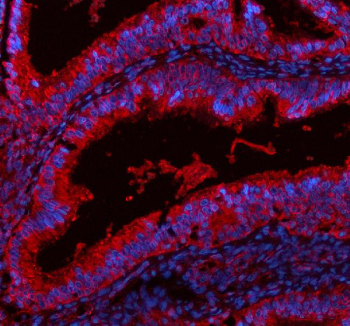
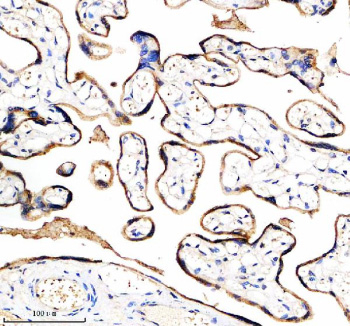
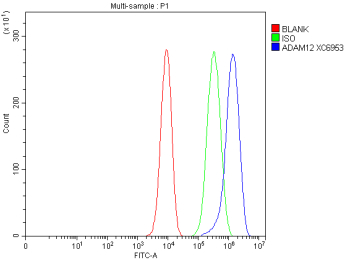
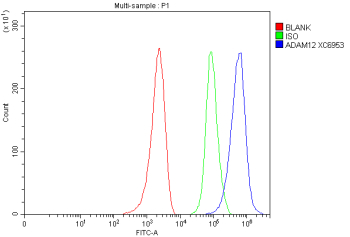
Adding 0.2 ml of distilled water will yield a concentration of 500 ug/ml. ADAM12 antibody detects Disintegrin and metalloproteinase domain-containing protein 12, a membrane-associated protease involved in cell adhesion, signaling, and extracellular matrix remodeling. The UniProt recommended name is Disintegrin and metalloproteinase domain-containing protein 12 (ADAM12). This enzyme plays essential roles in development, tissue repair, and tumor progression through its proteolytic and adhesive functions.Functionally, ADAM12 antibody identifies a 907-amino-acid protein containing a metalloprotease domain, a disintegrin domain, a cysteine-rich region, and a transmembrane segment. ADAM12 catalyzes the cleavage of cell-surface proteins such as growth factors, cytokines, and adhesion molecules, regulating intercellular communication and matrix remodeling. It acts on substrates including insulin-like growth factor binding proteins (IGFBPs), shedding them from the membrane to modulate IGF signaling.The ADAM12 gene is located on chromosome 10q26.2 and produces two major isoforms: the long transmembrane form (ADAM12-L) and a shorter secreted variant (ADAM12-S). ADAM12 participates in tissue remodeling, myogenesis, and angiogenesis, and its expression increases during wound healing and fibrosis. It interacts with integrins via its disintegrin domain, influencing cell adhesion and migration. In skeletal muscle development, ADAM12 promotes myoblast fusion and differentiation by remodeling extracellular components.In cancer biology, ADAM12 is frequently upregulated in breast, liver, and colorectal tumors, where it enhances growth factor signaling and tumor invasiveness. Elevated expression correlates with poor prognosis and therapy resistance. ADAM12 also participates in transforming growth factor-beta (TGF-beta) signaling and epithelial-to-mesenchymal transition (EMT), promoting metastatic potential. In cardiovascular tissues, ADAM12 contributes to vascular smooth muscle cell migration and atherosclerotic remodeling.ADAM12 antibody is widely used in developmental biology, oncology, and extracellular matrix research. It is suitable for immunoblotting, immunohistochemistry, and zymography to assess ADAM12 expression, localization, and enzymatic activity. This antibody aids in studying protease-mediated signal activation, tissue remodeling, and tumor invasion. It also supports investigations into muscle differentiation and fibrotic disease mechanisms.Structurally, ADAM12 features a catalytic zinc-binding motif within its metalloprotease domain and multiple adhesion modules that facilitate interaction with integrins and extracellular matrix proteins. Its activity is regulated by pro-domain removal, phosphorylation, and glycosylation. NSJ Bioreagents provides ADAM12 antibody reagents validated for use in protease biology, tumor signaling, and developmental research.
| Keywords: | Anti-ADAM12, Anti-Meltrin-alpha, Anti-Disintegrin and metalloproteinase domain-containing protein 12, ADAM12 Antibody / Disintegrin and metalloproteinase domain-containing protein 12 |
| Supplier: | NSJ Bioreagents |
| Supplier-Nr: | FY13014 |
Properties
| Application: | WB, IHC, IF, FC, ELISA |
| Antibody Type: | Polyclonal |
| Conjugate: | No |
| Host: | Rabbit |
| Species reactivity: | human, mouse, rat |
| Immunogen: | E.coli-derived human ADAM12 recombinant protein (Position: V31-K476) |
| Format: | Purified |
Database Information
| KEGG ID : | K06835 | Matching products |
| UniProt ID : | O43184 | Matching products |
| Gene ID : | GeneID 8038 | Matching products |
Handling & Safety
| Storage: | +4°C |
| Shipping: | +4°C (International: +4°C) |
Caution
Our products are for laboratory research use only: Not for administration to humans!
Our products are for laboratory research use only: Not for administration to humans!
Information about the product reference will follow.
more
You will get a certificate here
Viewed