PACAP (6-38) (human, chicken, mouse, ovine, porcine, rat) (trifluoroacetate salt)

PACAP (6-38) (human, chicken, mouse, ovine, porcine, rat) (trifluoroacetate salt)
Item number Size Datasheet Manual SDS Delivery time Quantity Price
Cay24554-500 500 µg -

6 - 10 business days*

344.00€
Cay24554-1 1 mg -

6 - 10 business days*

647.00€
 
Pituitary adenylate cyclase-activating peptide (PACAP) (6-38) is a PACAP receptor antagonist with... more
Product information "PACAP (6-38) (human, chicken, mouse, ovine, porcine, rat) (trifluoroacetate salt)"
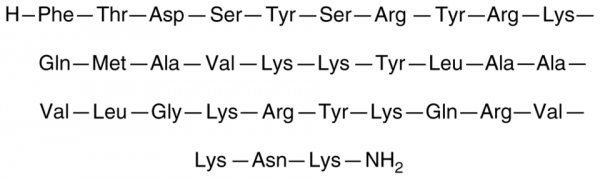
Pituitary adenylate cyclase-activating peptide (PACAP) (6-38) is a PACAP receptor antagonist with IC50 values of 30, 600, and 40 nM, respectively for rat PAC1, rat VPAC1, and human VPAC2 recombinant receptors expressed in CHO cells. It binds to PACAP receptors in rat brain membrane (IC50 = 39.14 nM) and to SH-SY5Y and SK-N-MC human neuroblastoma and T47D human breast cancer cells (IC50s = 2.9, 129, and 227 nM, respectively). In vivo, in newborn pigs, PACAP (6-38) (10 µM) inhibits vasodilation of pial arterioles induced by PACAP (1-38) (Cay-24770), the full-length peptide. It also inhibits decreased food intake and reduced body weight in rats induced by cocaine- and amphetamine-regulated transcript peptides (CARTp) following intracerebroventricular administration of 0.3-3 mol per animal doses.Formal Name: L-phenylalanyl-L-threonyl-L-alpha-aspartyl-L-seryl-L-tyrosyl-L-seryl-L-arginyl-L-tyrosyl-L-arginyl-L-lysyl-L-glutaminyl-L-methionyl-L-alanyl-L-valyl-L-lysyl-L-lysyl-L-tyrosyl-L-leucyl-L-alanyl-L-alanyl-L-valyl-L-leucylglycyl-L-lysyl-L-arginyl-L-tyrosyl-L-lysyl-L-glutaminyl-L-arginyl-L-valyl-L-lysyl-L-asparaginyl-L-lysinamide, trifluoroacetate salt. Synonyms: Pituitary Adenylate Cyclase-activating Peptide (6-38). Molecular Formula: C182H300N56O45S . XCF3COOH. Formula Weight: 4024.7. Purity: >95%. Formulation: (Request formulation change), A lyophilized powder. Solubility: Water: 1 mg/ml. SMILES: NC([C@H](CCCCN)NC([C@H](CC(N)=O)NC([C@H](CCCCN)NC([C@H](C(C)C)NC([C@H](CCCNC(N)=N)NC([C@H](CCC(N)=O)NC([C@H](CCCCN)NC([C@@H](NC([C@H](CCCNC(N)=N)NC([C@H](CCCCN)NC(CNC([C@H](CC(C)C)NC([C@H](C(C)C)NC([C@@H](NC([C@@H](NC([C@H](CC(C)C)NC([C@@H](NC([C@H](CCCCN)NC([C@H](CCCCN)NC([C@H](C(C)C)NC([C@@H](NC([C@@H](NC([C@H](CCC(N)=O)NC([C@H](CCCCN)NC([C@H](CCCNC(N)=N)NC([C@@H](NC([C@H](CCCNC(N)=N)NC([C@H](CO)NC([C@@H](NC([C@H](CO)NC([C@@H](NC([C@@]([C@@H](C)O)([H])NC([C@@H](N[H])CC1=CC=CC=C1)=O)=O)CC(O)=O)=O)=O)CC2=CC=C(O)C=C2)=O)=O)=O)CC3=CC=C(O)C=C3)=O)=O)=O)=O)CCSC)=O)C)=O)=O)=O)=O)CC4=CC=C(O)C=C4)=O)=O)C)=O)C)=O)=O)=O)=O)=O)=O)CC5=CC=C(O)C=C5)=O)=O)=O)=O)=O)=O)=O)=O.FC(F)(C(O)=O)F. InChi Code: InChI=1S/C182H300N56O45S.C2HF3O2/c1-95(2)83-128(152(257)207-92-141(249)211-115(40-20-27-72-184)154(259)215-122(47-34-79-204-180(197)198)161(266)226-130(86-105-50-58-109(242)59-51-105)167(272)217-117(42-22-29-74-186)156(261)220-125(66-68-138(191)246)163(268)216-124(49-36-81-206-182(201)202)165(270)237-145(99(9)10)176(281)224-120(45-25-32-77-189)160(265)230-134(90-140(193)248)171(276)212-114(147(194)252)39-19-26-71-183)231-177(282)144(98(7)8)236-149(254)101(12)208-148(253)100(11)210-166(271)129(84-96(3)4)225-169(274)132(88-107-54-62-111(244)63-55-107)228-159(264)118(43-23-30-75-187)214-157(262)119(44-24-31-76-188)223-175(280)143(97(5)6)235-150(255)102(13)209-153(258)127(70-82-284-15)222-164(269)126(67-69-139(192)247)221-155(260)116(41-21-28-73-185)213-158(263)121(46-33-78-203-179(195)196)218-168(273)131(87-106-52-60-110(243)61-53-106)227-162(267)123(48-35-80-205-181(199)200)219-173(278)136(93-239)233-170(275)133(89-108-56-64-112(245)65-57-108)229-174(279)137(94-240)234-172(277)135(91-142(250)251)232-178(283)146(103(14)241)238-151(256)113(190)85-104-37-17-16-18-38-104,3-2(4,5)1(6)7/h16-18,37-38,50-65,95-103,113-137,143-146,239-245H,19-36,39-49,66-94,183-190H2,1-15H3,(H2,191,246)(H2,192,247)(H2,193,248)(H2,194,252)(H,207,257)(H,208,253)(H,209,258)(H,210,271)(H,211,249)(H,212,276)(H,213,263)(H,214,262)(H,215,259)(H,216,268)(H,217,272)(H,218,273)(H,219,278)(H,220,261)(H,221,260)(H,222,269)(H,223,280)(H,224,281)(H,225,274)(H,226,266)(H,227,267)(H,228,264)(H,229,279)(H,230,265)(H,231,282)(H,232,283)(H,233,275)(H,234,277)(H,235,255)(H,236,254)(H,237,270)(H,238,256)(H,250,251)(H4,195,196,203)(H4,197,198,204)(H4,199,200,205)(H4,201,202,206),(H,6,7)/t100-,101-,102-,103+,113-,114-,115-,116-,117-,118-,119-,120-,121-,122-,123-,124-,125-,126-,127-,128-,129-,130-,131-,132-,133-,134-,135-,136-,137-,143-,144-,145-,146-,/m0./s1. InChi Key: VUTZKHJLSOPDFM-IKLXZCEOSA-N.
Keywords: Pituitary Adenylate Cyclase-activating Peptide (6-38), L-phenylalanyl-L-threonyl-L-alpha-aspartyl-L-seryl-L-tyrosyl-L-seryl-L-arginyl-L-tyrosyl-L-arginyl-L-lysyl-L-glutaminyl-L-methionyl-L-alanyl-L-valyl-L-lysyl-L-lysyl-L-tyrosyl-L-leucyl-L-alanyl-L-alany
Supplier: Cayman Chemical
Supplier-Nr: 24554

Properties

Application: PACAP receptor antagonist
Conjugate: No
MW: 4024.7 D
Formula: C182H300N56O45S . XCF3COOH
Purity: >95%
Format: Solid

Handling & Safety

Storage: -20°C
Shipping: +20°C (International: -20°C)
Caution
Our products are for laboratory research use only: Not for administration to humans!
You will get a certificate here
or to request a certificate of analysis.
Read, write and discuss reviews... more
Customer review for "PACAP (6-38) (human, chicken, mouse, ovine, porcine, rat) (trifluoroacetate salt)"
Write a review
or to review a product.
Viewed