This website uses cookies, which are necessary for the technical operation of the website and are always set. Other cookies, which increase the comfort when using this website, are used for direct advertising or to facilitate interaction with other websites and social networks, are only set with your consent.
Configuration
Technically required
These cookies are necessary for the basic functions of the shop.
"Allow all cookies" cookie
"Decline all cookies" cookie
CSRF token
Cookie preferences
Currency change
Customer-specific caching
FACT-Finder tracking
Individual prices
Selected shop
Session
Comfort functions
These cookies are used to make the shopping experience even more appealing, for example for the recognition of the visitor.
Note
Show the facebook fanpage in the right blod sidebar
Statistics & Tracking
Affiliate program
Conversion and usertracking via Google Tag Manager
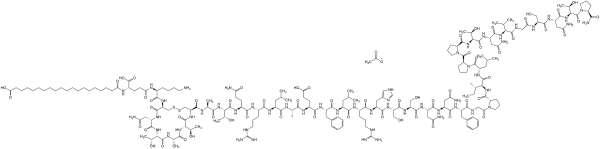
Cagrilintide is a novel long-acting nonselective amylin receptors (AMYR) and calcitonin G protein-coupled receptor (CTR) agonist. Cagrilintide is a stable synthetic peptide acylated amylin analog. Natural amylin is a pancreatic hormone that induces satiety. Cagrilintide binds human, mouse and rat amylin receptors and is used in studies of obesity and type 2 diabetes (T2D) and is designed enhancing energy expenditure and fat metabolism and decreasing food intake. Cagrilintide is now being developed in combination with the GLP-1 agonist semaglutide as "CagriSema" to achieve sustained weight loss in persons with overweight and obesity. Amylin, released with insulin from beta cells in the pancreas, induces its satiating effect via both the homoeostatic and hedonic regions of the brain. Semaglutide, a GLP-1 receptor agonist, reduces appetite via GLP-1 receptors in the hypothalamus and increases the production of insulin, and reduces glucagon secretion, delaying gastric emptying. These separate, but related mechanisms of action of an amylin-analog and a GLP-1 receptor agonist appear to have an additive effect on appetite reduction. Cagrilintide comprises a 37 amino acid linear synthetic peptide conjugated to a C20 fatty diacid through a hydrophilic linker at the lysine residue at position 1. Due to this moiety, the compound is highly bound to albumin in the plasma which prolongs its half-life. The N-terminus of the amylin peptide is predicted to form a loop, stabilized by a disulfide bond, that points out of the TM area, thereby tolerating N-terminal lipidation.
This website uses cookies, which are necessary for the technical operation of the website and are always set. Other cookies, which increase the usability of this website, serve for direct advertising or simplify interaction with other websites and social networks, will only be used with your consent.
More information