This website uses cookies, which are necessary for the technical operation of the website and are always set. Other cookies, which increase the comfort when using this website, are used for direct advertising or to facilitate interaction with other websites and social networks, are only set with your consent.
Configuration
Technically required
These cookies are necessary for the basic functions of the shop.
"Allow all cookies" cookie
"Decline all cookies" cookie
CSRF token
Cookie preferences
Currency change
Customer-specific caching
FACT-Finder tracking
Individual prices
Selected shop
Session
Comfort functions
These cookies are used to make the shopping experience even more appealing, for example for the recognition of the visitor.
Note
Show the facebook fanpage in the right blod sidebar
Statistics & Tracking
Affiliate program
Conversion and usertracking via Google Tag Manager
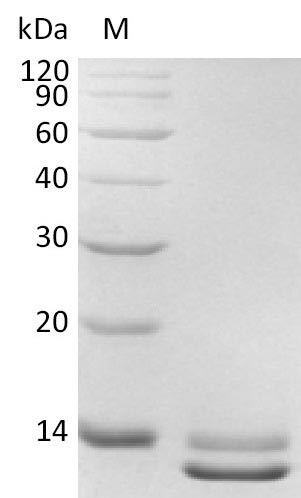
Organism: Homo sapiens (Human). Source: Mammalian cell. Expression Region: 301-412aa(Y340F). Protein Length: Partial. Tag Info: Tag-Free. Target Protein Sequence: ALDTNYCFRN LEENCCVRPL YIDFRQDLGW KWVHEPKGYF ANFCSGPCPY LRSADTTHST VLGLYNTLNP EASASPCCVP QDLEPLTILY YVGRTPKVEQ LSNMVVKSCK CS. Purity: Greater than 95% as determined by SDS-PAGE. Endotoxin: Less than 1.0 EU/µg as determined by LAL method. Biological Activity: The ED50 as determined by its ability to inhibit the IL-4-dependent proliferation of TF-1 mouse T cells is 10-80 pg/ml. Form: Lyophilized powder. Buffer: Lyophilized from a 0.2 µm filtered solution of 50mM Glycine-HCl, 150mM NaCl, pH2.5. Reconstitution: We recommend that this vial be briefly centrifuged prior to opening to bring the contents to the bottom. Please reconstitute protein in deionized sterile water to a concentration of 0.1-1.0 mg/mL.We recommend to add 5-50% of glycerol (final concentration) and aliquot for long-term storage at -20 °C/-80 °C. Our default final concentration of glycerol is 50%. Customers could use it as reference. Storage: The shelf life is related to many factors, storage state, buffer ingredients, storage temperature and the stability of the protein itself. Generally, the shelf life of liquid form is 6 months at -20 °C/-80 °C. The shelf life of lyophilized form is 12 months at -20 °C/-80 °C. Notes: Repeated freezing and thawing is not recommended. Store working aliquots at 4 °C for up to one week. Relevance: Transforming growth factor beta 3(TGFB3) is a member of a TGF -beta superfamily which is defined by theirstructural and functional similarities. TGFB3 is secreted as a complex with LAP. This latent form of TGFB3becomes active upon cleavage by plasmin, matrix metalloproteases, thrombospondin -1, and a subset ofintegrins. It binds with high affinity to TGF- beta RII, a type II serine/threonine kinase receptor. TGFB3 is involved incell differentiation, embryogenesis and development.It is believed to regulate molecules involved in cellularadhesion and extracellular matrix (ECM) formation during the process of palate development. Without TGF-beta3,mammals develop a deformity known as a cleft palate. Reference: n/a. Function: Involved in embryogenesis and cell differentiation.
Keywords:
TGFB3, Recombinant Human Transforming growth factor beta-3 (TGFB3), partial (Active)
This website uses cookies, which are necessary for the technical operation of the website and are always set. Other cookies, which increase the usability of this website, serve for direct advertising or simplify interaction with other websites and social networks, will only be used with your consent.
More information