This website uses cookies, which are necessary for the technical operation of the website and are always set. Other cookies, which increase the comfort when using this website, are used for direct advertising or to facilitate interaction with other websites and social networks, are only set with your consent.
Configuration
Technically required
These cookies are necessary for the basic functions of the shop.
"Allow all cookies" cookie
"Decline all cookies" cookie
CSRF token
Cookie preferences
Currency change
Customer-specific caching
FACT-Finder tracking
Individual prices
Selected shop
Session
Comfort functions
These cookies are used to make the shopping experience even more appealing, for example for the recognition of the visitor.
Note
Show the facebook fanpage in the right blod sidebar
Statistics & Tracking
Affiliate program
Conversion and usertracking via Google Tag Manager
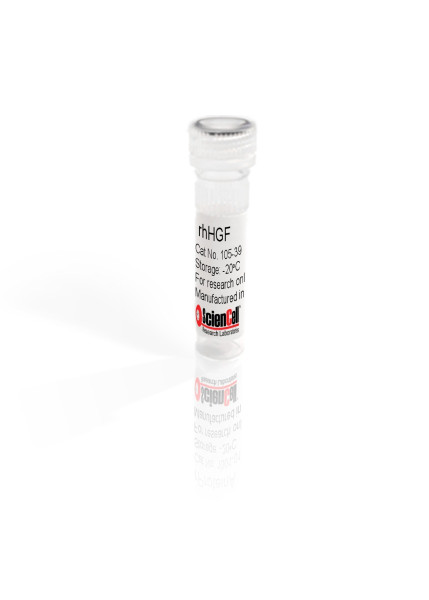
Product information "Recombinant Human Hepatocyte Growth Factor"
Hepatocyte Growth Factor (HGF), also known as scatter factor or hepatopoietin A, is a pleiotropic cytokine belonging to the plasminogen-related S1 serine protease family. Structurally, HGF contains an N-terminal PAN/APPLE-like domain, four kringle domains, and a C-terminal serine protease-like domain lacking enzymatic activity. Human HGF is synthesized as an inactive 728 amino acid single-chain precursor that is proteolytically cleaved into an active disulfide-linked heterodimer consisting of an ~60 kDa alpha-chain and ~30 kDa beta-chain. Alternative splicing generates multiple isoforms with truncated domain composition. HGF is highly conserved across mammalian species (>90% sequence identity). HGF binds heparan sulfate proteoglycans and signals through the receptor tyrosine kinase c-MET. Activation of the HGF/c-MET pathway regulates cell proliferation, motility, and morphogenesis, and is implicated in tumor development and progression. Functionally, HGF promotes epithelial cell scattering and branching morphogenesis, partly through upregulation of integrin alpha2beta1, a collagen I receptor. It also modulates cell-cell adhesion via induction of nectin-1 ectodomain shedding. In thyroid cells, HGF stimulates proliferation and migration while suppressing differentiation and TSH-dependent iodine uptake. Additionally, HGF enhances migration of cardiac stem cells in damaged myocardium.
This website uses cookies, which are necessary for the technical operation of the website and are always set. Other cookies, which increase the usability of this website, serve for direct advertising or simplify interaction with other websites and social networks, will only be used with your consent.
More information