
Cookie preferences
This website uses cookies, which are necessary for the technical operation of the website and are always set. Other cookies, which increase the comfort when using this website, are used for direct advertising or to facilitate interaction with other websites and social networks, are only set with your consent.
Configuration
Technically required
These cookies are necessary for the basic functions of the shop.
"Allow all cookies" cookie
"Decline all cookies" cookie
CSRF token
Cookie preferences
Currency change
Customer-specific caching
FACT-Finder tracking
Individual prices
Selected shop
Session
Comfort functions
These cookies are used to make the shopping experience even more appealing, for example for the recognition of the visitor.
Note
Show the facebook fanpage in the right blod sidebar
Statistics & Tracking
Affiliate program
Conversion and usertracking via Google Tag Manager
Track device being used

If you have any questions, please use our Contact Form.
You can also order by e-mail: info@biomol.com
Larger quantity required? Request bulk
You can also order by e-mail: info@biomol.com
Larger quantity required? Request bulk
Organism: Homo sapiens (Human). Source: E.coli. Expression Region: 23-206aa. Protein Length:... more
Product information "Neurosecretory protein VGF (VGF), partial, human, recombinant"
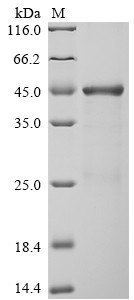
Organism: Homo sapiens (Human). Source: E.coli. Expression Region: 23-206aa. Protein Length: Partial. Tag Info: N-terminal 10xHis-GST-tagged and C-terminal Myc-tagged. Target Protein Sequence: APPGRPEAQP PPLSSEHKEP VAGDAVPGPK DGSAPEVRGA RNSEPQDEGE LFQGVDPRAL AAVLLQALDR PASPPAPSGS QQGPEEEAAE ALLTETVRSQ THSLPAPESP EPAAPPRPQT PENGPEASDP SEELEALASL LQELRDFSPS SAKRQQETAA AETETRTHTL TRVNLESPGP ERVW. Purity: Greater than 85% as determined by SDS-PAGE. Endotoxin: Not test. Biological Activity: n/a. Form: Liquid or Lyophilized powder. Buffer: If the delivery form is liquid, the default storage buffer is Tris/PBS-based buffer, 5%-50% glycerol. If the delivery form is lyophilized powder, the buffer before lyophilization is Tris/PBS-based buffer, 6% Trehalose, pH 8.0. Reconstitution: We recommend that this vial be briefly centrifuged prior to opening to bring the contents to the bottom. Please reconstitute protein in deionized sterile water to a concentration of 0.1-1.0 mg/mL.We recommend to add 5-50% of glycerol (final concentration) and aliquot for long-term storage at -20 °C/-80 °C. Our default final concentration of glycerol is 50%. Customers could use it as reference. Storage: The shelf life is related to many factors, storage state, buffer ingredients, storage temperature and the stability of the protein itself. Generally, the shelf life of liquid form is 6 months at -20 °C/-80 °C. The shelf life of lyophilized form is 12 months at -20 °C/-80 °C. Notes: Repeated freezing and thawing is not recommended. Store working aliquots at 4 °C for up to one week. Relevance: [Neurosecretory protein VGF]: Secreted polyprotein that is packaged and proteolytically processed by prohormone convertases PCSK1 and PCSK2 in a cell-type-specific manner. VGF and peptides derived from its processing play many roles in neurogenesis and neuroplasticity associated with learning, memory, depression and chronic pain., [Neuroendocrine regulatory peptide-1]: Plays a role in the control of body fluid homeostasis by regulating vasopressin release. Suppresses presynaptic glutamatergic neurons connected to vasopressin neurons., [Neuroendocrine regulatory peptide-2]: Plays a role in the control of body fluid homeostasis by regulating vasopressin release. Activates GABAergic interneurons which are inhibitory neurons of the nervous system and thereby suppresses presynaptic glutamatergic neurons. Stimulates also feeding behavior in an orexin-dependent manner in the hypothalamus. Functions as a positive regulator for the activation of orexin neurons resulting in elevated gastric acid secretion and gastric emptying., [VGF-derived peptide TLQP-21]: Secreted multifunctional neuropeptide that binds to different cell receptors and thereby plays multiple physiological roles including modulation of energy expenditure, pain, response to stress, gastric regulation, glucose homeostasis as well as lipolysis. Activates the G-protein-coupled receptor C3AR1 via a folding-upon-binding mechanism leading to enhanced lipolysis in adipocytes. Interacts with C1QBP receptor in macrophages and microglia causing increased levels of intracellular calcium and hypersensitivity., [VGF-derived peptide TLQP-62]: Plays a role in the regulation of memory formation and depression-related behaviors potentially by influencing synaptic plasticity and neurogenesis. Induces acute and transient activation of the NTRK2/TRKB receptor and subsequent CREB phosphorylation. Induces also insulin secretion in insulinoma cells by increasing intracellular calcium mobilization., [Antimicrobial peptide VGF[554-577]]: Has bactericidal activity against M. luteus, and antifungal activity against P. Pastoris. Reference: "Large-scale identification of endogenous secretory peptides using electron transfer dissociation mass spectrometry." Sasaki K., Osaki T., Minamino N. Mol. Cell. Proteomics 12:700-709(2013). Function: nan
| Keywords: | VGF, Recombinant Human Neurosecretory protein VGF (VGF), partial |
| Supplier: | Cusabio |
| Supplier-Nr: | EP025847HU1 |
Properties
| Application: | Activity not tested |
| Conjugate: | No |
| Host: | E.coli |
| Species reactivity: | human |
| MW: | 54.6 kD |
| Purity: | >85% (SDS-PAGE) |
Database Information
| UniProt ID : | O15240 | Matching products |
| Gene ID : | GeneID 7425 | Matching products |
Handling & Safety
| Storage: | -20°C |
| Shipping: | +4°C (International: +4°C) |
Caution
Our products are for laboratory research use only: Not for administration to humans!
Our products are for laboratory research use only: Not for administration to humans!
You will get a certificate here
Viewed