Cookie preferences
This website uses cookies, which are necessary for the technical operation of the website and are always set. Other cookies, which increase the comfort when using this website, are used for direct advertising or to facilitate interaction with other websites and social networks, are only set with your consent.
Configuration
Technically required
These cookies are necessary for the basic functions of the shop.
"Allow all cookies" cookie
"Decline all cookies" cookie
CSRF token
Cookie preferences
Currency change
Customer-specific caching
FACT-Finder tracking
Individual prices
Selected shop
Session
Comfort functions
These cookies are used to make the shopping experience even more appealing, for example for the recognition of the visitor.
Note
Show the facebook fanpage in the right blod sidebar
Statistics & Tracking
Affiliate program
Conversion and usertracking via Google Tag Manager
Track device being used
If you have any questions, please use our Contact Form.
You can also order by e-mail: info@biomol.com
Larger quantity required? Request bulk
You can also order by e-mail: info@biomol.com
Larger quantity required? Request bulk
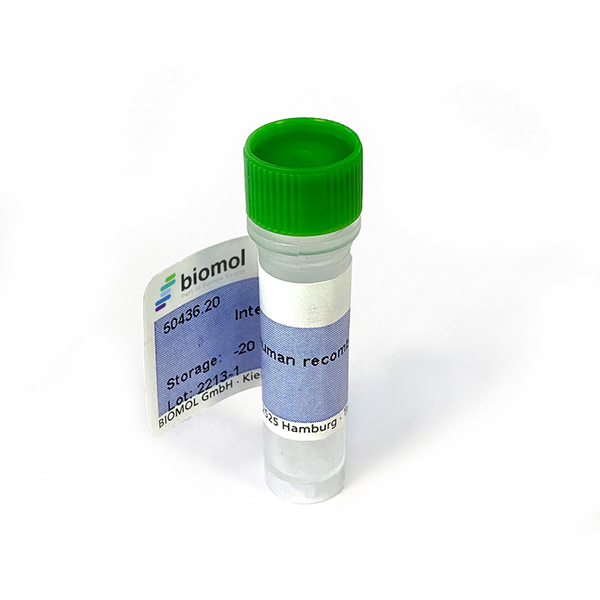
Cardiotrophin-1 rat recombinant produced in E. coli is a single, non-glycosylated, polypeptide... more
Product information "Cardiotrophin-1, rat recombinant (rrCT-1)"
Cardiotrophin-1 rat recombinant produced in E. coli is a single, non-glycosylated, polypeptide chain containing 203 amino acids and having a molecular mass of 21.4 kDa. Cardiotrophin 1 (CT-1) is a 201 amino acid member of the interleukin-6 superfamily. It was identified by its ability to induce hypertrophic response in cardiac myocytes. CT-1 mRNA levels were found both in cardiac myocytes and in cardiac nonmyocytes. CT-1 was also detected in abundance in normal adult human lung and was expressed in both fetal and adult airway smooth muscle cells. CT-1 activates gp130 dependent signaling and stimulates the Janus kinase/signal transducers and activators of transcription (JAK/STAT) pathway to transduce hypertrophic and cytoprotective signals in cardiac myocytes.CT-1 has also a neurotrophic function. CTF1 deficiency causes increased motoneuron cell death in spinal cord and brainstem nuclei of mice during a period between embryonic day 14 and the first postnatal week. Moreover, CT-1 is a hepatocyte survival factor that efficiently reduces hepatocellular damage in animal models of acute liver injury. Cardiotrophin 1 expression is augmented after hypoxic stimulation and it can protect cardiac cells when added either prior to simulated ischaemia or at the time of reoxygenation following simulated ischaemia. Cardiotrophin-1 can induce expression of the protective heat shock proteins (hsps) in cardiac cells. Cardiotrophin-1 increased ventricular expression of ANP, brain natriuretic peptide (BNP) and angiotensinogen mRNA. Cardiophin-1 levels were significantly elevated in patients with heart failure, patients with dilatative cardiomyopathy, moderate/severe mitral regurgitation, stable and unstable angina and after acute myocardial infarction. The ED50 as determined by the dose-dependent proliferation of TF-1 cells was found to be < 0.5ng/ml, corresponding to a specific activity of > 2.0 × 10⁶ units/mg.
| Keywords: | CTF1, CT1, CT-1, Cardiophin 1. |
| Supplier: | Biomol GmbH |
| Supplier-Nr: | 97636 |
Properties
| Application: | Cell culture |
| Conjugate: | No |
| Host: | E.coli |
| Species reactivity: | rat |
| MW: | 21400 D |
| Purity: | >95% |
| Format: | Lyophilized |
Database Information
| KEGG ID : | K05422 | Matching products |
| UniProt ID : | Q63086 | Matching products |
| Gene ID : | GeneID 29201 | Matching products |
Handling & Safety
| Storage: | -20°C |
| Shipping: | +20°C (International: +20°C) |
Caution
Our products are for laboratory research use only: Not for administration to humans!
Information about the product reference will follow.
more
You will get a certificate here
Viewed