
Cookie preferences
This website uses cookies, which are necessary for the technical operation of the website and are always set. Other cookies, which increase the comfort when using this website, are used for direct advertising or to facilitate interaction with other websites and social networks, are only set with your consent.
Configuration
Technically required
These cookies are necessary for the basic functions of the shop.
"Allow all cookies" cookie
"Decline all cookies" cookie
CSRF token
Cookie preferences
Currency change
Customer-specific caching
FACT-Finder tracking
Individual prices
Selected shop
Session
Comfort functions
These cookies are used to make the shopping experience even more appealing, for example for the recognition of the visitor.
Note
Show the facebook fanpage in the right blod sidebar
Statistics & Tracking
Affiliate program
Conversion and usertracking via Google Tag Manager
Track device being used

If you have any questions, please use our Contact Form.
You can also order by e-mail: info@biomol.com
Larger quantity required? Request bulk
You can also order by e-mail: info@biomol.com
Larger quantity required? Request bulk
Organism: Homo sapiens (Human). Source: Mammalian cell. Expression Region: 47-631aa. Protein... more
Product information "Sphingomyelin phosphodiesterase (SMPD1), human, recombinant"
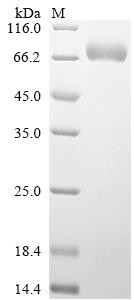
Organism: Homo sapiens (Human). Source: Mammalian cell. Expression Region: 47-631aa. Protein Length: Full Length of Mature Protein. Tag Info: C-terminal 10xHis-tagged. Target Protein Sequence: LALSDSRVLW APAEAHPLSP QGHPARLHRI VPRLRDVFGW GNLTCPICKG LFTAINLGLK KEPNVARVGS VAIKLCNLLK IAPPAVCQSI VHLFEDDMVE VWRRSVLSPS EACGLLLGST CGHWDIFSSW NISLPTVPKP PPKPPSPPAP GAPVSRILFL TDLHWDHDYL EGTDPDCADP LCCRRGSGLP PASRPGAGYW GEYSKCDLPL RTLESLLSGL GPAGPFDMVY WTGDIPAHDV WHQTRQDQLR ALTTVTALVR KFLGPVPVYP AVGNHESTPV NSFPPPFIEG NHSSRWLYEA MAKAWEPWLP AEALRTLRIG GFYALSPYPG LRLISLNMNF CSRENFWLLI NSTDPAGQLQ WLVGELQAAE DRGDKVHIIG HIPPGHCLKS WSWNYYRIVA RYENTLAAQF FGHTHVDEFE VFYDEETLSR PLAVAFLAPS ATTYIGLNPG YRVYQIDGNY SGSSHVVLDH ETYILNLTQA NIPGAIPHWQ LLYRARETYG LPNTLPTAWH NLVYRMRGDM QLFQTFWFLY HKGHPPSEPC GTPCRLATLC AQLSARADSP ALCRHLMPDG SLPEAQSLWP RPLFC. Purity: Greater than 90% as determined by SDS-PAGE. Endotoxin: Not test. Biological Activity: n/a. Form: Liquid or Lyophilized powder. Buffer: If the delivery form is liquid, the default storage buffer is Tris/PBS-based buffer, 5%-50% glycerol. If the delivery form is lyophilized powder, the buffer before lyophilization is Tris/PBS-based buffer, 6% Trehalose, pH 8.0. Reconstitution: We recommend that this vial be briefly centrifuged prior to opening to bring the contents to the bottom. Please reconstitute protein in deionized sterile water to a concentration of 0.1-1.0 mg/mL.We recommend to add 5-50% of glycerol (final concentration) and aliquot for long-term storage at -20 °C/-80 °C. Our default final concentration of glycerol is 50%. Customers could use it as reference. Storage: The shelf life is related to many factors, storage state, buffer ingredients, storage temperature and the stability of the protein itself. Generally, the shelf life of liquid form is 6 months at -20 °C/-80 °C. The shelf life of lyophilized form is 12 months at -20 °C/-80 °C. Notes: Repeated freezing and thawing is not recommended. Store working aliquots at 4 °C for up to one week. Relevance: Converts sphingomyelin to ceramide. Exists as two enzymatic forms that arise from alternative trafficking of a single protein precursor, one that is targeted to the endolysosomal compartment, whereas the other is released extracellularly. However, in response to various forms of stress, lysosomal exocytosis may represent a major source of the secretory form. , In the lysosomes, converts sphingomyelin to ceramide. Plays an important role in the export of cholesterol from the intraendolysosomal membranes. Also has phospholipase C activities toward 1,2-diacylglycerolphosphocholine and 1,2-diacylglycerolphosphoglycerol. Modulates stress-induced apoptosis through the production of ceramide. , When secreted, modulates cell signaling with its ability to reorganize the plasma membrane by converting sphingomyelin to ceramide. Secreted form is increased in response to stress and inflammatory mediators such as IL1B, IFNG or TNF as well as upon infection with bacteria and viruses. Produces the release of ceramide in the outer leaflet of the plasma membrane playing a central role in host defense. Ceramide reorganizes these rafts into larger signaling platforms that are required to internalize P. aeruginosa, induce apoptosis and regulate the cytokine response in infected cells. In wounded cells, the lysosomal form is released extracellularly in the presence of Ca(2+) and promotes endocytosis and plasma membrane repair. , [Sphingomyelin phosphodiesterase, processed form]: This form is generated following cleavage by CASP7 in the extracellular milieu in response to bacterial infection. It shows increased ability to convert sphingomyelin to ceramide and promotes plasma membrane repair. Plasma membrane repair by ceramide counteracts the action of gasdermin-D (GSDMD) perforin (PRF1) pores that are formed in response to bacterial infection. , (Microbial infection) Secretion is activated by bacteria such as P. aeruginos, N. gonorrhoeae and others, this activation results in the release of ceramide in the outer leaflet of the plasma membrane which facilitates the infection. , (Microbial infection) Secretion is activated by human coronaviruses SARS-CoV and SARS-CoV-2 as well as Zaire ebolavirus, this activation results in the release of ceramide in the outer leaflet of the plasma membrane which facilitates the infection. , [Isoform 2]: Lacks residues that bind the cofactor Zn(2+) and has no enzyme activity. , [Isoform 3]: Lacks residues that bind the cofactor Zn(2+) and has no enzyme activity. Reference: "Regulated secretion of acid sphingomyelinase: implications for selectivity of ceramide formation." Jenkins R.W., Canals D., Idkowiak-Baldys J., Simbari F., Roddy P., Perry D.M., Kitatani K., Luberto C., Hannun Y.A. J. Biol. Chem. 285:35706-35718(2010). Function: nan
| Keywords: | aSMase, Acid sphingomyelinase, Sphingomyelin phosphodiesterase, Recombinant Human Sphingomyelin phosphodiesterase (SMPD1) |
| Supplier: | Cusabio |
| Supplier-Nr: | MP021845HU |
Properties
| Application: | Activity not tested |
| Conjugate: | No |
| Host: | Mammalian cells |
| Species reactivity: | human |
| MW: | 66.6 kD |
| Purity: | >90% (SDS-PAGE) |
Database Information
| KEGG ID : | K12350 | Matching products |
| UniProt ID : | P17405 | Matching products |
| Gene ID : | GeneID 6609 | Matching products |
Handling & Safety
| Storage: | -20°C |
| Shipping: | +4°C (International: +4°C) |
Caution
Our products are for laboratory research use only: Not for administration to humans!
Our products are for laboratory research use only: Not for administration to humans!
You will get a certificate here
Viewed