
Cookie preferences
This website uses cookies, which are necessary for the technical operation of the website and are always set. Other cookies, which increase the comfort when using this website, are used for direct advertising or to facilitate interaction with other websites and social networks, are only set with your consent.
Configuration
Technically required
These cookies are necessary for the basic functions of the shop.
"Allow all cookies" cookie
"Decline all cookies" cookie
CSRF token
Cookie preferences
Currency change
Customer-specific caching
FACT-Finder tracking
Individual prices
Selected shop
Session
Comfort functions
These cookies are used to make the shopping experience even more appealing, for example for the recognition of the visitor.
Note
Show the facebook fanpage in the right blod sidebar
Statistics & Tracking
Affiliate program
Conversion and usertracking via Google Tag Manager
Track device being used

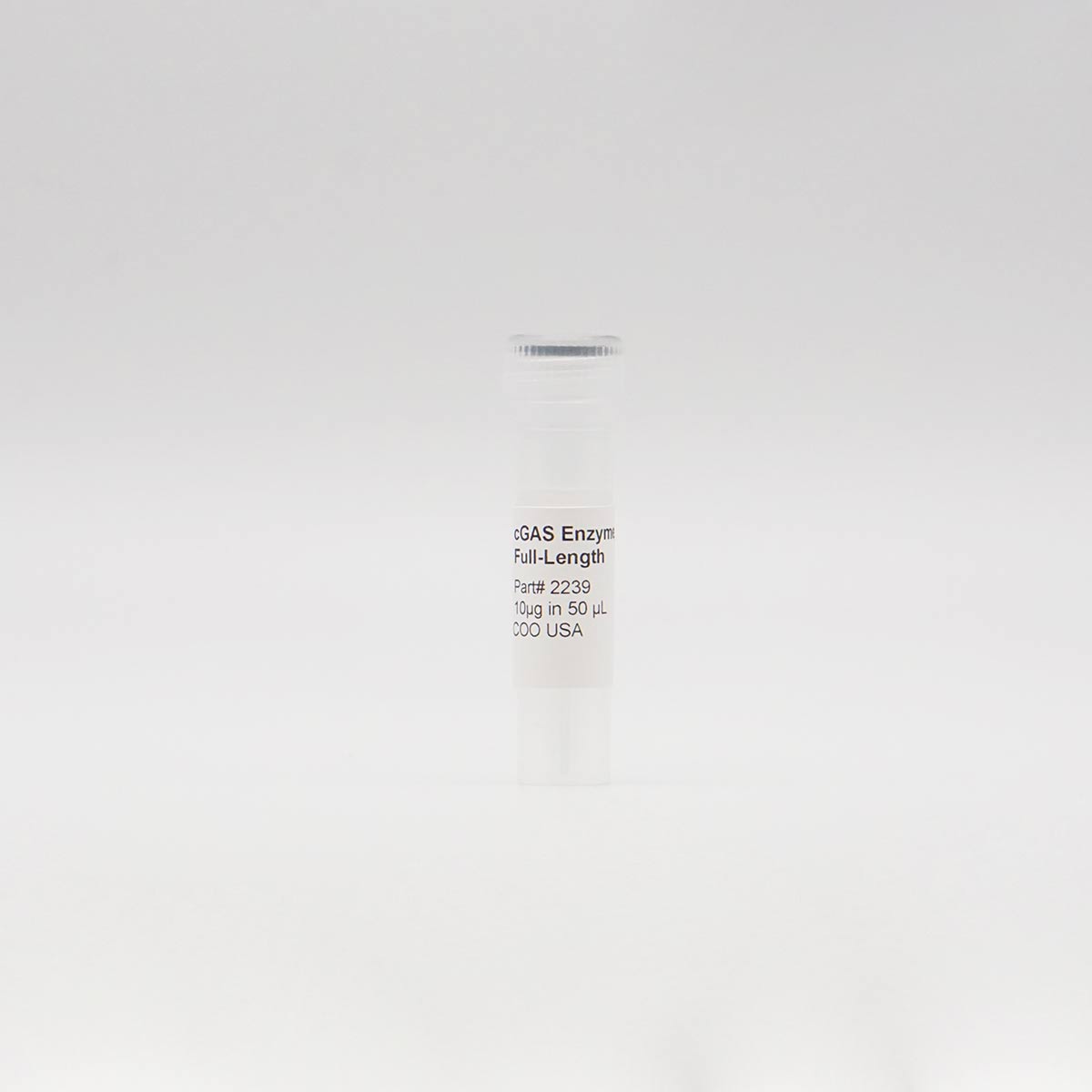
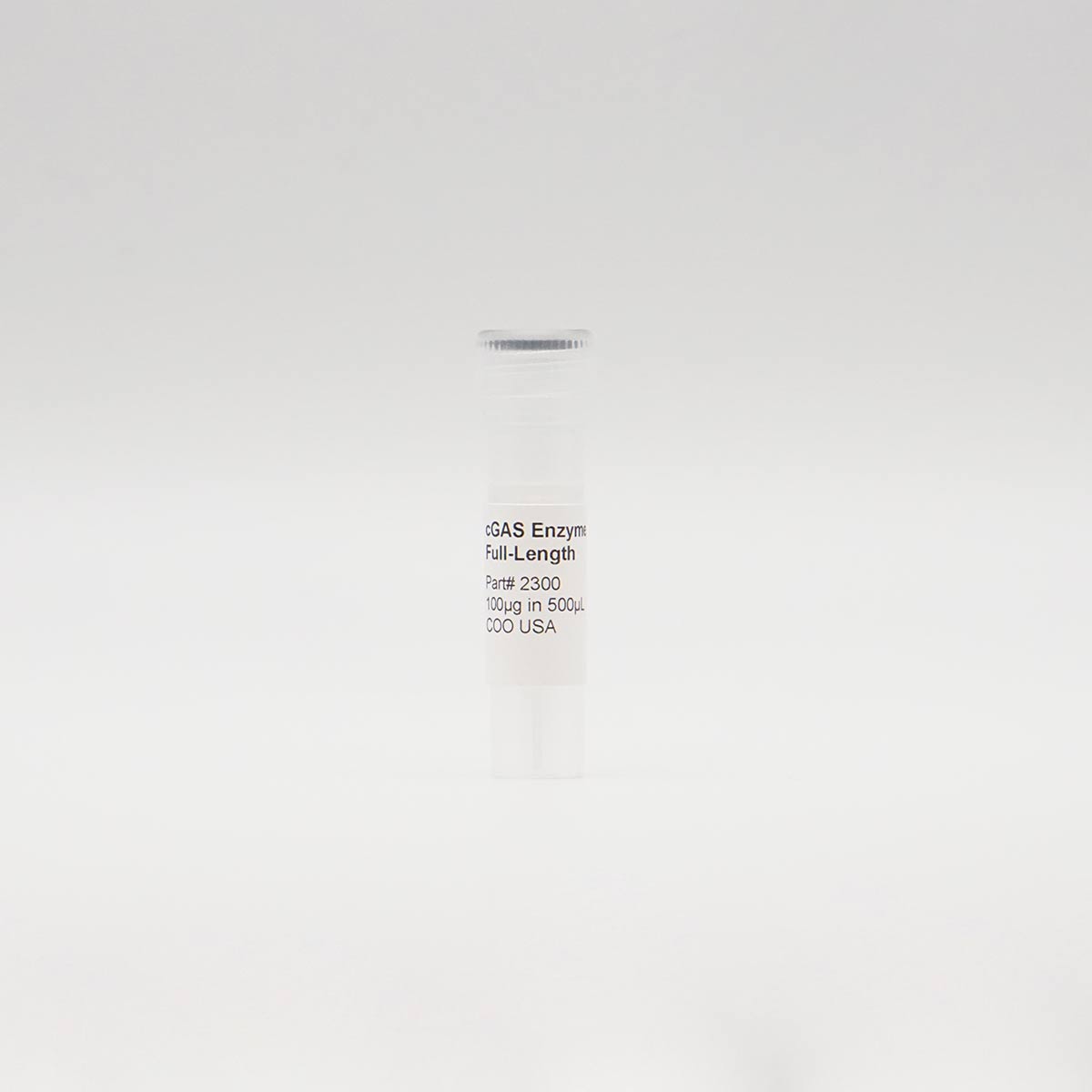

| Item number | Size | Datasheet | Manual | SDS | Delivery time | Quantity | Price |
|---|---|---|---|---|---|---|---|
| BBL-2239 | 10 µg | - | - |
10 - 15 business days* |
500.00€
|
||
| BBL-2300 | 100 µg | - | - |
10 - 15 business days* |
1,708.00€
|
If you have any questions, please use our Contact Form.
You can also order by e-mail: info@biomol.com
Larger quantity required? Request bulk
You can also order by e-mail: info@biomol.com
Larger quantity required? Request bulk
Active, full-length Mouse Cyclic GMP-AMP synthase enzyme, His-tagged protein expressed and... more
Product information "Recombinant cGAS Enzyme, Active, Mouse, Full-Length"
Active, full-length Mouse Cyclic GMP-AMP synthase enzyme, His-tagged protein expressed and purified from E.coli. The enzyme has been thoroughly validated with Transcreener cGAS Activity Assays. For specific activity, please refer to the Certificate of Analysis for each individual enzyme lot. Purity is >79% in a 10mM Tris 8.0, 50mM NaCl, 1mM TCEP, 10% glycerol buffer composition. Protein Function: Nucleotidyltransferase that catalyzes the formation of cyclic GMP-AMP (2',3'-cGAMP) from ATP and GTP and plays a key role in innate immunity (PubMed:23258413, PubMed:23647843, PubMed:23722158, PubMed:26829768, PubMed:28214358, PubMed:29426904, PubMed:29625897, PubMed:32814054). Catalysis involves both the formation of a 2',5' phosphodiester linkage at the GpA step and the formation of a 3',5' phosphodiester linkage at the ApG step, producing c[G(2',5')pA(3',5')p] (PubMed:23258413, PubMed:23647843, PubMed:23722158, PubMed:26829768, PubMed:28214358). Acts as a key DNA sensor: directly binds double-stranded DNA (dsDNA), inducing the formation of liquid-like droplets in which CGAS is activated, leading to synthesis of 2',3'-cGAMP, a second messenger that binds to and activates STING1, thereby triggering type-I interferon production (PubMed:23722158, PubMed:28095500, PubMed:28314590, PubMed:28363908, PubMed:39322678). Preferentially binds long dsDNA (around 45 bp) and forms ladder-like networks that function cooperatively to stabilize individual cGAS-dsDNA complexes (PubMed:28902841). Acts as a key foreign DNA sensor, the presence of double-stranded DNA (dsDNA) in the cytoplasm being a danger signal that triggers the immune responses (PubMed:23722158, PubMed:28314590, PubMed:28363908). Has antiviral activity by sensing the presence of dsDNA from DNA viruses in the cytoplasm (PubMed:23258413, PubMed:23647843, PubMed:23722158). Also acts as an innate immune sensor of infection by retroviruses by detecting the presence of reverse-transcribed DNA in the cytosol (PubMed:23929945). Detection of retroviral reverse-transcribed DNA in the cytosol may be indirect and be mediated via interaction with PQBP1, which directly binds reverse-transcribed retroviral DNA (By similarity). Also detects the presence of DNA from bacteria (By similarity). 2',3'-cGAMP can be transferred from producing cells to neighboring cells through gap junctions, leading to promote STING1 activation and convey immune response to connecting cells (PubMed:24077100). 2',3'-cGAMP can also be transferred between cells by virtue of packaging within viral particles contributing to IFN-induction in newly infected cells in a cGAS-independent but STING1-dependent manner (PubMed:26229117). Also senses the presence of neutrophil extracellular traps (NETs) that are translocated to the cytosol following phagocytosis, leading to synthesis of 2',3'-cGAMP (PubMed:33688080). In addition to foreign DNA, can also be activated by endogenous nuclear or mitochondrial DNA (By similarity). When self-DNA leaks into the cytosol during cellular stress (such as mitochondrial stress, DNA damage, mitotic arrest or senescence), or is present in form of cytosolic micronuclei, CGAS is activated leading to a state of sterile inflammation (PubMed:28738408, PubMed:28759028). Acts as a regulator of cellular senescence by binding to cytosolic chromatin fragments that are present in senescent cells, leading to trigger type-I interferon production via STING1 and promote cellular senescence (PubMed:28759028). Also involved in the inflammatory response to genome instability and double-stranded DNA breaks: acts by localizing to micronuclei arising from genome instability (PubMed:28738408). Micronuclei, which as frequently found in cancer cells, consist of chromatin surrounded by its own nuclear membrane: following breakdown of the micronuclear envelope, a process associated with chromothripsis, CGAS binds self-DNA exposed to the cytosol, leading to 2',3'-cGAMP synthesis and subsequent activation of STING1 and type-I interferon production (PubMed:28738408). In a healthy cell, CGAS is however kept inactive even in cellular events that directly expose it to self-DNA, such as mitosis, when cGAS associates with chromatin directly after nuclear envelope breakdown or remains in the form of postmitotic persistent nuclear cGAS pools bound to chromatin (By similarity). Nuclear CGAS is inactivated by chromatin via direct interaction with nucleosomes, which block CGAS from DNA binding and thus prevent CGAS-induced autoimmunity (PubMed:31808743, PubMed:32911480, PubMed:32911481, PubMed:32913000). Also acts as a suppressor of DNA repair in response to DNA damage: inhibits homologous recombination repair by interacting with PARP1, the CGAS-PARP1 interaction leading to impede the formation of the PARP1-TIMELESS complex (PubMed:30356214, PubMed:31544964, PubMed:35210392). In addition to DNA, also sense translation stress: in response to translation stress, translocates to the cytosol and associates with collided ribosomes, promoting its activation and triggering type-I interferon production (By similarity) [The Uniprot Consortium]
| Keywords: | Cgas, 2'3'-cGAMP synthase, Cyclic GMP-AMP synthase, Mab-21 domain-containing protein 1 |
| Supplier: | BellBrook Labs |
| Supplier-Nr: | 2239 |
Properties
| Application: | HTS, drug discovery, enzyme assays |
| Conjugate: | No |
| Host: | E.coli |
| Species reactivity: | mouse |
Database Information
| KEGG ID : | K17834 | Matching products |
| UniProt ID : | Q8C6L5 | Matching products |
| Gene ID : | GeneID 214763 | Matching products |
Handling & Safety
| Storage: | -80°C |
| Shipping: | -80°C (International: -80°C) |
Caution
Our products are for laboratory research use only: Not for administration to humans!
Our products are for laboratory research use only: Not for administration to humans!
You will get a certificate here
Viewed