
Cookie preferences
This website uses cookies, which are necessary for the technical operation of the website and are always set. Other cookies, which increase the comfort when using this website, are used for direct advertising or to facilitate interaction with other websites and social networks, are only set with your consent.
Configuration
Technically required
These cookies are necessary for the basic functions of the shop.
"Allow all cookies" cookie
"Decline all cookies" cookie
CSRF token
Cookie preferences
Currency change
Customer-specific caching
FACT-Finder tracking
Individual prices
Selected shop
Session
Comfort functions
These cookies are used to make the shopping experience even more appealing, for example for the recognition of the visitor.
Note
Show the facebook fanpage in the right blod sidebar
Statistics & Tracking
Affiliate program
Conversion and usertracking via Google Tag Manager
Track device being used

If you have any questions, please use our Contact Form.
You can also order by e-mail: info@biomol.com
Larger quantity required? Request bulk
You can also order by e-mail: info@biomol.com
Larger quantity required? Request bulk
Organism: Homo sapiens (Human). Source: Mammalian cell. Expression Region: 1-533aa. Protein... more
Product information "Protein mono-ADP-ribosyltransferase PARP3 (PARP3), human, recombinant"
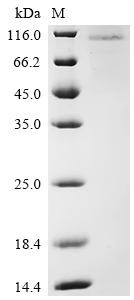
Organism: Homo sapiens (Human). Source: Mammalian cell. Expression Region: 1-533aa. Protein Length: Full Length. Tag Info: N-terminal 10xHis-tagged and C-terminal hFc-tagged. Target Protein Sequence: MAPKPKPWVQ TEGPEKKKGR QAGREEDPFR STAEALKAIP AEKRIIRVDP TCPLSSNPGT QVYEDYNCTL NQTNIENNNN KFYIIQLLQD SNRFFTCWNR WGRVGEVGQS KINHFTRLED AKKDFEKKFR EKTKNNWAER DHFVSHPGKY TLIEVQAEDE AQEAVVKVDR GPVRTVTKRV QPCSLDPATQ KLITNIFSKE MFKNTMALMD LDVKKMPLGK LSKQQIARGF EALEALEEAL KGPTDGGQSL EELSSHFYTV IPHNFGHSQP PPINSPELLQ AKKDMLLVLA DIELAQALQA VSEQEKTVEE VPHPLDRDYQ LLKCQLQLLD SGAPEYKVIQ TYLEQTGSNH RCPTLQHIWK VNQEGEEDRF QAHSKLGNRK LLWHGTNMAV VAAILTSGLR IMPHSGGRVG KGIYFASENS KSAGYVIGMK CGAHHVGYMF LGEVALGREH HINTDNPSLK SPPPGFDSVI ARGHTEPDPT QDTELELDGQ QVVVPQGQPV PCPEFSSSTF SQSEYLIYQE SQCRLRYLLE VHL. Purity: Greater than 85% as determined by SDS-PAGE. Endotoxin: n/a. Biological Activity: n/a. Form: Liquid or Lyophilized powder. Buffer: If the delivery form is liquid, the default storage buffer is Tris/PBS-based buffer, 5%-50% glycerol. If the delivery form is lyophilized powder, the buffer before lyophilization is Tris/PBS-based buffer, 6% Trehalose, pH 8.0. Reconstitution: We recommend that this vial be briefly centrifuged prior to opening to bring the contents to the bottom. Please reconstitute protein in deionized sterile water to a concentration of 0.1-1.0 mg/mL.We recommend to add 5-50% of glycerol (final concentration) and aliquot for long-term storage at -20 °C/-80 °C. Our default final concentration of glycerol is 50%. Customers could use it as reference. Storage: The shelf life is related to many factors, storage state, buffer ingredients, storage temperature and the stability of the protein itself. Generally, the shelf life of liquid form is 6 months at -20 °C/-80 °C. The shelf life of lyophilized form is 12 months at -20 °C/-80 °C. Notes: Repeated freezing and thawing is not recommended. Store working aliquots at 4 °C for up to one week. Relevance: Mono-ADP-ribosyltransferase that mediates mono-ADP-ribosylation of target proteins and plays a key role in the response to DNA damage. Mediates mono-ADP-ribosylation of glutamate, aspartate or lysine residues on target proteins. In contrast to PARP1 and PARP2, it is not able to mediate poly-ADP-ribosylation. Involved in DNA repair by mediating mono-ADP-ribosylation of a limited number of acceptor proteins involved in chromatin architecture and in DNA metabolism, such as histone H2B, XRCC5 and XRCC6. ADP-ribosylation follows DNA damage and appears as an obligatory step in a detection/signaling pathway leading to the reparation of DNA strand breaks. Involved in single-strand break repair by catalyzing mono-ADP-ribosylation of histone H2B on 'Glu-2' (H2BE2ADPr) of nucleosomes containing nicked DNA. Cooperates with the XRCC5-XRCC6 (Ku80-Ku70) heterodimer to limit end-resection thereby promoting accurate NHEJ. Suppresses G-quadruplex (G4) structures in response to DNA damage. Associates with a number of DNA repair factors and is involved in the response to exogenous and endogenous DNA strand breaks. Together with APLF, promotes the retention of the LIG4-XRCC4 complex on chromatin and accelerate DNA ligation during non-homologous end-joining (NHEJ). May link the DNA damage surveillance network to the mitotic fidelity checkpoint. Acts as a negative regulator of immunoglobulin class switch recombination, probably by controlling the level of AICDA /AID on the chromatin. In addition to proteins, also able to ADP-ribosylate DNA: mediates DNA mono-ADP-ribosylation of DNA strand break termini via covalent addition of a single ADP-ribose moiety to a 5'- or 3'-terminal phosphate residues in DNA containing multiple strand breaks. Reference: n/a. Function: nan
| Keywords: | IRT1, ARTD3, PARP-3, hPARP-3, ADPRT-3, pADPRT-3, Poly[ADP-ribose] synthase 3, Poly [ADP-ribose] polymerase 3, NAD(+) ADP-ribosyltransferase 3, DNA ADP-ribosyltransferase PARP3, Protein mono-ADP-ribosyltransferase PARP3, Recombinant Human Protein mono-ADP- |
| Supplier: | Cusabio |
| Supplier-Nr: | MP017467HU |
Properties
| Application: | Activity not tested |
| Conjugate: | No |
| Host: | Mammalian cells |
| Species reactivity: | human |
| MW: | 90.4 kD |
| Purity: | >85% (SDS-PAGE) |
Database Information
| KEGG ID : | K10798 | Matching products |
| UniProt ID : | Q9Y6F1 | Matching products |
| Gene ID : | GeneID 10039 | Matching products |
Handling & Safety
| Storage: | -20°C |
| Shipping: | +4°C (International: +4°C) |
Caution
Our products are for laboratory research use only: Not for administration to humans!
Our products are for laboratory research use only: Not for administration to humans!
You will get a certificate here
Viewed