
Cookie preferences
This website uses cookies, which are necessary for the technical operation of the website and are always set. Other cookies, which increase the comfort when using this website, are used for direct advertising or to facilitate interaction with other websites and social networks, are only set with your consent.
Configuration
Technically required
These cookies are necessary for the basic functions of the shop.
"Allow all cookies" cookie
"Decline all cookies" cookie
CSRF token
Cookie preferences
Currency change
Customer-specific caching
FACT-Finder tracking
Individual prices
Selected shop
Session
Comfort functions
These cookies are used to make the shopping experience even more appealing, for example for the recognition of the visitor.
Note
Show the facebook fanpage in the right blod sidebar
Statistics & Tracking
Affiliate program
Conversion and usertracking via Google Tag Manager
Track device being used
| Item number | Size | Datasheet | Manual | SDS | Delivery time | Quantity | Price |
|---|---|---|---|---|---|---|---|
| Cay32074-100 | 100 µg | - |
6 - 10 business days* |
487.00€
|
|||
| Cay32074-1 | 1 mg | - |
6 - 10 business days* |
3,159.00€
|
If you have any questions, please use our Contact Form.
You can also order by e-mail: info@biomol.com
Larger quantity required? Request bulk
You can also order by e-mail: info@biomol.com
Larger quantity required? Request bulk
Nectin-2, also known as CD112, is a member of the nectin family of adhesion molecules that... more
Product information "Nectin-2 Extracellular Domain (mouse, recombinant)"
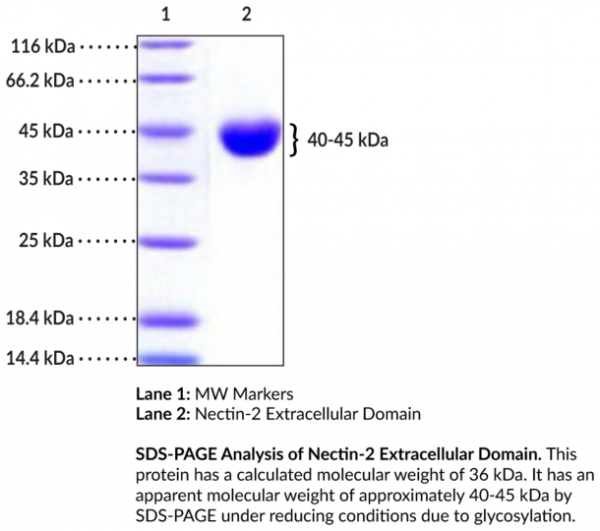
Nectin-2, also known as CD112, is a member of the nectin family of adhesion molecules that mediates the formation of adherens junctions and regulates immune cell activation. It contains an N-terminal extracellular domain with three immunoglobulin-like (Ig-like) loops, C1-like and C2 domains that mediate dimerization, a transmembrane segment, and a C-terminal cytoplasmic tail that binds to the actin filament-binding protein afadin. Nectin-2 is expressed by a variety of cell types, including epithelial cells, neurons, fibroblasts, Sertoli cells, and cancer cells, and is upregulated by TGF-beta1 (Cay-30606) or IFN-beta stimulation. It localizes to the cell surface where it forms cis-homodimers that associate by trans-interactions with cis-homodimers of other nectins and nectin-like molecules (Necls) expressed on adjacent cells, resulting in cell-cell adhesion. Nectin-2 binds the co-stimulatory receptor CD226/DNAM-1, which is widely expressed by most immune cells, including T cells, B cells, natural killer (NK) cells, and monocytes, and the inhibitory receptors TIGIT and CD96, which are expressed by NK cells and T cells, thus regulating both the activation or inhibition of immune cells in a receptor-specific manner. It is also the receptor for herpesvirus entry into cells. Sperm isolated from Nectin2-/- mice have decreased motility and maturation and fail to fuse with oocytes, resulting in male-specific infertility. Neutralization of nectin-2 with a monoclonal antibody decreases tumor growth and reduces metastasis in OV-90 or MDA-MB-231 mouse xenograft models, respectively. Cayman's Nectin-2 Extracellular Domain (mouse, recombinant) protein can be used for binding assay applications. This protein consists of 331 amino acids, has a calculated molecular weight of 36 kDa, and a predicted N-terminus of Gln32 after signal peptide cleavage. By SDS-PAGE, under reducing conditions, the apparent molecular mass of the protein is 40 to 45 kDa due to glycosylation.Synonyms: CD112, Herpesvirus Entry Mediator B, HveB, Nectin Cell Adhesion Molecule 2, Poliovirus Receptor-related Protein 2, PRR2. Purity: >98% estimated by SDS-PAGE. Endotoxin Testing: <1.0 EU/µg, determined by the LAL endotoxin assay. Source: Active recombinant mouse C-terminal His-tagged nectin-2 expressed in HEK293 cells. Amino Acids: 32-351. MW: 36 kDa. Formulation: (Request formulation change), Lyophilized from sterile PBS, pH 7.4. UniProt Accession #: P32507.
| Keywords: | Mph, HveB, HveB, mHveB, CD112, mHveB, CD112, Nectin-2, Nectin-2, Poliovirus receptor homolog, Poliovirus receptor homolog, Herpesvirus entry mediator B, Herpesvirus entry mediator B, Herpes virus entry mediator B, Herpes virus entry mediator B, Murine her |
| Supplier: | Cayman Chemical |
| Supplier-Nr: | 32074 |
Properties
| Conjugate: | No |
| Purity: | >98% estimated by SDS-PAGE |
| Format: | Lyophilized |
Database Information
| KEGG ID : | K06531 | Matching products |
| UniProt ID : | P32507 | Matching products |
| Gene ID : | GeneID 19294 | Matching products |
Handling & Safety
| Storage: | -80°C |
| Shipping: | -80°C (International: -80°C) |
Caution
Our products are for laboratory research use only: Not for administration to humans!
Our products are for laboratory research use only: Not for administration to humans!
Information about the product reference will follow.
more
You will get a certificate here
Viewed