
This website uses cookies, which are necessary for the technical operation of the website and are always set. Other cookies, which increase the comfort when using this website, are used for direct advertising or to facilitate interaction with other websites and social networks, are only set with your consent.
Configuration
Technically required
These cookies are necessary for the basic functions of the shop.
"Allow all cookies" cookie
"Decline all cookies" cookie
CSRF token
Cookie preferences
Currency change
Customer-specific caching
FACT-Finder tracking
Individual prices
Selected shop
Session
Comfort functions
These cookies are used to make the shopping experience even more appealing, for example for the recognition of the visitor.
Note
Show the facebook fanpage in the right blod sidebar
Statistics & Tracking
Affiliate program
Conversion and usertracking via Google Tag Manager
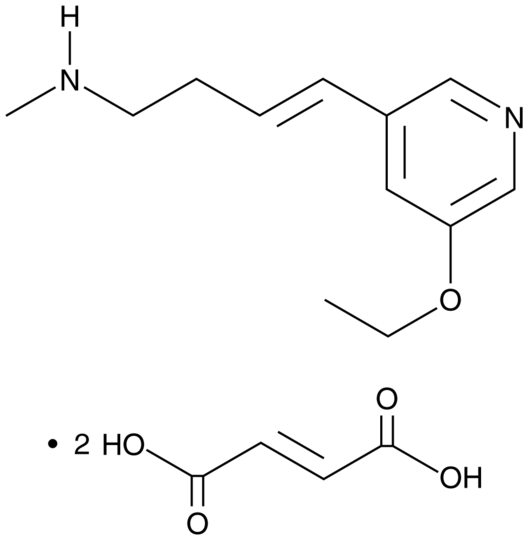
TC 2559 is a CNS-selective partial agonist for alpha4beta2 subunit-containing nicotinic acetylcholine receptors (nAChRs) with an EC50 value of 0.18 µM for calcium signaling in HEK293 cells expressing human recombinant nAChRs. It is selective for alpha4beta2 over alpha2beta4, alpha4beta4, alpha3beta4, alpha3beta2, and alpha7 subunit-containing nAChRs (EC50s = 14, 12.5, >30, >100, and >100 µM, respectively). It increases dopamine cell firing in the rat ventral tegmental area (VTA) in vitro. TC 2559 increases spontaneous inhibitory postsynaptic currents (sIPSCs) in dorsal horn neurons, indicating an enhancement of inhibitory synaptic transmission, an effect that is blocked by the alpha4beta2 subunit-containing nAChR antagonist DHbetaE. It reduces formalin-induced paw-licking time in mice when administered at doses of 3 and 10 mg/kg and increases paw withdrawal latency in a rat model of chronic constriction injury when administered at a dose of 3 mg/kg. TC 2559 (3 and 6 µmol/kg) also reverses cognitive deficits induced by scopolamine in rats, increasing step-through latency in a passive avoidance task.Formal Name: 4-(5-ethoxy-3-pyridinyl)-N-methyl-3-buten-1-amine, difumaric acid. CAS Number: 212332-35-9. Molecular Formula: C12H18N2O . 2C4H4O4. Formula Weight: 438.4. Purity: >95%. Formulation: (Request formulation change), A solid. Solubility: DMSO: slightly soluble, Methanol: slightly soluble. SMILES: CNCC/C=C/C1=CC(OCC)=CN=C1.OC(/C=C/C(O)=O)=O.OC(/C=C\C(O)=O)=O. InChi Code: InChI=1S/C12H18N2O.2C4H4O4/c1-3-15-12-8-11(9-14-10-12)6-4-5-7-13-2,2*5-3(6)1-2-4(7)8/h4,6,8-10,13H,3,5,7H2,1-2H3,2*1-2H,(H,5,6)(H,7,8)/b6-4+,2*2-1+. InChi Key: GEWVPSJQGJBDLM-MYBAKCFCSA-N.
This website uses cookies, which are necessary for the technical operation of the website and are always set. Other cookies, which increase the usability of this website, serve for direct advertising or simplify interaction with other websites and social networks, will only be used with your consent.
More information