
This website uses cookies, which are necessary for the technical operation of the website and are always set. Other cookies, which increase the comfort when using this website, are used for direct advertising or to facilitate interaction with other websites and social networks, are only set with your consent.
Configuration
Technically required
These cookies are necessary for the basic functions of the shop.
"Allow all cookies" cookie
"Decline all cookies" cookie
CSRF token
Cookie preferences
Currency change
Customer-specific caching
FACT-Finder tracking
Individual prices
Selected shop
Session
Comfort functions
These cookies are used to make the shopping experience even more appealing, for example for the recognition of the visitor.
Note
Show the facebook fanpage in the right blod sidebar
Statistics & Tracking
Affiliate program
Conversion and usertracking via Google Tag Manager
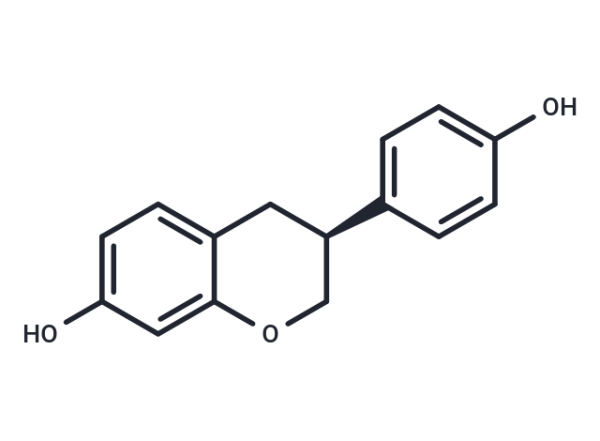
Description: (-)-(S)-Equol (4',7-Dihydroxyisoflavan) is an orally bioavailable, non-steroidal estrogen naturally produced by the metabolism of the isoflavonoid daidzein by human intestinal microflora, with potential chemoprotective and estrogen receptor (ER) modulating activities. S-equol preferentially binds to and activates the beta isoform of ER in certain target tissues, while having an antagonistic effect in other tissues. This modulates the expression of ER-responsive genes in a tissue-specific manner. This agent may increase bone mineral density, affect vasomotor symptoms, and may decrease the proliferation rate of susceptible cancer cells. In addition, this agent interferes with the activity of enzymes involved in steroid biosynthesis. S-equol inhibits dihydrotestosterone (DHT) production and may inhibit the proliferation of androgen-driven prostate cancer. S-equol is the biologically active enantiomer while R-equol is essentially inactive and has a weak affinity for alpha-ER. Target: Estrogen Receptor/ERR, Estrogen/progestogen Receptor, Endogenous Metabolite. Smiles: OC=1C=C2C(C[C@H](CO2)C3=CC=C(O)C=C3)=CC1. References: Muthyala RS, et al. Bioorg Med Chem, 2004, 12(6), 1559-1567.
This website uses cookies, which are necessary for the technical operation of the website and are always set. Other cookies, which increase the usability of this website, serve for direct advertising or simplify interaction with other websites and social networks, will only be used with your consent.
More information