
Pralidoxime (chloride)
If you have any questions, please use our Contact Form.
You can also order by e-mail: info@biomol.com
Larger quantity required? Request bulk
You can also order by e-mail: info@biomol.com
Larger quantity required? Request bulk
Pralidoxime reactivates acetylcholinesterase (AChE) that has been deactivated by binding of... more
Product information "Pralidoxime (chloride)"
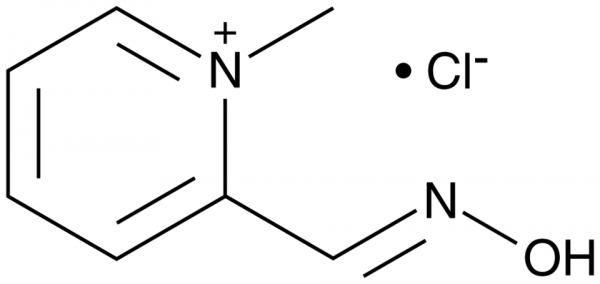
Pralidoxime reactivates acetylcholinesterase (AChE) that has been deactivated by binding of organophosphates to its esteratic site. Pralidoxime binds to the anionic site of AChE and displaces the phosphate from the esteratic site through formation of phosphate-pralidoxime conjugates. It reactivates paraoxon- and diisopropyl fluorophosphate-inactivated human red blood cell (RBC) AChE with IC50 shifts of 0.3 and 0.8 nM per µM of pralidoxime, respectively., At a concentration of 10 µM, it reactivates human RBC AChE that has been inactivated by chlorpyrifos (Cay-21412), diazinon (Cay-23769), and malathion (Cay-22998) by 17, 61, and 36%, respectively. Pralidoxime binds to sarin-bound hAChE (Kd = 25.72 µM) and inhibits sarin-induced AChE deactivation (IC50 = 1.21 mM) in hemoglobin-free erythrocyte ghosts. Formulations containing pralidoxime have been used to treat organophosphate poisoning.Formal Name: 2-[(hydroxyimino)methyl]-1-methyl-pyridinium, monochloride. CAS Number: 51-15-0. Synonyms: 2-PAM. Molecular Formula: C7H9N2O . Cl. Formula Weight: 172.6. Purity: >95%. Formulation: (Request formulation change), A crystalline solid. Solubility: DMSO: 1 mg/ml, PBS (pH 7.2): 10 mg/ml. lambdamax: 247, 300 nm. SMILES: C[N+]1=CC=CC=C1/C=N/O.[Cl-]. InChi Code: InChI=1S/C7H8N2O.ClH/c1-9-5-3-2-4-7(9)6-8-10,/h2-6H,1H3,1H. InChi Key: HIGSLXSBYYMVKI-UHFFFAOYSA-N.
| Keywords: | 2-PAM, 2-[(hydroxyimino)methyl]-1-methyl-pyridinium, monochloride |
| Supplier: | Cayman Chemical |
| Supplier-Nr: | 23666 |
Properties
| Application: | Acetylcholinesterase (AChE) reactivator |
| MW: | 172.6 D |
| Formula: | C7H9N2O . Cl |
| Purity: | >95% |
| Format: | Crystalline Solid |
Database Information
| CAS : | 51-15-0| Matching products |
| KEGG ID : | K01049 | Matching products |
Handling & Safety
| Storage: | -20°C |
| Shipping: | +20°C (International: -20°C) |
| Signal Word: | Warning |
| GHS Hazard Pictograms: |

|
| H Phrases: | H302, H312, H315, H319, H332, H335 |
| P Phrases: | P261, P264, P270, P271, P280, P312, P321, P330, P301+P310, P302+P352, P304+P340, P305+P351+P338, P332+P313, P337+P313, P361+P364, P362+P364, P405, P403+P233, P501 |
Caution
Our products are for laboratory research use only: Not for administration to humans!
Our products are for laboratory research use only: Not for administration to humans!
Information about the product reference will follow.
more
You will get a certificate here
Viewed