
Mepenzolate (bromide)

| Item number | Size | Datasheet | Manual | SDS | Delivery time | Quantity | Price |
|---|---|---|---|---|---|---|---|
| Cay23717-500 | 500 mg | - |
6 - 10 business days* |
51.00€
|
|||
| Cay23717-1 | 1 g | - |
6 - 10 business days* |
70.00€
|
If you have any questions, please use our Contact Form.
You can also order by e-mail: info@biomol.com
Larger quantity required? Request bulk
You can also order by e-mail: info@biomol.com
Larger quantity required? Request bulk
Mepenzolate is an antagonist of muscarinic (M) acetylcholine receptors (Kis = 0.68 and 2.6 nM for... more
Product information "Mepenzolate (bromide)"
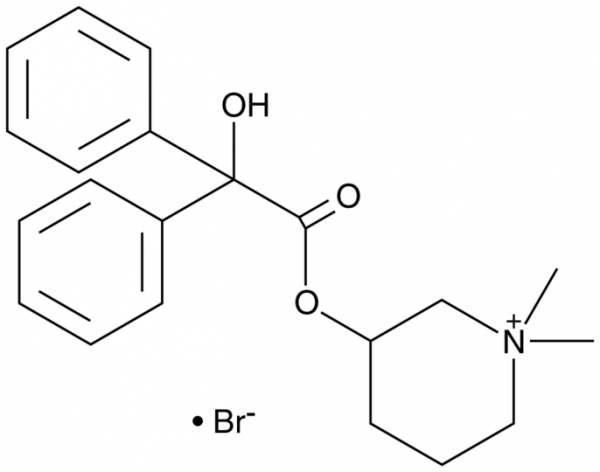
Mepenzolate is an antagonist of muscarinic (M) acetylcholine receptors (Kis = 0.68 and 2.6 nM for human M2 and M3 receptors, respectively). It has antispasmodic activity in the gastrointestinal tract of anesthetized cats and dogs when administered at a dose of 0.5 mg/kg. Mepenzolate decreases airspace enlargement induced by elastase or cigarette smoke and reduces respiratory dysfunction in a mouse model of chronic obstructive pulmonary disease (COPD). It also reduces oxidative stress, decreases the expression of IL-1beta, IL-6, and TNF-alpha, and increases the expression of TGF-beta1, IGF-1, and VEGF in a diabetic wound healing mouse model.Formal Name: 3-[(2-hydroxy-2,2-diphenylacetyl)oxy]-1,1-dimethyl-piperidinium, monobromide. CAS Number: 76-90-4. Synonyms: NSC 4358. Molecular Formula: C21H26NO3 . Br. Formula Weight: 420.3. Purity: >95%. Formulation: (Request formulation change), A solid. Solubility: DMF: 5 mg/ml, DMSO: 30 mg/ml, PBS (pH 7.2): 1 mg/ml. SMILES: C[N+]1(C)CCCC(OC(C(O)(C2=CC=CC=C2)C3=CC=CC=C3)=O)C1.[Br-]. InChi Code: InChI=1S/C21H26NO3.BrH/c1-22(2)15-9-14-19(16-22)25-20(23)21(24,17-10-5-3-6-11-17)18-12-7-4-8-13-18,/h3-8,10-13,19,24H,9,14-16H2,1-2H3,1H/q+1,/p-1. InChi Key: JRRNZNSGDSFFIR-UHFFFAOYSA-M.
| Keywords: | NSC 4358, 3-[(2-hydroxy-2,2-diphenylacetyl)oxy]-1,1-dimethyl-piperidinium, monobromide |
| Supplier: | Cayman Chemical |
| Supplier-Nr: | 23717 |
Properties
| Application: | Muscarinic (M) acetylcholine receptor antagonist |
| MW: | 420.3 D |
| Formula: | C21H26NO3 . Br |
| Purity: | >95% |
| Format: | Solid |
Database Information
| CAS : | 76-90-4| Matching products |
| KEGG ID : | K04130 | Matching products |
Handling & Safety
| Storage: | -20°C |
| Shipping: | +20°C (International: -20°C) |
| Signal Word: | Warning |
| GHS Hazard Pictograms: |

|
| H Phrases: | H302 |
| P Phrases: | P264, P270, P330, P301+P310, P501 |
Caution
Our products are for laboratory research use only: Not for administration to humans!
Our products are for laboratory research use only: Not for administration to humans!
Information about the product reference will follow.
more
You will get a certificate here
Viewed