
This website uses cookies, which are necessary for the technical operation of the website and are always set. Other cookies, which increase the comfort when using this website, are used for direct advertising or to facilitate interaction with other websites and social networks, are only set with your consent.
Configuration
Technically required
These cookies are necessary for the basic functions of the shop.
"Allow all cookies" cookie
"Decline all cookies" cookie
CSRF token
Cookie preferences
Currency change
Customer-specific caching
FACT-Finder tracking
Individual prices
Selected shop
Session
Comfort functions
These cookies are used to make the shopping experience even more appealing, for example for the recognition of the visitor.
Note
Show the facebook fanpage in the right blod sidebar
Statistics & Tracking
Affiliate program
Conversion and usertracking via Google Tag Manager
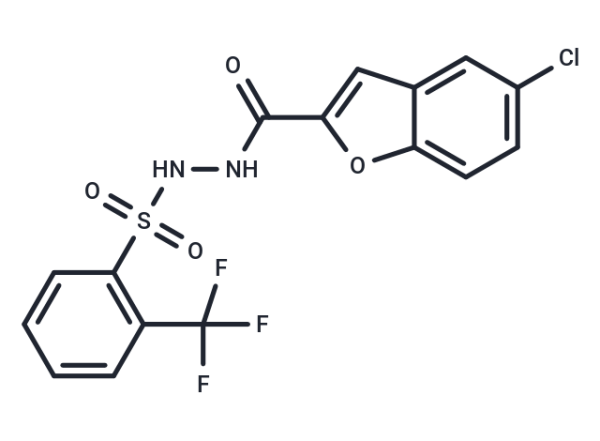
Description: BCATc Inhibitor 2 exhibited an IC50 of 0.8 microM in the hBCATc assays, it is an active and selective inhibitor. BCATc Inhibitor 2 also blocked calcium influx into neuronal cells following inhibition of glutamate uptake, and demonstrated neuroprotective efficacy in vivo[1]. Branched-chain amino acid transferases (BCATs) have been implicated in catalyzing reversible transamination of isoleucine, leucine, and valine branched-chain amino acids to their corresponding alpha-keto acids, generating L-glutamate. It has been identified that there are two forms of BCAT in mammals: mitochondrial BCAT (BCATm) and cytosolic BCAT (BCATc). BCATc is expressed in particular brain region and involved in regulating glutamate synthesis for release during neuronal excitation. Thus, BCATc inhibition may be useful for the treatment of neurodegenerative and behavioral disorders involving disturbances of the glutamatergic system [2]. Target: Others. Smiles: FC(F)(F)c1ccccc1S(=O)(=O)NNC(=O)c1cc2cc(Cl)ccc2o1. References: Hu L Y, Boxer P A, Kesten S R, et al. The design and synthesis of human branched-chain amino acid aminotransferase inhibitors for treatment of neurodegenerative diseases[J]. Bioorganic & medicinal chemistry letters, 2006, 16(9): 2337-2340.
This website uses cookies, which are necessary for the technical operation of the website and are always set. Other cookies, which increase the usability of this website, serve for direct advertising or simplify interaction with other websites and social networks, will only be used with your consent.
More information