
Cookie preferences
This website uses cookies, which are necessary for the technical operation of the website and are always set. Other cookies, which increase the comfort when using this website, are used for direct advertising or to facilitate interaction with other websites and social networks, are only set with your consent.
Configuration
Technically required
These cookies are necessary for the basic functions of the shop.
"Allow all cookies" cookie
"Decline all cookies" cookie
CSRF token
Cookie preferences
Currency change
Customer-specific caching
FACT-Finder tracking
Individual prices
Selected shop
Session
Comfort functions
These cookies are used to make the shopping experience even more appealing, for example for the recognition of the visitor.
Note
Show the facebook fanpage in the right blod sidebar
Statistics & Tracking
Affiliate program
Conversion and usertracking via Google Tag Manager
Track device being used

| Item number | Size | Datasheet | Manual | SDS | Delivery time | Quantity | Price |
|---|---|---|---|---|---|---|---|
| ABS-ES-628.1 | 1 pair (100 µg/100 µg) | - | - |
10 - 14 business days* |
1,080.00€
|
If you have any questions, please use our Contact Form.
You can also order by e-mail: info@biomol.com
Larger quantity required? Request bulk
You can also order by e-mail: info@biomol.com
Larger quantity required? Request bulk
Product Description: Receptor-interacting serine/threonine-protein kinase 3 (RIPK3) is a critical... more
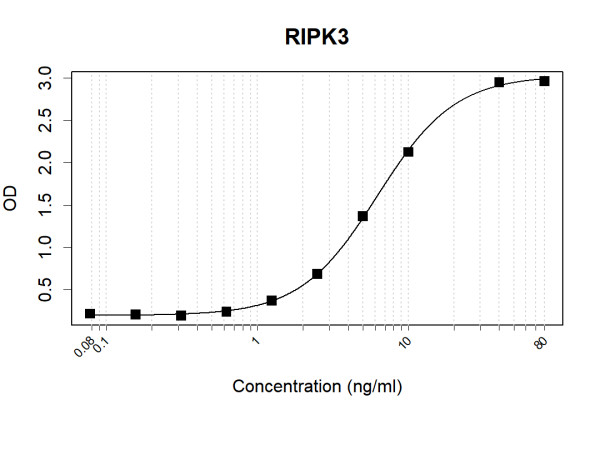
Product information "Anti-Human RIPK3 Antibody Pair"
Product Description: Receptor-interacting serine/threonine-protein kinase 3 (RIPK3) is a critical regulator of programmed necrosis, specifically necroptosis, which is an inflammatory form of cell death. It is part of the receptor-interacting protein (RIP) kinase family and plays a pivotal role in cellular responses to stress and inflammation. RIPK3 functions by forming a complex known as the necrosome with RIPK1 and mixed lineage kinase domain-like protein (MLKL), which is essential for executing necroptosis. Dysregulation of RIPK3 has been implicated in various diseases, particularly inflammatory conditions and cancer. For instance, excessive RIPK3 activity can contribute to tissue damage in conditions such as ischemia-reperfusion injury and chronic inflammatory diseases, while reduced RIPK3 function may lead to impaired necroptosis, allowing for tumor survival and progression. Protein Function: Serine/threonine-protein kinase that activates necroptosis and apoptosis, two parallel forms of cell death (PubMed:19524512, PubMed:19524513, PubMed:22265413, PubMed:22265414, PubMed:22421439, PubMed:29883609, PubMed:32657447). Necroptosis, a programmed cell death process in response to death-inducing TNF-alpha family members, is triggered by RIPK3 following activation by ZBP1 (PubMed:19524512, PubMed:19524513, PubMed:22265413, PubMed:22265414, PubMed:22421439, PubMed:29883609, PubMed:32298652). Activated RIPK3 forms a necrosis-inducing complex and mediates phosphorylation of MLKL, promoting MLKL localization to the plasma membrane and execution of programmed necrosis characterized by calcium influx and plasma membrane damage (PubMed:19524512, PubMed:19524513, PubMed:22265413, PubMed:22265414, PubMed:22421439, PubMed:25316792, PubMed:29883609). In addition to TNF-induced necroptosis, necroptosis can also take place in the nucleus in response to orthomyxoviruses infection: following ZBP1 activation, which senses double-stranded Z-RNA structures, nuclear RIPK3 catalyzes phosphorylation and activation of MLKL, promoting disruption of the nuclear envelope and leakage of cellular DNA into the cytosol (By similarity). Also regulates apoptosis: apoptosis depends on RIPK1, FADD and CASP8, and is independent of MLKL and RIPK3 kinase activity (By similarity). Phosphorylates RIPK1: RIPK1 and RIPK3 undergo reciprocal auto- and trans-phosphorylation (PubMed:19524513). In some cell types, also able to restrict viral replication by promoting cell death-independent responses (By similarity). In response to Zika virus infection in neurons, promotes a cell death-independent pathway that restricts viral replication: together with ZBP1, promotes a death-independent transcriptional program that modifies the cellular metabolism via up-regulation expression of the enzyme ACOD1/IRG1 and production of the metabolite itaconate (By similarity). Itaconate inhibits the activity of succinate dehydrogenase, generating a metabolic state in neurons that suppresses replication of viral genomes (By similarity). RIPK3 binds to and enhances the activity of three metabolic enzymes: GLUL, GLUD1, and PYGL (PubMed:19498109). These metabolic enzymes may eventually stimulate the tricarboxylic acid cycle and oxidative phosphorylation, which could result in enhanced ROS production (PubMed:19498109) , (Microbial infection) In case of herpes simplex virus 1/HHV-1 infection, forms heteromeric amyloid structures with HHV-1 protein RIR1/ICP6 which may inhibit RIPK3-mediated necroptosis, thereby preventing host cell death pathway and allowing viral evasion [The Uniprot Consortium]
| Keywords: | Anti-RIPK3, Anti-RIP-like protein kinase 3, Anti-Receptor-interacting protein 3, Anti-Receptor-interacting serine/threonine-protein kinase 3, Human RIPK3 Antibody Pair |
| Supplier: | Absea |
| Supplier-Nr: | ES-628 |
Properties
| Application: | ELISA |
| Antibody Type: | Monoclonal |
| Clone: | K16307_5C12/K16307_7F9 |
| Conjugate: | No |
| Host: | Mouse/Mouse |
| Species reactivity: | human |
| Purity: | >85% |
| Format: | Solution |
Database Information
| KEGG ID : | K08847 | Matching products |
| UniProt ID : | Q9Y572 | Matching products |
| Gene ID : | GeneID 11035 | Matching products |
Handling & Safety
| Storage: | -20°C (avoid repeat freezing and thawing cycles) |
| Shipping: | -20°C (International: +4°C) |
Caution
Our products are for laboratory research use only: Not for administration to humans!
Our products are for laboratory research use only: Not for administration to humans!
You will get a certificate here
Viewed