
Cookie preferences
This website uses cookies, which are necessary for the technical operation of the website and are always set. Other cookies, which increase the comfort when using this website, are used for direct advertising or to facilitate interaction with other websites and social networks, are only set with your consent.
Configuration
Technically required
These cookies are necessary for the basic functions of the shop.
"Allow all cookies" cookie
"Decline all cookies" cookie
CSRF token
Cookie preferences
Currency change
Customer-specific caching
FACT-Finder tracking
Individual prices
Selected shop
Session
Comfort functions
These cookies are used to make the shopping experience even more appealing, for example for the recognition of the visitor.
Note
Show the facebook fanpage in the right blod sidebar
Statistics & Tracking
Affiliate program
Conversion and usertracking via Google Tag Manager
Track device being used

| Item number | Size | Datasheet | Manual | SDS | Delivery time | Quantity | Price |
|---|---|---|---|---|---|---|---|
| ABS-ES-1164.1 | 1 pair (100 µg/100 µg) | - | - |
10 - 14 business days* |
1,080.00€
|
If you have any questions, please use our Contact Form.
You can also order by e-mail: info@biomol.com
Larger quantity required? Request bulk
You can also order by e-mail: info@biomol.com
Larger quantity required? Request bulk
Product Description: Phospholipase A and acyltransferase 3 (PLAAT3) is a member of the PLAAT... more
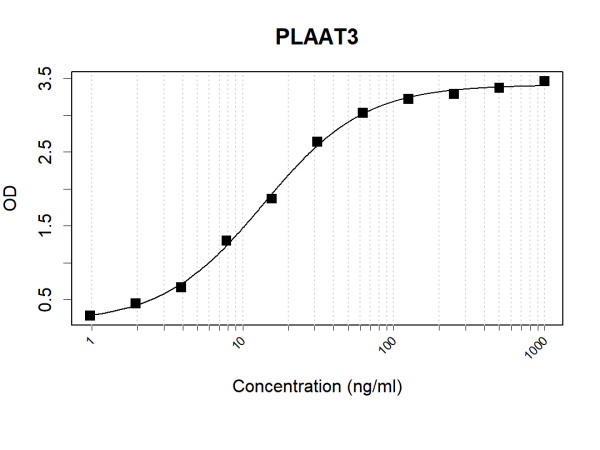
Product information "Anti-Human PLAAT3 Antibody Pair"
Product Description: Phospholipase A and acyltransferase 3 (PLAAT3) is a member of the PLAAT family of enzymes, which are involved in the formation of N-acylphosphatidylethanolamines (NAPEs) and N-acyl ethanolamines (NAEs), important bioactive lipids with roles in anti-inflammation, fat catabolism, and endocannabinoid signaling. PLAAT3 exhibits N-acyltransferase, lipid binding, and phospholipase activities, specifically catalyzing the transfer of fatty acyl groups from glycerophospholipids to lysophospholipids. Structurally, PLAAT3 has a compact, globular structure stabilized by a network of 17 salt bridges, which contrasts with the more elongated structure of PLAAT4. Suppression of PLAAT3 expression has been shown to reduce adipocyte-related gene expression and lipid accumulation, highlighting its role in lipid metabolism. Protein Function: Exhibits both phospholipase A1/2 and acyltransferase activities (PubMed:19047760, PubMed:19615464, PubMed:22605381, PubMed:22825852, PubMed:26503625). Shows phospholipase A1 (PLA1) and A2 (PLA2) activity, catalyzing the calcium-independent release of fatty acids from the sn-1 or sn-2 position of glycerophospholipids (PubMed:19047760, PubMed:19615464, PubMed:22605381, PubMed:22825852, PubMed:22923616). For most substrates, PLA1 activity is much higher than PLA2 activity (PubMed:19615464). Shows O-acyltransferase activity,catalyzing the transfer of a fatty acyl group from glycerophospholipid to the hydroxyl group of lysophospholipid (PubMed:19615464). Shows N-acyltransferase activity, catalyzing the calcium-independent transfer of a fatty acyl group at the sn-1 position of phosphatidylcholine (PC) and other glycerophospholipids to the primary amine of phosphatidylethanolamine (PE), forming N-acylphosphatidylethanolamine (NAPE), which serves as precursor for N-acylethanolamines (NAEs) (PubMed:19047760, PubMed:19615464, PubMed:22605381, PubMed:22825852). Exhibits high N-acyltransferase activity and low phospholipase A1/2 activity (PubMed:22825852). Required for complete organelle rupture and degradation that occur during eye lens terminal differentiation, when fiber cells that compose the lens degrade all membrane-bound organelles in order to provide lens with transparency to allow the passage of light. Organelle membrane degradation is probably catalyzed by the phospholipase activity (By similarity) , (Microbial infection) Acts as a host factor for picornaviruses: required during early infection to promote viral genome release into the cytoplasm (PubMed:28077878). May act as a cellular sensor of membrane damage at sites of virus entry, which relocalizes to sites of membrane rupture upon virus unfection (PubMed:28077878). Facilitates safe passage of the RNA away from LGALS8, enabling viral genome translation by host ribosome (PubMed:28077878). May also be involved in initiating pore formation, increasing pore size or in maintaining pores for genome delivery (PubMed:28077878). The lipid-modifying enzyme activity is required for this process (PubMed:28077878) [The Uniprot Consortium]
| Keywords: | Anti-PLAAT3, Anti-HREV107-3, Anti-HRAS-like suppressor 1, Anti-HRAS-like suppressor 3, Anti-H-rev 107 protein homolog, Anti-Group XVI phospholipase A1/A2, Anti-Renal carcinoma antigen NY-REN-65, Anti-Adipose-specific phospholipase A2, Anti-Phospholipase A |
| Supplier: | Absea |
| Supplier-Nr: | ES-1164 |
Properties
| Application: | ELISA |
| Antibody Type: | Monoclonal |
| Clone: | K16304_14H2/K16304_18G12 |
| Conjugate: | No |
| Host: | Mouse/Mouse |
| Species reactivity: | human |
| Purity: | >85% |
| Format: | Solution |
Database Information
| KEGG ID : | K16817 | Matching products |
| UniProt ID : | P53816 | Matching products |
| Gene ID : | GeneID 11145 | Matching products |
Handling & Safety
| Storage: | -20°C (avoid repeat freezing and thawing cycles) |
| Shipping: | -20°C (International: +4°C) |
Caution
Our products are for laboratory research use only: Not for administration to humans!
Our products are for laboratory research use only: Not for administration to humans!
You will get a certificate here
Viewed