
Cookie preferences
This website uses cookies, which are necessary for the technical operation of the website and are always set. Other cookies, which increase the comfort when using this website, are used for direct advertising or to facilitate interaction with other websites and social networks, are only set with your consent.
Configuration
Technically required
These cookies are necessary for the basic functions of the shop.
"Allow all cookies" cookie
"Decline all cookies" cookie
CSRF token
Cookie preferences
Currency change
Customer-specific caching
FACT-Finder tracking
Individual prices
Selected shop
Session
Comfort functions
These cookies are used to make the shopping experience even more appealing, for example for the recognition of the visitor.
Note
Show the facebook fanpage in the right blod sidebar
Statistics & Tracking
Affiliate program
Conversion and usertracking via Google Tag Manager
Track device being used

| Item number | Size | Datasheet | Manual | SDS | Delivery time | Quantity | Price |
|---|---|---|---|---|---|---|---|
| CSB-EP842673HU1.20 | 20 µg | - | - | - |
10 - 14 business days* |
219.00€
|
|
| CSB-EP842673HU1.100 | 100 µg | - | - | - |
10 - 14 business days* |
392.00€
|
|
| CSB-EP842673HU1.1 | 1 mg | - | - | - |
10 - 14 business days* |
1,628.00€
|
If you have any questions, please use our Contact Form.
You can also order by e-mail: info@biomol.com
Larger quantity required? Request bulk
You can also order by e-mail: info@biomol.com
Larger quantity required? Request bulk
Organism: Homo sapiens (Human). Source: E.coli. Expression Region: 2-201aa. Protein Length:... more
Product information "Ubiquitin thioesterase OTUB1 (OTUB1), partial, recombinant human"
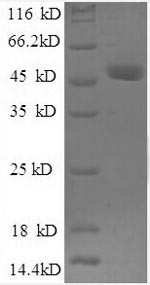
Organism: Homo sapiens (Human). Source: E.coli. Expression Region: 2-201aa. Protein Length: Partial. Tag Info: N-terminal GST-tagged. Target Protein Sequence: AAEEPQQQKQ EPLGSDSEGV NCLAYDEAIM AQQDRIQQEI AVQNPLVSER LELSVLYKEY AEDDNIYQQK IKDLHKKYSY IRKTRPDGNC FYRAFGFSHL EALLDDSKEL QRFKAVSAKS KEDLVSQGFT EFTIEDFHNT FMDLIEQVEK QTSVADLLAS FNDQSTSDYL VVYLRLLTSG YLQRESKFFE HFIEGGRTVK. Purity: Greater than 90% as determined by SDS-PAGE. Endotoxin: Not test. Biological Activity: n/a. Form: Liquid or Lyophilized powder. Buffer: If the delivery form is liquid, the default storage buffer is Tris/PBS-based buffer, 5%-50% glycerol. If the delivery form is lyophilized powder, the buffer before lyophilization is Tris/PBS-based buffer, 6% Trehalose, pH 8.0. Reconstitution: We recommend that this vial be briefly centrifuged prior to opening to bring the contents to the bottom. Please reconstitute protein in deionized sterile water to a concentration of 0.1-1.0 mg/mL.We recommend to add 5-50% of glycerol (final concentration) and aliquot for long-term storage at -20°C/-80°C. Our default final concentration of glycerol is 50%. Customers could use it as reference. Storage: The shelf life is related to many factors, storage state, buffer ingredients, storage temperature and the stability of the protein itself. Generally, the shelf life of liquid form is 6 months at -20°C/-80°C. The shelf life of lyophilized form is 12 months at -20°C/-80°C. Notes: Repeated freezing and thawing is not recommended. Store working aliquots at 4°C for up to one week. Relevance: Hydrolase that can specifically rove 'Lys-48'-linked conjugated ubiquitin from proteins and plays an important regulatory role at the level of protein turnover by preventing degradation. Regulator of T-cell anergy, a phenomenon that occurs when T-cells are rendered unresponsive to antigen rechallenge and no longer respond to their cognate antigen. Acts via its interaction with RNF128/GRAIL, a crucial inductor of CD4 T-cell anergy. Isoform 1 destabilizes RNF128, leading to prevent anergy. In contrast, isoform 2 stabilizes RNF128 and promotes anergy. Surprisingly, it regulates RNF128-mediated ubiquitination, but does not deubiquitinate polyubiquitinated RNF128. Deubiquitinates estrogen receptor alpha (ESR1). Mediates deubiquitination of 'Lys-48'-linked polyubiquitin chains, but not 'Lys-63'-linked polyubiquitin chains. Not able to cleave di-ubiquitin. Also capable of roving NEDD8 from NEDD8 conjugates, but with a much lower preference compared to 'Lys-48'-linked ubiquitin.Plays a key non-catalytic role in DNA repair regulation by inhibiting activity of RNF168, an E3 ubiquitin-protein ligase that promotes accumulation of 'Lys-63'-linked histone H2A and H2AX at DNA damage sites. Inhibits RNF168 independently of ubiquitin thioesterase activity by binding and inhibiting UBE2N/UBC13, the E2 partner of RNF168, thereby limiting spreading of 'Lys-63'-linked histone H2A and H2AX marks. Inhibition occurs by binding to free ubiquitin: free ubiquitin acts as an allosteric regulator that increases affinity for UBE2N/UBC13 and disrupts interaction with UBE2V1. The OTUB1-UBE2N/UBC13-free ubiquitin complex adopts a configuration that mimics a cleaved 'Lys48'-linked di-ubiquitin chain. Reference: Human chromosome 11 DNA sequence and analysis including novel gene identification.Taylor T.D., Noguchi H., Totoki Y., Toyoda A., Kuroki Y., Dewar K., Lloyd C., Itoh T., Takeda T., Kim D.-W., She X., Barlow K.F., Bloom T., Bruford E., Chang J.L., Cuomo C.A., Eichler E., FitzGerald M.G. , Jaffe D.B., LaButti K., Nicol R., Park H.-S., Seaman C., Sougnez C., Yang X., Zimmer A.R., Zody M.C., Birren B.W., Nusbaum C., Fujiyama A., Hattori M., Rogers J., Lander E.S., Sakaki Y.Nature 440:497-500(2006). Function: Hydrolase that can specifically remove 'Lys-48'-linked conjugated ubiquitin from proteins and plays an important regulatory role at the level of protein turnover by preventing degradation. Regulator of T-cell anergy, a phenomenon that occurs when T-cells are rendered unresponsive to antigen rechallenge and no longer respond to their cognate antigen. Acts via its interaction with RNF128/GRAIL, a crucial inductor of CD4 T-cell anergy. Isoform 1 destabilizes RNF128, leading to prevent anergy. In contrast, isoform 2 stabilizes RNF128 and promotes anergy. Surprisingly, it regulates RNF128-mediated ubiquitination, but does not deubiquitinate polyubiquitinated RNF128. Deubiquitinates estrogen receptor alpha (ESR1). Mediates deubiquitination of 'Lys-48'-linked polyubiquitin chains, but not 'Lys-63'-linked polyubiquitin chains. Not able to cleave di-ubiquitin. Also capable of removing NEDD8 from NEDD8 conjugates, but with a much lower preference compared to 'Lys-48'-linked ubiquitin., FUNCTION
| Keywords: | OTB1, hOTU1, OTUB1, HSPC263, Otubain-1, Ubiquitin thioesterase OTUB1, Deubiquitinating enzyme OTUB1, Ubiquitin-specific-processing protease OTUB1, OTU domain-containing ubiquitin aldehyde-binding protein 1 |
| Supplier: | Cusabio |
| Supplier-Nr: | EP842673HU1 |
Properties
| Application: | Activity not tested |
| Conjugate: | No |
| Host: | E.coli |
| Species reactivity: | human |
| MW: | 50.1 kD |
| Purity: | >90% (SDS-PAGE) |
Database Information
| KEGG ID : | K09602 | Matching products |
| UniProt ID : | Q96FW1 | Matching products |
| Gene ID : | GeneID 55611 | Matching products |
Handling & Safety
| Storage: | -20°C |
| Shipping: | +4°C (International: +4°C) |
Caution
Our products are for laboratory research use only: Not for administration to humans!
Our products are for laboratory research use only: Not for administration to humans!
You will get a certificate here
Viewed