
Cookie preferences
This website uses cookies, which are necessary for the technical operation of the website and are always set. Other cookies, which increase the comfort when using this website, are used for direct advertising or to facilitate interaction with other websites and social networks, are only set with your consent.
Configuration
Technically required
These cookies are necessary for the basic functions of the shop.
"Allow all cookies" cookie
"Decline all cookies" cookie
CSRF token
Cookie preferences
Currency change
Customer-specific caching
FACT-Finder tracking
Individual prices
Selected shop
Session
Comfort functions
These cookies are used to make the shopping experience even more appealing, for example for the recognition of the visitor.
Note
Show the facebook fanpage in the right blod sidebar
Statistics & Tracking
Affiliate program
Conversion and usertracking via Google Tag Manager
Track device being used

If you have any questions, please use our Contact Form.
You can also order by e-mail: info@biomol.com
Larger quantity required? Request bulk
You can also order by e-mail: info@biomol.com
Larger quantity required? Request bulk
Organism: Homo sapiens (Human). Source: E.coli. Expression Region: 1-147aa. Protein Length: Full... more
Product information "Ubiquitin-conjugating enzyme E2 D3 (UBE2D3), human, recombinant"
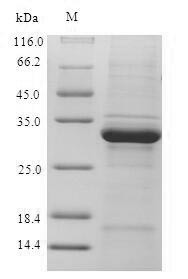
Organism: Homo sapiens (Human). Source: E.coli. Expression Region: 1-147aa. Protein Length: Full Length. Tag Info: N-terminal 6xHis-SUMO-tagged. Target Protein Sequence: MALKRINKEL SDLARDPPAQ CSAGPVGDDM FHWQATIMGP NDSPYQGGVF FLTIHFPTDY PFKPPKVAFT TRIYHPNINS NGSICLDILR SQWSPALTIS KVLLSICSLL CDPNPDDPLV PEIARIYKTD RDKYNRISRE WTQKYAM. Purity: Greater than 90% as determined by SDS-PAGE. Endotoxin: Not test. Biological Activity: n/a. Form: Liquid or Lyophilized powder. Buffer: If the delivery form is liquid, the default storage buffer is Tris/PBS-based buffer, 5%-50% glycerol. If the delivery form is lyophilized powder, the buffer before lyophilization is Tris/PBS-based buffer, 6% Trehalose, pH 8.0. Reconstitution: We recommend that this vial be briefly centrifuged prior to opening to bring the contents to the bottom. Please reconstitute protein in deionized sterile water to a concentration of 0.1-1.0 mg/mL.We recommend to add 5-50% of glycerol (final concentration) and aliquot for long-term storage at -20 °C/-80 °C. Our default final concentration of glycerol is 50%. Customers could use it as reference. Storage: The shelf life is related to many factors, storage state, buffer ingredients, storage temperature and the stability of the protein itself. Generally, the shelf life of liquid form is 6 months at -20 °C/-80 °C. The shelf life of lyophilized form is 12 months at -20 °C/-80 °C. Notes: Repeated freezing and thawing is not recommended. Store working aliquots at 4 °C for up to one week. Relevance: Accepts ubiquitin from the E1 complex and catalyzes its covalent attachment to other proteins. In vitro catalyzes 'Lys-11'-, as well as 'Lys-48'-linked polyubiquitination. Cooperates with the E2 CDC34 and the SCF(FBXW11) E3 ligase complex for the polyubiquitination of NFKBIA leading to its subsequent proteasomal degradation. Acts as an initiator E2, priming the phosphorylated NFKBIA target at positions 'Lys-21' and/or 'Lys-22' with a monoubiquitin. Ubiquitin chain elongation is then performed by CDC34, building ubiquitin chains from the UBE2D3-primed NFKBIA-linked ubiquitin. Acts also as an initiator E2, in conjunction with RNF8, for the priming of PCNA. Monoubiquitination of PCNA, and its subsequent polyubiquitination, are essential events in the operation of the DNA damage tolerance (DDT) pathway that is activated after DNA damage caused by UV or chical agents during S-phase. Associates with the BRCA1/BARD1 E3 ligase complex to perform ubiquitination at DNA damage sites following ionizing radiation leading to DNA repair. Targets DAPK3 for ubiquitination which influences promyelocytic leukia protein nuclear body (PML-NB) formation in the nucleus. In conjunction with the MDM2 and TOPORS E3 ligases, functions ubiquitination of p53/TP53. Supports NRDP1-mediated ubiquitination and degradation of ERBB3 and of BRUCE which triggers apoptosis. In conjunction with the CBL E3 ligase, targets EGFR for polyubiquitination at the plasma mbrane as well as during its internalization and transport on endosomes. In conjunction with the STUB1 E3 quality control E3 ligase, ubiquitinates unfolded proteins to catalyze their immediate destruction . Reference: Identification of a family of closely related human ubiquitin conjugating enzymes.Jensen J.P., Bates P.W., Yang M., Vierstra R.D., Weissman A.M.J. Biol. Chem. 270:30408-30414(1995). Function: Accepts ubiquitin from the E1 complex and catalyzes its covalent attachment to other proteins. In vitro catalyzes 'Lys-11'-, as well as 'Lys-48'-linked polyubiquitination. Cooperates with the E2 CDC34 and the SCF(FBXW11) E3 ligase complex for the polyubiquitination of NFKBIA leading to its subsequent proteasomal degradation. Acts as an initiator E2, priming the phosphorylated NFKBIA target at positions 'Lys-21' and/or 'Lys-22' with a monoubiquitin. Ubiquitin chain elongation is then performed by CDC34, building ubiquitin chains from the UBE2D3-primed NFKBIA-linked ubiquitin. Acts also as an initiator E2, in conjunction with RNF8, for the priming of PCNA. Monoubiquitination of PCNA, and its subsequent polyubiquitination, are essential events in the operation of the DNA damage tolerance (DDT) pathway that is activated after DNA damage caused by UV or chemical agents during S-phase. Associates with the BRCA1/BARD1 E3 ligase complex to perform ubiquitination at DNA damage sites following ionizing radiation leading to DNA repair. Targets DAPK3 for ubiquitination which influences promyelocytic leukemia protein nuclear body (PML-NB) formation in the nucleus. In conjunction with the MDM2 and TOPORS E3 ligases, functions ubiquitination of p53/TP53. Supports NRDP1-mediated ubiquitination and degradation of ERBB3 and of BRUCE which triggers apoptosis. In conjunction with the CBL E3 ligase, targets EGFR for polyubiquitination at the plasma membrane as well as during its internalization and transport on endosomes. In conjunction with the STUB1 E3 quality control E3 ligase, ubiquitinates unfolded proteins to catalyze their immediate destruction.
| Keywords: | UBC5C, UBE2D3, Ubiquitin-protein ligase D3, Ubiquitin carrier protein D3, Ubiquitin-conjugating enzyme E2 D3, E2 ubiquitin-conjugating enzyme D3, Ubiquitin-conjugating enzyme E2(17)KB 3, Ubiquitin-conjugating enzyme E2-17 kDa 3, Recombinant Human Ubiquiti |
| Supplier: | Cusabio |
| Supplier-Nr: | EP025445HU |
Properties
| Application: | Activity not tested |
| Conjugate: | No |
| Host: | E.coli |
| Species reactivity: | human |
| MW: | 32.7 kD |
| Purity: | >90% (SDS-PAGE) |
Database Information
| KEGG ID : | K06689 | Matching products |
| UniProt ID : | P61077 | Matching products |
| Gene ID : | GeneID 7323 | Matching products |
Handling & Safety
| Storage: | -20°C |
| Shipping: | +4°C (International: +4°C) |
Caution
Our products are for laboratory research use only: Not for administration to humans!
Our products are for laboratory research use only: Not for administration to humans!
You will get a certificate here
Viewed