
Cookie preferences
This website uses cookies, which are necessary for the technical operation of the website and are always set. Other cookies, which increase the comfort when using this website, are used for direct advertising or to facilitate interaction with other websites and social networks, are only set with your consent.
Configuration
Technically required
These cookies are necessary for the basic functions of the shop.
"Allow all cookies" cookie
"Decline all cookies" cookie
CSRF token
Cookie preferences
Currency change
Customer-specific caching
FACT-Finder tracking
Individual prices
Selected shop
Session
Comfort functions
These cookies are used to make the shopping experience even more appealing, for example for the recognition of the visitor.
Note
Show the facebook fanpage in the right blod sidebar
Statistics & Tracking
Affiliate program
Conversion and usertracking via Google Tag Manager
Track device being used

If you have any questions, please use our Contact Form.
You can also order by e-mail: info@biomol.com
Larger quantity required? Request bulk
You can also order by e-mail: info@biomol.com
Larger quantity required? Request bulk
Organism: Rattus norvegicus (Rat). Source: E.coli. Expression Region: 534-1255aa. Protein Length:... more
Product information "Ubiquitin carboxyl-terminal hydrolase 19 (Usp19), partial, rat, recombinant"
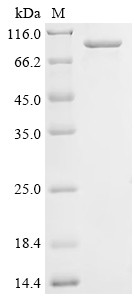
Organism: Rattus norvegicus (Rat). Source: E.coli. Expression Region: 534-1255aa. Protein Length: Partial. Tag Info: N-terminal 10xHis-tagged and C-terminal Myc-tagged. Target Protein Sequence: GFTGLVNLGN TCFMNSVIQS LSNTRELRDF FHDRSFEAEI NYNNPLGTGG RLAIGFAVLL RALWKGTHQA FQPSKLKAIV ASKASQFTGY AQHDAQEFMA FLLDGLHEDL NRIQNKPYTE TVDSDGRPDE VVAEEAWQRH KMRNDSFIVD LFQGQYKSKL VCPVCAKVSI TFDPFLYLPV PLPQKQKVLP IYYFAREPHS KPIKFLVSVS KENSSASEVL ESLSQSVHVK PESLRLAEVI KNRFHRVFLP SHSLDAVSPT DVLLCFELLS PELAKERVVV LEVQQRPQVP SIPISKCAAC QRKQQSEDEK LKRCTRCYRV GYCNQFCQKT HWPDHKGLCR PENIGYPFLV SVPASRLTYA RLAQLLEGYA RYSVSVFQPP FQPGRMALES QSPGCTTLLS TSSLEAGDSE REPIQPSELQ LVTPVAEGDT GAHRMWPPAD RGPVPSTSGI SSEMLASGPM EGCSLLAGER VSRPEAAVPG YQHSRESVSA HTPQFFIYKI DASSREQRLE DKGDTPLELG DDCSLALVWR NNERLQEFVL VASKELECAE DPGSAGEAAR AGHFTLDQCL NLFTRPEVLA PEEAWYCPQC KQHREASKQL LLWRLPNVLI VQLKRFSFRS FIWRDKINDL VEFPVRNLDL SKFCIGQKEE QLPSYDLYAV INHYGGMIGG HYTACARLPS DRSSQRSDVG WRLFDDSTVT TVDESQVVTR YAYVLFYRRR NS. Purity: Greater than 85% as determined by SDS-PAGE. Endotoxin: n/a. Biological Activity: Not Test. Form: Liquid or Lyophilized powder. Buffer: If the delivery form is liquid, the default storage buffer is Tris/PBS-based buffer, 5%-50% glycerol. If the delivery form is lyophilized powder, the buffer before lyophilization is Tris/PBS-based buffer, 6% Trehalose, pH 8.0. Reconstitution: We recommend that this vial be briefly centrifuged prior to opening to bring the contents to the bottom. Please reconstitute protein in deionized sterile water to a concentration of 0.1-1.0 mg/mL.We recommend to add 5-50% of glycerol (final concentration) and aliquot for long-term storage at -20 °C/-80 °C. Our default final concentration of glycerol is 50%. Customers could use it as reference. Storage: The shelf life is related to many factors, storage state, buffer ingredients, storage temperature and the stability of the protein itself. Generally, the shelf life of liquid form is 6 months at -20 °C/-80 °C. The shelf life of lyophilized form is 12 months at -20 °C/-80 °C. Notes: Repeated freezing and thawing is not recommended. Store working aliquots at 4 °C for up to one week. Relevance: Deubiquitinating enzyme that regulates the degradation of various proteins. Deubiquitinates and prevents proteasomal degradation of RNF123 which in turn stimulates CDKN1B ubiquitin-dependent degradation thereby playing a role in cell proliferation. Involved in decreased protein synthesis in atrophying skeletal muscle. Modulates transcription of major myofibrillar proteins. Also involved in turnover of endoplasmic-reticulum-associated degradation (ERAD) substrates. Regulates the stability of BIRC2/c-IAP1 and BIRC3/c-IAP2 by preventing thier ubiquitination. Required for cells to mount an appropriate response to hypoxia and rescues HIF1A from degradation in a non-catalytic manner. Plays an important role in 17 beta-estradiol (E2)-inhibited myogenesis. Decreases the levels of ubiquitinated proteins during skeletal muscle formation and acts to repress myogenesis. Exhibits a preference towards 'Lys-63'-linked ubiquitin chains. Reference: n/a. Function: nan
| Keywords: | Usp19, EC=3.4.19.12, Ubiquitin thioesterase 19, Deubiquitinating enzyme 19, Ubiquitin carboxyl-terminal hydrolase 19, Ubiquitin-specific-processing protease 19, Recombinant Rat Ubiquitin carboxyl-terminal hydrolase 19 (Usp19), partial |
| Supplier: | Cusabio |
| Supplier-Nr: | EP746947RA |
Properties
| Application: | Activity not tested |
| Conjugate: | No |
| Host: | E.coli |
| Species reactivity: | rat |
| MW: | 86.5 kD |
| Purity: | >85% (SDS-PAGE) |
Database Information
| KEGG ID : | K11847 | Matching products |
| UniProt ID : | Q6J1Y9 | Matching products |
| Gene ID : | GeneID 361190 | Matching products |
Handling & Safety
| Storage: | -20°C |
| Shipping: | +4°C (International: +4°C) |
Caution
Our products are for laboratory research use only: Not for administration to humans!
Our products are for laboratory research use only: Not for administration to humans!
You will get a certificate here
Viewed