
Cookie preferences
This website uses cookies, which are necessary for the technical operation of the website and are always set. Other cookies, which increase the comfort when using this website, are used for direct advertising or to facilitate interaction with other websites and social networks, are only set with your consent.
Configuration
Technically required
These cookies are necessary for the basic functions of the shop.
"Allow all cookies" cookie
"Decline all cookies" cookie
CSRF token
Cookie preferences
Currency change
Customer-specific caching
FACT-Finder tracking
Individual prices
Selected shop
Session
Comfort functions
These cookies are used to make the shopping experience even more appealing, for example for the recognition of the visitor.
Note
Show the facebook fanpage in the right blod sidebar
Statistics & Tracking
Affiliate program
Conversion and usertracking via Google Tag Manager
Track device being used
| Item number | Size | Datasheet | Manual | SDS | Delivery time | Quantity | Price |
|---|---|---|---|---|---|---|---|
| Cay32049-100 | 100 µg | - |
5 - 10 business days* |
586.00€
|
|||
| Cay32049-1 | 1 mg | - |
5 - 10 business days* |
3,801.00€
|
If you have any questions, please use our Contact Form.
You can also order by e-mail: info@biomol.com
Larger quantity required? Request bulk
You can also order by e-mail: info@biomol.com
Larger quantity required? Request bulk
TNF-related apoptosis-inducing ligand (TRAIL) is a protein encoded by the TNFSF10 gene in humans... more
Product information "TRAIL Intracellular Domain (human, recombinant)"
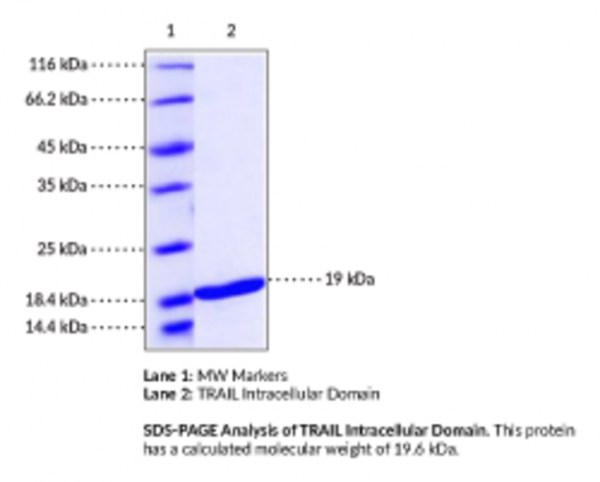
TNF-related apoptosis-inducing ligand (TRAIL) is a protein encoded by the TNFSF10 gene in humans and a member of the TNF superfamily of proteins. TRAIL contains an N-terminal cytoplasmic domain, a transmembrane domain, and a C-terminal extracellular receptor binding domain. It is produced in immune effector cells as a transmembrane precursor protein from which mature, soluble TRAIL is formed by proteolysis. Soluble TRAIL is cleaved from the precursor protein on the extracellular side of the membrane in response to stimulation by cytokines, such as IFN-gamma (Cay-32008). TRAIL monomers form trimers with a single zinc atom bound at the trimer interface, which is required for its structural stability and function. The trimer binds to the pro-apoptotic death receptors DR4 and DR5 and the decoy receptors DcR1 and DcR2, which lack functional intracellular domains. The intracellular death domains of DR4 or DR5 colocalize upon TRAIL binding, which recruits Fas-associated death domain (FADD) and pro-caspase-8 and initiates either the extrinsic or intrinsic apoptotic pathways depending on the cell type. DR4 and DR5 are highly expressed on a variety of cancer cells while DcR1 and DcR1 are primarily expressed on non-cancerous cells, which allows TRAIL to selectively induce apoptosis in cancer cells. Recombinant human TRAIL induces apoptosis in a variety of cancer cell lines and reduces tumor growth in mouse xenograft models. However, it increases proliferation in certain cancer cells in vitro, and other cells lines develop resistance, which can sometimes be partially mitigated by combining it with other agents. A cysteine-to-threonine mutation at position 723 of TNFSF10 is associated with sporadic breast cancer, and SNPs in TNFSF10 are associated with fatty liver disease, multiple sclerosis, and asthma. TNFSF10 expression is decreased in breast cancer patients with brain metastases and increased in patients with multiple sclerosis. In addition, protein levels of TRAIL are increased in patients with systemic lupus erythematosus (SLE) and multiple sclerosis. Cayman's TRAIL Intracellular Domain (human, recombinant) protein consists of 169 amino acids and has a calculated molecular weight of 19.6 kDa.Synonyms: Apo-2L, Apo-2 Ligand, CD253, TNF Ligand Superfamily Member 10, TNFSF10. Purity: >97% estimated by SDS-PAGE. Source: Recombinant human TNFSF10 expressed in E. coli. Amino Acids: 114-281. MW: 19.6 kDa. Formulation: (Request formulation change), Lyophilized from sterile 40 mM Tris, pH 7.0 and 0.3 M sodium chloride. UniProt Accession #: P50591.
| Keywords: | APO2L, CD253, CD253, Apo-2L, Apo-2L, TNFSF10, Apo-2 ligand, Apo-2 ligand, Protein TRAIL, Protein TRAIL, TNF-related apoptosis-inducing ligand, TNF-related apoptosis-inducing ligand, Tumor necrosis factor ligand superfamily member 10, Tumor necrosis factor |
| Supplier: | Cayman Chemical |
| Supplier-Nr: | 32049 |
Properties
| Conjugate: | No |
| Purity: | >97% estimated by SDS-PAGE |
| Format: | Lyophilized |
Database Information
| KEGG ID : | K04721 | Matching products |
| UniProt ID : | P50591 | Matching products |
| Gene ID : | GeneID 8743 | Matching products |
Handling & Safety
| Storage: | -80°C |
| Shipping: | -80°C (International: -80°C) |
Caution
Our products are for laboratory research use only: Not for administration to humans!
Our products are for laboratory research use only: Not for administration to humans!
Information about the product reference will follow.
more
You will get a certificate here
Viewed